Quick Answer: How Much Does Spray Foam Insulation Removal Cost?
Spray foam insulation removal in the UK typically costs around £40 per square metre, with a typical 3-bed semi loft coming in at about £3,200. The single biggest driver of your quote is the foam type:
- Open-cell foam removal: from around £3,150 for a standard loft. The softer foam is easier to cut back and scrape off.
- Closed-cell foam removal: from around £12,500 in some cases. The rigid foam bonds hard to the timbers and often has to be taken back in much smaller sections, so labour time soars.
- Inspection first: most owners end up paying for an independent inspection before any removal happens, and that step alone can save you the cost of a removal you never needed.
Industry reporting estimates that around 250,000 UK homes now have spray foam in the loft. If you are selling, remortgaging or buying one of them, the removal question usually arrives through the surveyor, not through your heating bill.
Open-Cell vs Closed-Cell Foam: Why the Price Gap Is So Big
Not all spray foam is the same material, and your removal quote will be shaped almost entirely by which type you have.
| Open-cell foam | Closed-cell foam | |
|---|---|---|
| Texture | Soft, spongy, compressible | Rigid, hard, like dense plastic |
| Density | Lower | Higher |
| Water vapour behaviour | Breathable to a degree | Seals the roof almost completely |
| How it is removed | Cut back and scraped from timbers | Chiselled or ground off in sections |
| Typical removal project | From ~£3,150 | From ~£12,500 |
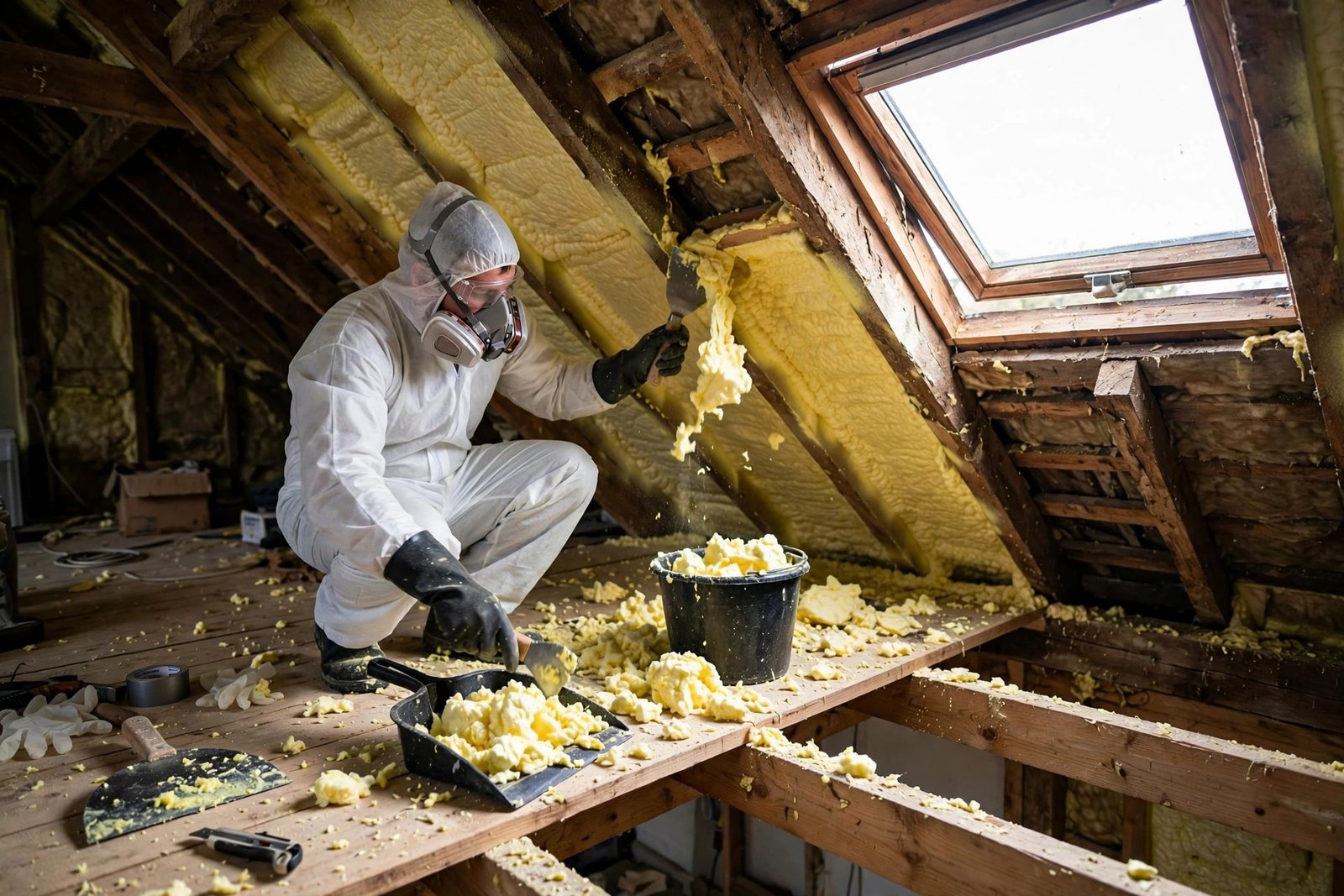
Open-cell foam is the cheaper problem to fix. A crew can cut it back in strips and scrape the residue off the rafters without doing much damage to the wood underneath. Closed-cell foam is a different job: it adheres to the timber so firmly that removing it is slow, dusty, physical work, and the bill reflects the days on site rather than the materials.
If you do not know which type you have, the inspection step (below) identifies it. Closed-cell is often visibly smooth and glossy with a harder feel; open-cell looks rougher and gives slightly when pressed. Do not rely on the original installer’s paperwork alone, as installations from years ago do not always match what was quoted.
Spray Foam Removal Cost by House Size
Most removal firms quote by loft area, with a rate of roughly £40 per square metre plus a day-rate for the crew. Expect these planning figures for a full loft strip:
| Property | Typical loft area | Open-cell removal | Closed-cell removal |
|---|---|---|---|
| 2-bed terraced | ~50 m² | ~£2,000 to £3,000 | ~£8,000 to £12,000 |
| 3-bed semi | ~70 to 80 m² | ~£3,000 to £4,000 | ~£10,000 to £14,000 |
| 4-bed detached | ~100 m² and up | ~£4,000 to £6,000 | £12,500 and up |
What moves the number up or down:
- Foam thickness. Deeper applications take longer to remove per square metre.
- Access. A clear, boarded loft hatch with good headroom is quick. A cramped hatch over a finished bedroom is slow.
- Underside detail. Foam sprayed between the rafters and over the membrane is harder to take back than foam on a simple pitched roof.
- Timber repairs. If removal exposes damaged rafters or batten rot, timber work is quoted separately.
- Re-insulation. Almost everyone re-insulates afterwards, so budget for that at the same time (see below).
Treat these as planning ranges, not quotes. Two firms can price the same loft very differently depending on how they judge the foam’s adhesion, so get at least three written quotes with the foam type and the per-square-metre rate stated on each.
Why Lenders and Surveyors Object to Spray Foam
The removal boom is not driven by energy performance. It is driven by mortgages.
When a surveyor sees spray foam applied to the underside of the roof slope, they have a problem: the foam hides the timber. They cannot check the condition of the rafters, battens or membrane underneath, and on some installations the foam traps moisture against the wood. Surveyor guidance, including the Property Care Association protocol and Residential Property Surveyors Association guidance, flags this as a valuation risk.
The chain reaction is familiar to conveyancers:
- The surveyor notes the foam and declines to confirm the roof’s condition.
- The lender’s valuation gets qualified, sometimes to the point of a mortgage refusal or a retention until the roof is checked.
- The buyer asks for proof the roof is sound, which usually means either an independent inspection report or removal of the foam so the timbers can be seen.
This is why the inspection route matters more than the removal route. A lender does not always require the foam to go. They require evidence. If an independent inspection shows sound timbers, a well-installed breathable system and no moisture issues, many owners can keep the foam and satisfy the lender with the report alone. Removal is the expensive fallback for when the foam is the wrong type, poorly installed, or already associated with timber damage.
The Inspection Route: What to Do Before You Pay for Removal
Pay for removal only after you have done this sequence:
Step 1: Independent spray foam inspection. The PCA and RPSA both publish inspection protocols for spray foam in roofs. An accredited surveyor examines the foam type, checks for condensation and timber decay where the timber is visible at the eaves and edges, and produces a written report. This report is the document lenders and buyers recognise.
Step 2: An evidence pack for the lender. If the inspection is clean, your evidence pack typically includes the inspection report, the original installation paperwork if you have it, and confirmation of the foam type. Many sales proceed at this point with no removal needed.
Step 3: A removal decision. If the inspection finds the wrong type for the application, trapped moisture, or timber damage you cannot monitor, then removal becomes the sensible route, and the report itself helps removal firms quote accurately.
Step 4: The buyer’s lender. If you are buying a spray-foamed home, push the seller to provide this report before exchange. It is far cheaper for them to obtain than a price chip for a full removal, and it protects you from inheriting the problem.
Get the inspection before you book the removal crew. A surprising number of owners who rang removal firms first never needed one.
How Spray Foam Removal Works, Step by Step
- Survey and quotation. The firm identifies the foam type, measures the loft, and checks access. Expect a written quote with the rate per square metre, not a round number over the phone.
- Preparation. The loft is cleared, floors and hatchways are protected, and the area is sealed so foam dust does not travel into the living space.
- Cutting back. Open-cell foam is sliced into strips and pulled away, then the rafters are scraped clean. Closed-cell foam is chiselled or ground back in sections, which is where the extra days come from.
- Timber inspection. With the timbers exposed, the crew checks for rot, insect damage or staining that was hidden. Any timber repairs are flagged and priced separately.
- Clearance. All foam waste is bagged and removed. Spray foam waste is a controlled waste stream, so it goes through a licensed carrier, which is part of what you pay for.
- Make good. Damaged felt, batten ends and eaves ventilation are put right so the roof is weather-tight and can breathe again.
- Re-insulation. Most jobs finish with a conventional insulation install, which is quoted as part of the package or as a separate line.
Dust control matters more than it sounds. Removal generates a lot of fine particulate, so a reputable firm masks off the hatch, works in PPE and runs extraction. If a quote does not mention dust management, ask about it before you agree.
Re-Insulating After Removal
Almost nobody removes spray foam and leaves the loft bare. The usual replacement is mineral wool loft insulation at the current UK recommended depth of 270mm, which for a typical semi costs a few hundred pounds professionally installed and is straightforward work once the roof is clear.
If you are doing this as part of a wider energy upgrade, it is worth looking at the whole thermal fabric rather than insulating in isolation. Our loft insulation complete guide covers depth, boarding and the ventilation details that matter after a strip-out, and our cavity wall insulation guide covers the other half of the fabric for homes that need both.
One warning: do not let anyone talk you into re-spraying foam as the replacement. The whole point of the exercise is a roof the next surveyor can see.
When Removal Is NOT the Answer
Removal is the right call in some situations, but it is not the default. Skip it when:
- An independent inspection gives the foam a clean bill of health. Sound timbers, correct application, no moisture, and the lender accepts the report. This is the cheapest good outcome.
- You are not selling or remortgaging. The lender problem only bites when a valuation is involved. If you plan to stay put, the foam is usually not an emergency unless it is causing condensation problems.
- The foam is keeping the roof dry and the loft usable. Some open-cell installations in well-ventilated lofts perform fine for years. Removing good insulation to fix a problem you do not have is money burned.
- The real issue is condensation, not the foam. If moisture is appearing at the eaves or on the underside of the membrane, the fix may be ventilation rather than removal. Our damp in homes guide explains how to read the difference before you spend.
The worst outcome is paying £12,500 for a closed-cell removal on a roof that a £400 inspection would have cleared. Inspection first, removal second.
Grants and Funding
There is no mainstream UK grant that pays for spray foam removal as a standalone job. The energy-efficiency schemes are built around installing insulation, not taking it out. If your home qualifies, the ECO4 scheme can cover conventional insulation installed after the removal. Our ECO4 guide explains who qualifies and how to apply before the scheme’s current window closes. Treat any company that claims it can get your removal “fully funded” with suspicion unless it names the scheme and the qualifying criteria in writing.
Frequently Asked Questions
Does spray foam always have to be removed before selling a house?
No. What lenders and surveyors need is evidence the roof is sound. An independent inspection report that confirms the foam type, checks the timbers where visible and finds no moisture problem satisfies many sales. Removal is the fallback for foam that fails that test.
How do I tell open-cell from closed-cell foam?
Open-cell foam is soft and spongy and gives slightly when pressed; closed-cell foam is rigid and hard with a smoother, often glossy surface. If in doubt, the independent inspection identifies it as part of the report.
Will removing spray foam damage the roof timbers?
A careful crew causes minimal damage, but aggressive removal of closed-cell foam can mark or score rafters, and hidden rot is sometimes exposed for the first time. That is why the post-removal timber check is part of the job, and why timber repairs are usually priced separately.
Can spray foam cause damp in a roof?
It can when it blocks ventilation or traps moisture against the timber, particularly in roofs where the felt is already failing. That is the main technical objection surveyors raise, and it is also why ventilation is reinstated as part of a proper removal.
How long does spray foam removal take?
A standard open-cell loft strip is usually a one to two day job for a small crew. Closed-cell removal on a larger roof can take several days, which is a large part of why the price is so much higher.
Should I get quotes before the inspection?
No. Get the inspection first. It identifies the foam type and condition, and that information lets removal firms quote accurately instead of pricing in the worst case. Inspection first is almost always the cheaper route to the same answer.
About the Author