Quick Answer: How Much Does Loft Insulation Cost and Save?
Loft insulation typically costs £300 to £600 for a professionally installed average semi-detached loft, or £150 to £350 for DIY materials, and can reduce heat loss through the roof significantly, often paying for itself within two to five years through lower heating bills. Current UK guidance recommends a minimum insulation depth of 270mm for mineral wool loft insulation.
How Much Loft Insulation Do You Need?
| Insulation Material | Recommended Depth | Typical Cost per sqm |
|---|---|---|
| Mineral wool (rolls) | 270mm | £5 to £10 |
| Loose fill (cellulose/mineral) | 270mm equivalent | £6 to £12 |
| Rigid insulation board | 100 to 150mm (higher performance per mm) | £15 to £30 |
Many older UK homes have significantly less than the recommended depth, sometimes only 100mm or less, meaning a simple top-up can deliver a noticeable improvement in heat retention at relatively low cost.
Types of Loft Insulation
Mineral Wool (Glass or Rock Wool)
The most common and affordable loft insulation type in the UK, supplied in rolls that are laid between and then across the ceiling joists to avoid thermal bridging.
Loose Fill Insulation
Blown in by a professional installer, loose fill works well for lofts with irregular joist spacing or awkward access, settling into gaps that rolled insulation might miss.
Rigid Insulation Boards
Higher performance per millimetre than mineral wool, rigid boards suit situations where loft height is limited, such as a loft that will also be used for storage or partial conversion.
DIY vs Professional Loft Insulation
Laying mineral wool loft insulation in an easily accessible loft is one of the more DIY-friendly home improvement projects, requiring basic protective equipment and straightforward technique. Professional installation is recommended for loose fill insulation, difficult access lofts, or where existing insulation needs removing and replacing due to damage or contamination.
Loft Insulation and Ventilation
Adequate loft ventilation must be maintained even after adding insulation, since blocking eaves ventilation can lead to condensation and damp problems within the roof space. Insulation should stop short of the eaves or use proprietary vents to preserve airflow while still covering the full ceiling area.
Can You Board Over Loft Insulation?
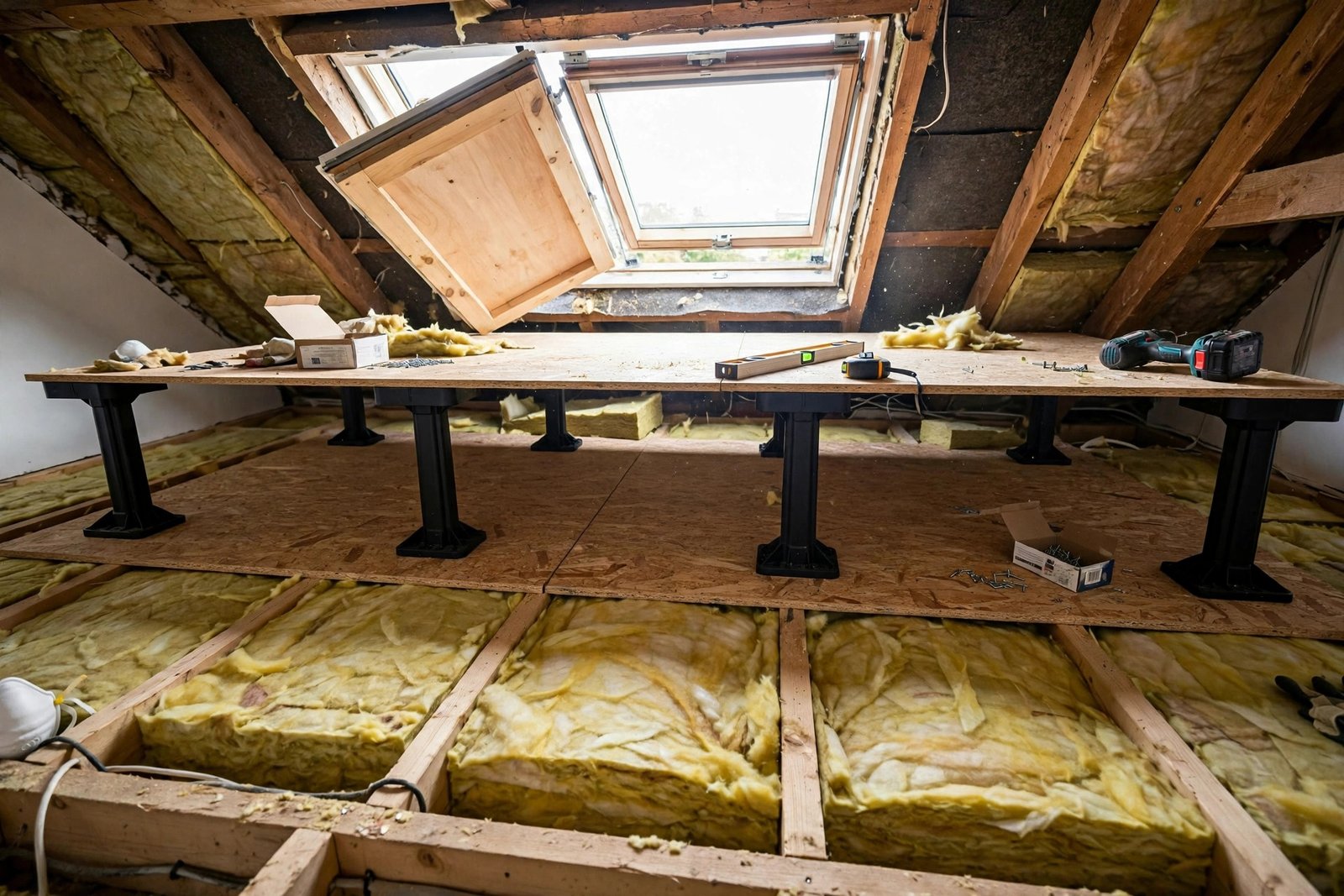
Yes, you can board over loft insulation to create storage space, but you should never lay boards directly onto the joists. Mineral wool works by trapping air, and compressing it under boards can cut its effectiveness by around half, leaving you with a tidy loft floor and noticeably higher heating bills. The correct approach is a raised boarding system that keeps the full 270mm depth of insulation intact underneath.
Ceiling joists in most UK homes are only around 100mm deep, which is less than half the recommended insulation depth. Raised systems, such as proprietary plastic support legs fixed to the joists or DIY timber battens screwed across them, lift the boarding high enough to clear the insulation with a small air gap above it. That gap matters: it lets moisture move through the loft rather than sitting against the underside of the boards, which protects against condensation.
| Boarding method | How it works | Typical cost |
|---|---|---|
| Raised leg system (e.g. Loft Leg) | 175mm plastic legs screw to joists, boards fix on top; keeps 270mm insulation uncompressed | £20 to £40 per sqm in materials; £50 to £100 per sqm professionally installed |
| DIY raised timber battens | Timber battens laid across joists to lift boarding above insulation level | £10 to £25 per sqm in materials |
| Boards straight onto joists | Not recommended: compresses insulation, increases heat loss and can breach building regulations | Cheapest, but undoes the insulation investment |
Before boarding, check the load your loft can safely carry. Most newer lofts are designed for around 25kg per square metre plus the weight of a person walking on the boards, which suits light storage such as suitcases and seasonal decorations. If your home is older or you plan to store heavy items, get a structural engineer to confirm the joists can take the weight. Boarding a loft for storage only does not need planning permission, but converting it into a living space such as a bedroom is a full loft conversion and must meet building regulations.
Does Loft Insulation Pay for Itself?
| Property Type | Typical Installation Cost | Estimated Annual Saving |
|---|---|---|
| Detached house | £500 to £600 | £150 to £250 |
| Semi-detached house | £350 to £450 | £100 to £180 |
| Terraced house | £250 to £350 | £80 to £150 |
These are general estimates, and actual savings depend heavily on your current insulation level, heating usage patterns, and energy prices at the time.
Signs Your Loft Needs More Insulation
- Existing insulation is visibly thin, patchy, or compressed below the recommended 270mm depth
- Higher than expected heating bills relative to similar sized homes
- Noticeable cold spots in upstairs rooms, particularly directly under the loft space
- Snow melting unevenly or faster on your roof compared to neighbouring properties, indicating heat escaping through the roof
Loft Insulation Grants and Schemes
Various UK government energy efficiency schemes have periodically offered grants or subsidised loft insulation, particularly for lower income households or those on certain benefits. Eligibility criteria change over time, so checking current government energy efficiency scheme guidance directly is the most reliable way to confirm what support may be available.
Frequently Asked Questions
How long does loft insulation last?
Mineral wool loft insulation typically lasts 40 years or more without needing replacement, provided it stays dry and is not compressed or disturbed significantly.
Can you have too much loft insulation?
Beyond the recommended 270mm depth for mineral wool, additional thickness offers diminishing thermal returns, so exceeding this significantly provides limited extra benefit relative to the cost and reduced loft storage space.
Does loft insulation cause damp?
Correctly installed insulation that maintains eaves ventilation should not cause damp, but blocking ventilation gaps while insulating can lead to condensation problems, so proper installation technique matters.
Is loft insulation worth it in a warm climate?
Insulation helps retain heat in winter and can also help keep a loft space cooler in summer by reducing heat transfer, so it offers year-round benefit even outside the coldest months.
Can I top up old loft insulation myself?
Yes, adding fresh mineral wool on top of existing thinner insulation, laid perpendicular to the original layer to avoid gaps, is a straightforward DIY task for most accessible lofts.
Can I lay loft boards straight onto the joists?
You should not. Joists are far shallower than the recommended 270mm insulation depth, so boards laid directly on them compress the insulation and can cut its effectiveness by around half. They can also restrict airflow, which raises the risk of condensation and damp in the roof space.
Will boarding over insulation cause damp?
Not if it is done correctly. A raised boarding system leaves an air gap between the insulation and the boards so moisture can move through the loft. Damp becomes a risk mainly when boards are laid flat on the joists or when boarding blocks the eaves ventilation.
How high do loft boards need to be raised?
The boarding needs to sit above the full depth of your insulation, so for the standard 270mm of mineral wool the raised floor must clear roughly 270mm plus a small ventilation gap. Proprietary systems such as 175mm support legs are sized for this, with taller versions available where insulation exceeds 300mm.
Can I board a new build loft without voiding the warranty?
Some new build warranties place conditions on loft alterations, particularly where work could compromise thermal performance or structural integrity. Check your warranty terms before starting, and use a raised system that keeps the insulation at full depth rather than compressing it.
Do I need permission to board my loft for storage?
No planning permission or building consent is needed to board a loft for storage or a non-living hobby space. If the loft will become a bedroom or any other living space, that counts as a loft conversion and must comply with building regulations, including fire safety and a permanent staircase.
Expert Insight
Energy assessors consistently identify under-insulated lofts as one of the most cost-effective home energy improvements available, since the relatively low material and installation cost compares favourably against the ongoing heating bill savings over many years of use.
Final Thoughts
Loft insulation remains one of the best value energy efficiency improvements available to UK homeowners, with a straightforward installation process and meaningful ongoing savings. Checking your current insulation depth against the recommended 270mm standard is a sensible first step before deciding whether a top-up is worthwhile.
Checking your loft insulation? Measure the current depth against a tape measure before assuming it meets modern standards, since many homes have considerably less than recommended without the homeowner realising.
Related Guides
Written by the HometoWorld editorial team, covering home improvement, renovation, and property maintenance across the UK.
About the Author