Quick Answer: How Much Does Radiator Replacement Cost in the UK?
Replacing a radiator in the UK typically costs £150 to £450 per radiator, supplied and fitted, with around £200 as a typical average for a straightforward like-for-like swap. That is the figure to start your budget with, and it is the figure this whole guide is built on: every whole-house total below is that per-radiator range multiplied by the number of radiators, not a separate quote.
The reason for the spread is simple. A radiator replacement is two costs in one: the radiator itself, and the labour to drain down, fit it, refill the system and test it. A standard panel radiator in a room where the pipework already lines up sits at the lower end. A large designer or cast iron radiator, or any job where pipes have to move, sits at the upper end or beyond it, because the unit costs more and the fitting takes longer.
If you are replacing one radiator, budget £200 and be pleasantly surprised if it comes in lower. If you are replacing the radiators through the whole house, use the table in the next section, and read the sections on size and extra work before you accept a quote, because those are the two things that turn a simple swap into a bigger job.
Cost by Radiator Count: The Whole-House Table
Most engineers price radiator work per radiator, with the per-unit labour falling slightly as the count rises, because the system only has to be drained and refilled once. The table below keeps it honest: it is the £150 to £450 per-radiator range multiplied out, so treat it as a budgeting range, not a promise.
| Radiators replaced | Typical total (supplied and fitted) |
|---|---|
| 1 radiator | £150 to £450 |
| 3 radiators | £450 to £1,350 |
| 5 radiators | £750 to £2,250 |
| 8 radiators | £1,200 to £3,600 |
| 10 radiators | £1,500 to £4,500 |
| Whole house (12 radiators) | £1,800 to £5,400 |
A typical three-bedroom house has around eight to ten radiators, so a full-house replacement usually lands somewhere in the £1,200 to £4,500 band for standard panel radiators. That is the most useful single range in this guide. If your quote for standard panels comes in well above it, ask what is different about your job: moved pipework, designer units, and extra system work are the usual answers, and all three are covered below.
One thing to note about whole-house jobs: replacing every radiator at once is also the moment to deal with the system itself. If the system water is dirty, or the boiler is old, a new set of radiators on a dirty system will not heat as well as it should. That is a conversation to have with your engineer before the work starts, not after the new radiators are on the wall, and it links to the separate questions of boiler replacement and system flushing covered elsewhere on this site.
Cost by Radiator Type: Panel, Column, Designer and Cast Iron
Not all radiators are the same job, even when they heat the same room. The four types below cover almost everything you will be quoted for, and they differ in unit price, weight, and fitting time.
Standard panel radiators are the workhorse of UK homes: a pressed-steel panel, sometimes doubled up with convector fins behind it for extra output. They are the cheapest to buy, the quickest to fit, and the type the £150 to £450 typical range is really describing. If your quote is for panel radiators, expect to sit inside that band for a like-for-like swap.
Column radiators are the traditional-looking vertical-column style, popular in period homes and hallways. They cost more than panels as units, they are heavier, and they often need sturdier wall fixings, especially on plasterboard. Expect the upper end of the typical band, and above it for large column radiators, because both the unit and the fitting time increase.
Designer radiators cover a wide family: vertical flat-panel styles for narrow walls, towel-style radiators for bathrooms, and statement pieces chosen for looks as much as heat. The unit price varies far more than for panels, so a designer radiator quote is really two quotes in one: the unit you chose, and the fitting. Always ask for those two figures separately, so you can see whether a high total is the radiator or the labour.
Cast iron radiators are the heaviest of all, and the most labour-intensive to fit. They suit period properties and large rooms, and they hold heat for a long time after the heating switches off. Fitting them can mean two people, reinforced fixings, and sometimes floor support as well as wall brackets. They are the type most likely to land above the typical per-radiator band, and that is down to weight and time, not markup.
A practical rule: if you are replacing like for like, panel for panel in the same position, you are buying the cheapest version of this job. Every step away from that, a heavier unit, a different position, a different size, adds cost in a way you can trace back to either the unit or the labour.
Labour vs Unit Split: What You Are Actually Paying For
A radiator quote that only gives one total hides the most useful information. Ask for the split, and the conversation gets much clearer.
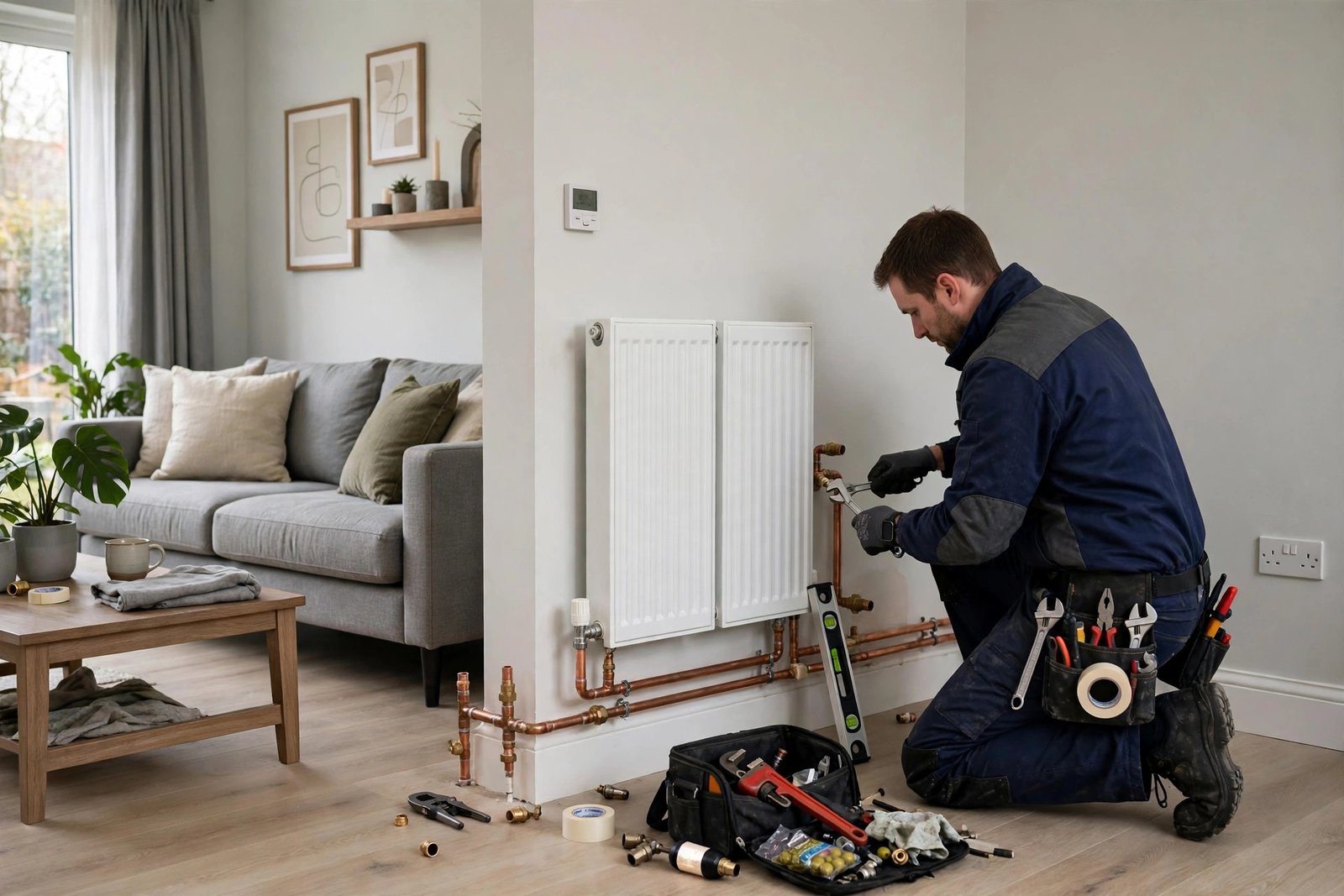
The unit is the radiator itself, plus valves and brackets. Standard panels are modest here; designer and cast iron units are where the unit share grows. The labour covers draining the system (or isolating that radiator), removing the old unit, fitting the new one, refilling, bleeding, balancing, and testing for leaks. A straightforward swap is typically a short job per radiator. The labour share grows when pipework has to be altered, when the system needs a full drain and refill rather than a local isolation, or when access is awkward, for example a radiator behind fitted furniture or in a tight understair space.
Valves deserve a specific question. New radiators are normally fitted with new valves, and thermostatic radiator valves (TRVs) are worth specifying: they let each room control its own temperature, so a spare bedroom does not have to be heated to the same level as the living room. If your quote says “valves included”, ask whether that means TRVs or manual valves, because the difference matters to both comfort and bills, and it is a small cost to get right at fitting time rather than afterwards. Controls are covered in more depth in the smart thermostats guide on this site.
What Size Radiator Do You Need? BTU in Plain English
Size is where radiator replacement goes wrong most often, and it is not about the physical size of the radiator on the wall. It is about heat output: whether the radiator can warm the room it sits in on a cold day.
Heat output is traditionally measured in BTUs (British Thermal Units), and increasingly in watts. The two describe the same thing, and your engineer will work in whichever unit they prefer. What matters to you is the idea behind the number: a radiator’s output has to match the room’s heat loss. A large, draughty room with big windows loses more heat than a small, well-insulated box room, so it needs a bigger output, even if the two rooms look similar on a floor plan.
An engineer sizes a radiator by looking at the room’s volume, its windows and outside walls, how well it is insulated, and what the room is used for. A bathroom needs a higher output per square metre than a bedroom, because it is expected to feel warmer. A hallway with an outside door loses heat every time the door opens. None of this is guesswork, and a good quote will be based on a room-by-room calculation, not on “the old one was this size, so the new one will be too”.
That last point matters. The old radiator may have been undersized from the start, or the room may have changed since it was fitted, with new windows, new insulation, or an extension. Replacing like-for-like in size without checking output simply carries an old mistake into a new radiator. If a room has always felt cold, say so before the quote is written, not after the new radiator is fitted, because the fix at that point is a larger radiator, and that is a second job.
There is one more sizing trap: bigger is not automatically better. A radiator far too large for a room will overshoot, making the room stuffy and the TRV work hard to throttle it back. The goal is a radiator matched to the room, not the biggest one that fits the wall.
Extra Work That Adds Cost: Pipework Moves, Valves and System Drains
Three extras account for most radiator quotes that come in above the typical band. None of them is a surprise if you know to ask about them.
Pipework moves. The cheapest swap reuses the existing pipe positions. If the new radiator is a different width, height, or position, the pipes have to be altered to meet it. Moving pipes under a floor or through a wall adds labour and sometimes making-good work afterwards, such as plastering or redecorating around the new position. If you are changing radiator positions as part of a room redesign, budget for pipework as a separate item, not as part of the per-radiator price.
Valves and controls. As above, TRVs, lockshield valves, and any change to the room thermostat or heating controls add parts and time. They are worth having, but they should be itemised so you can see what you are paying for. A quote that bundles “all valves and controls” without detail is a quote to question.
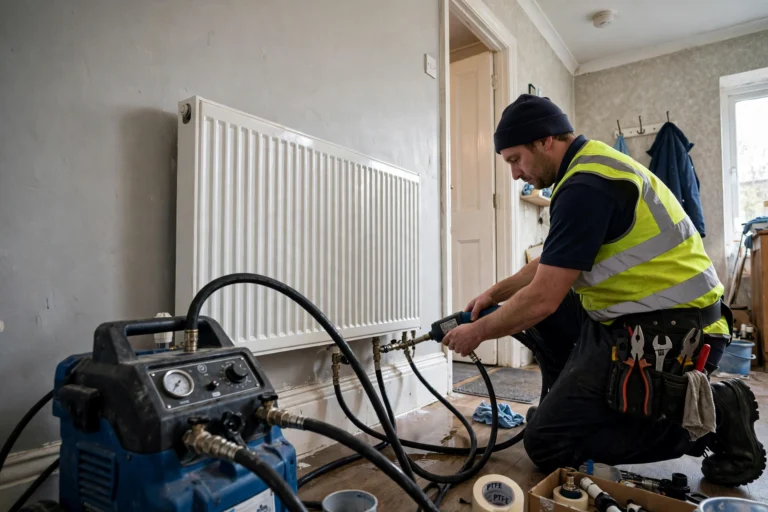
System drain, refill and balancing. Draining a heating system, refilling it, adding inhibitor (the chemical that protects against corrosion and sludge), bleeding every radiator, and balancing the system so every room heats evenly all take time. On a whole-house job this is a significant part of the day. On a single-radiator swap, the engineer may be able to isolate just that radiator without a full drain, which is one reason a single swap can be quick and cheap. Ask which approach your job needs, because it explains a lot of the difference between a low and a high quote.
Other extras, in descending order of likelihood: disposing of old radiators, repairing wall damage behind the old unit, and redecorating around the new one. None of these is expensive on its own, but together they explain why two quotes for “replace the radiators” can differ by hundreds of pounds.
Radiators for Heat Pumps: Why Oversizing Matters
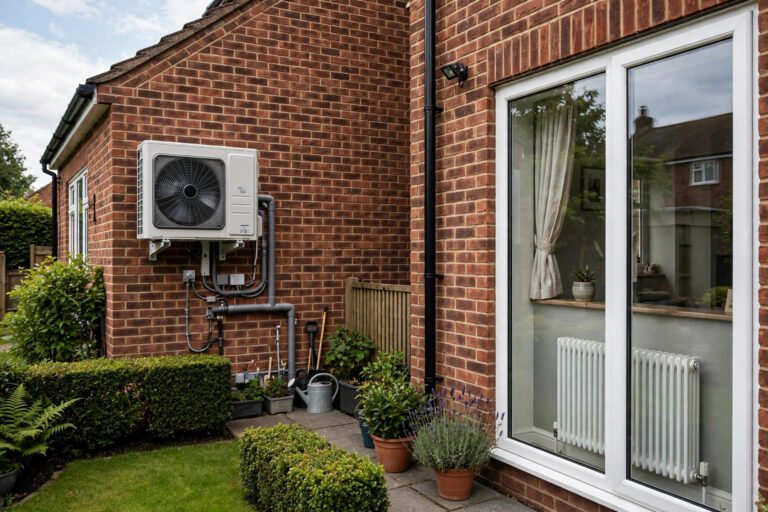
If you are planning, or already have, an air source heat pump, radiator sizing changes. Heat pumps work most efficiently at lower water temperatures than gas boilers, and a radiator gives out less heat at a lower water temperature. The answer is larger radiators, or more of them, so the same room can be heated with cooler water. This is called oversizing, and it is a deliberate design choice, not a mistake.
In practice, a home moving to a heat pump often needs some radiators upsized, sometimes significantly, and sometimes needs double-panel radiators where single panels sat before. That pushes the job above the typical £150 to £450 per-radiator band, because the units are larger and the fitting can involve pipework changes. It is also a job that should be designed as part of the heat pump installation, with proper heat-loss calculations for every room, not added as an afterthought.
If a heat pump is on your horizon but not yet installed, tell your radiator engineer. Fitting standard-sized radiators now and then discovering they are too small for a heat pump later means paying for the job twice. Fitting oversized radiators now, with a boiler, is harmless: the TRVs will simply throttle them back. The same logic applies in reverse to underfloor heating, which also runs at lower temperatures and is covered as an alternative emitter elsewhere on this site. Heat pump costs themselves, including the grant position, are covered in a separate guide on this site when it is published.
DIY vs Engineer: Should You Fit a Radiator Yourself?
Replacing a radiator is one of the more approachable heating jobs for a confident DIYer, but it is not a job to start without understanding what can go wrong.
The DIY case is strongest for a single, like-for-like panel swap where the pipe positions match, the system can be isolated or drained safely, and you are comfortable refilling, bleeding and checking for leaks. The saving is the labour share of the £150 to £450 range, which is real money on a whole-house job.
The engineer case is stronger whenever any of these apply: pipework has to move, the system is old or its condition is unknown, the boiler is involved, the radiators are heavy cast iron or designer units, or the house has a heat pump or a pressurised system you have not worked on before. An engineer also brings balancing: getting every radiator in the house heating evenly is a skill, and an unbalanced system wastes the money you just spent on new radiators.
There is also a warranty and insurance angle. A badly fitted radiator that leaks can damage floors and ceilings, and the cost of that damage dwarfs the labour saving. If you DIY, check your home insurance position and be honest about your experience level. If you hire an engineer, check they are experienced with heating systems, ask for the itemised quote described above, and make sure the work includes a leak check after the system has been running, not just at the moment of fitting.
One middle route suits many homeowners: DIY the easy swaps, such as a single panel radiator in a spare room, and hire an engineer for the whole-house job, the heavy units, and anything involving pipework moves. That keeps the saving where the risk is low and the expertise where it matters.
Frequently Asked Questions
How much does it cost to replace one radiator?
Typically £150 to £450 supplied and fitted, with around £200 as a typical average for a straightforward panel swap. Designer, column and cast iron radiators cost more, mainly because the unit costs more and fitting takes longer.
How much does it cost to replace all the radiators in a house?
Using the same per-radiator range, a typical three-bedroom house with eight to ten standard panel radiators usually falls in the £1,200 to £4,500 band. Get an itemised quote: the unit, labour, valves and any pipework moves should be shown separately.
Do I need a Gas Safe engineer to replace a radiator?
Radiator replacement itself is plumbing work, not gas work, so it does not legally require a Gas Safe engineer unless the job involves the boiler or gas pipework. If your job touches the boiler, use a Gas Safe registered engineer. The gas safety guide on this site explains the distinction for boiler-related work.
What size radiator do I need for my room?
It depends on the room’s heat loss, not just its floor area: volume, windows, outside walls, insulation and use all matter. Ask your engineer for a room-by-room output calculation. If a room has always felt cold, say so before quoting, because the old radiator may have been undersized.
Should I get thermostatic radiator valves?
Yes, in most homes. TRVs let each room control its own temperature, so you are not heating empty rooms to living-room levels. Ask whether your quote includes TRVs or manual valves, and get the difference itemised.
Will new radiators lower my heating bills?
New radiators on their own do not cut bills dramatically. They heat more evenly and respond better to controls, which helps, but the bigger savings come from the boiler, controls and insulation working together. Be wary of any quote that promises a specific bill saving from radiators alone.
Can I replace radiators one at a time?
Yes, and many homeowners do exactly that, starting with the coldest rooms. The trade-off is that each visit involves draining or isolating part of the system, so doing the whole house at once is usually cheaper per radiator than doing them one by one over several visits.
Do radiators for heat pumps need to be bigger?
Yes, usually. Heat pumps run at lower water temperatures, so radiators need a larger surface area to give out the same heat. This oversizing should be designed as part of the heat pump installation, with a heat-loss calculation for every room.
About the Author