Combi Boiler vs System Boiler: Which Is Right for Your Home?
Quick Decision Summary
If you want the short answer first, here it is. A combi boiler suits most smaller homes with one bathroom and modest simultaneous hot water demand, because it heats water on demand and needs no cylinder or tanks. A system boiler suits larger homes, homes with two or more bathrooms, and homes where two people regularly need hot water at the same time, because it stores hot water in a cylinder and can serve more than one outlet at once.
That summary is a starting point, not a decision. The two boilers fail in different ways, and the wrong choice shows up every morning in a lukewarm shower or a bath that takes far too long to fill. The sections below work through the four tests that actually decide between them: how much water your mains can deliver, how many hot water outlets you use at once, how much space you have, and what each option costs to install and run. Read them in order and the decision table at the end will largely make itself.
One thing to settle at the outset: this guide compares combi and system boilers only. A regular (heat-only) boiler, which needs both a cylinder and a cold water tank in the loft, is a third option, and it is the right choice in some older homes with low mains pressure. Its prices are mentioned below for comparison, but the decision here is between the two sealed-system boilers most installers fit today.
How Each Boiler Works
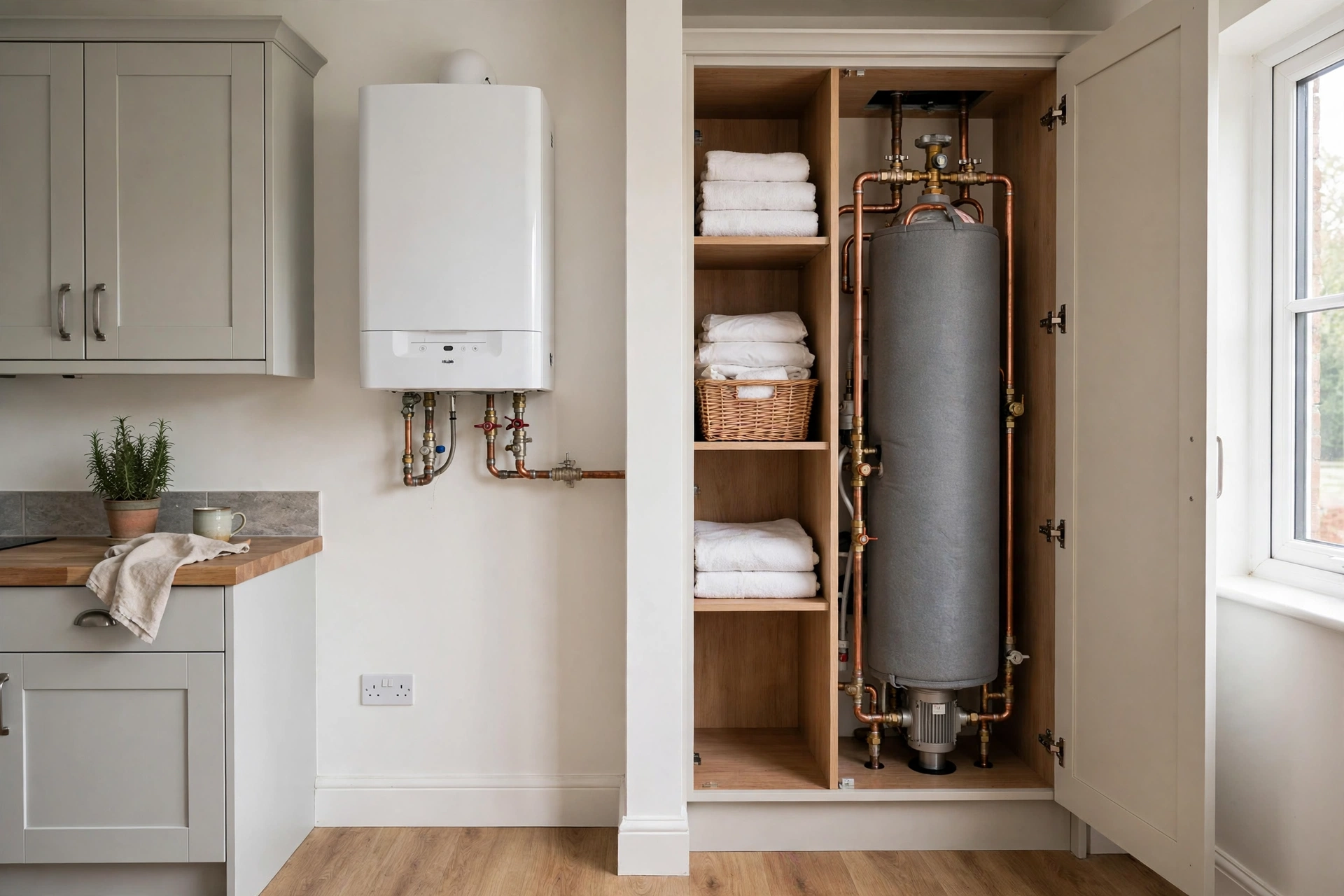
A combi boiler, short for combination boiler, does two jobs in one box. It heats your radiators, and when you turn on a hot tap it heats the water there and then, as it passes through the boiler. There is no stored hot water waiting in a cylinder, and no cold water tank in the loft. When the tap closes, the boiler stops heating water. That is why combis are compact and popular in flats and smaller houses: the whole system lives in one wall-mounted unit, usually in the kitchen or a utility cupboard.
A system boiler also heats your radiators, but it does not heat your tap water directly. Instead, it heats water that is stored in a separate hot water cylinder, usually in an airing cupboard. The cylinder holds a full tank of hot water at temperature, ready to use. The system boiler also contains the pump and expansion vessel that a regular boiler keeps as separate components, which is why it needs no loft tanks, but it still needs the cylinder itself. That cylinder is the key difference: it is stored capacity, and stored capacity is what lets a system boiler serve two showers at once.
Both are sealed, pressurised systems, which means they run at mains pressure rather than relying on gravity from a loft tank. Both are condensing boilers as fitted today, which means they recover heat from their own exhaust gases to use less gas than the older non-condensing boilers they replace. The difference between them is not efficiency in the abstract. It is whether your hot water is made on demand or stored in advance, and that one difference drives everything else in this guide.
The Flow-Rate Test: Measure Your Mains Water
Here is the test that most boiler guides skip, and it is the single most useful thing you can do before choosing. A combi boiler can only deliver hot water as fast as your cold mains supply delivers cold water to it. If your mains flow is weak, a combi will give you a weak shower and a slow-filling bath, however powerful the boiler itself is. A system boiler is far less affected, because its cylinder is filled in advance and can then deliver hot water at a good rate even if the mains flow behind it is modest.
You can measure your mains flow rate in two minutes with a bucket. Find the cold tap nearest the mains stopcock, usually the kitchen tap, and make sure no other tap, shower, washing machine or dishwasher is running. Put a container of known size under the tap, open the tap fully, and time how long it takes to fill. Divide the volume by the time, and you have your flow rate in litres per minute. Do it twice, once in the morning and once in the evening, because mains pressure varies through the day when your neighbours are also using water.
Take that number to your installer and ask a direct question: given this measured flow rate, what hot water flow will this combi actually deliver in my home? A good installer will answer with a number, and will tell you honestly if the answer is too low for a comfortable shower. If the flow rate is poor, that alone can settle the decision in favour of a system boiler, because no combi, however expensive, can create water flow that the mains does not supply. If the flow rate is strong, the combi stays in the running, and the next test decides it.
This test also explains why two identical houses on the same street can need different boilers. Mains supply varies by street, by time of day, and by how many homes share the supply. Bedroom count tells you nothing about any of this, which is why the bedroom-count rule of thumb found in so many boiler guides is such a poor way to choose.
Simultaneous Demand: The Real Deciding Test
Simultaneous demand means how many hot water outlets are used at the same time. It is the second deciding test, and for many homes it is the one that matters most.
With a combi boiler, the hot water flow is shared. If one person is showering and someone else turns on a hot tap, or starts a second shower, the flow to each outlet drops, and the temperature can fluctuate. In a home where that almost never happens, because there is one bathroom and one person showers at a time, this is not a problem. In a home with two bathrooms where two people shower at the same time every morning, it is a daily frustration, and it is the most common reason people regret choosing a combi.
With a system boiler, the cylinder changes the picture. Two outlets can draw on stored hot water at the same time, and each gets a proper flow, until the cylinder runs down. A well-sized cylinder covers the morning peak in most family homes, and then reheats during the day. The trade-off is recovery time: once the cylinder is empty, you wait while it reheats, whereas a combi never runs out, it just delivers more slowly.
So ask yourself an honest question about your household at its busiest. Is it one shower at a time, or two showers plus a hot tap? Do you run a bath while someone else showers? Is there a teenager whose shower overlaps with yours every school morning? If the honest answer is that hot water is regularly needed in two places at once, a system boiler is the safer choice, even in a home that is not especially large. If the honest answer is one outlet at a time, a combi will serve you well and save you the space and cost of a cylinder.
Space and the Cylinder
Space is the most straightforward of the four tests, and it often decides the question before the others get a look in.
A combi boiler needs only the wall space for the unit itself. That is why it suits flats, small houses, and homes where the airing cupboard has been converted into something else. There is no cylinder to house, no loft tanks to keep, and no airing cupboard given over to hot water storage. For a home short on space, that freedom is worth a great deal, and it is a genuine advantage, not a sales point.
A system boiler needs a home for its cylinder. The traditional spot is the airing cupboard, and the cylinder is a tall, insulated tank that takes up most of it. You lose that storage space, and you need access around the cylinder for servicing. In a larger home this is rarely a problem, because an airing cupboard exists and is not desperately needed for anything else. In a small flat or a house where every cupboard is already spoken for, finding room for a cylinder can be the deal-breaker, and it can push the job towards a combi even when the demand tests point the other way.
There is also a middle consideration worth knowing about. If you already have a cylinder and an airing cupboard from an older regular boiler system, moving to a system boiler reuses that space and that pipework, which can make the conversion simpler and cheaper than moving to a combi. If you already have a combi, moving to a system boiler means finding space for a cylinder that does not currently exist, which adds cost and disruption. Your starting point matters, and a good installer will price the conversion from what you actually have, not from a blank slate.
Running Cost Reality
Neither boiler type is automatically cheaper to run, and any guide that tells you otherwise is simplifying too far. Running cost depends on how much hot water you use, how well your home is insulated, what controls you have, and what tariff you are on, far more than on whether the boiler is a combi or a system boiler.
A combi boiler wastes very little stored heat, because it only heats water when you ask for it. There is no cylinder losing heat through the day, even a well-insulated one. In a home where hot water use is modest and spread out, that is a real, if small, saving. A system boiler keeps a cylinder hot, and even a modern insulated cylinder loses some heat over time, so it uses a little energy maintaining that stored water. In a home where hot water use is heavy and concentrated, that standing loss is a small price for the convenience of serving two outlets at once.
The bigger running-cost factors are the same for both types. A boiler that is oversized for the heating load wastes gas by cycling on and off. Controls matter enormously: a room thermostat, thermostatic radiator valves, and, for many homes, a smart thermostat that learns when the house is occupied, all cut waste far more than the choice between combi and system. The new boiler cost guide on this site covers controls and the Boiler Plus requirements in more detail, and the smart thermostats guide on this site explains what modern controls can actually do.
One honest caveat: a system boiler with a large cylinder that is kept hot all day for a household that uses little hot water is wasteful, and a combi in a household that runs two showers every morning is frustrating. Match the boiler to the household, and the running costs will largely look after themselves. Choose on price alone, and you will live with the mismatch every day.
Cost Difference to Install
The cost difference between the two is real but smaller than many homeowners expect, and it is driven mainly by the cylinder and the conversion work, not by the boiler unit itself.
As a guide, taken from the price ranges checked in this site’s boiler research, a like-for-like combi replacement typically costs £2,000 to £3,500 installed. A like-for-like system boiler replacement typically costs £2,500 to £3,500 installed. A regular boiler replacement typically costs £2,500 to £4,000 or more. Conversions, where you change from one type to another, typically cost £3,000 to £6,000 or more, because pipework, flue, controls and, for a move to a system boiler, the cylinder all have to change.
Within those ranges, the same factors push a quote up for both types: relocating the boiler, upgrading the gas pipe or flue, adding a system filter and flush, and bringing controls up to current standards. The full breakdown of what an installed price should include is in the new boiler cost guide on this site, and it is worth reading before you accept any quote, whichever type you choose.
The practical point is this: do not choose a combi purely because the headline quote is a few hundred pounds lower, if the demand tests in this guide point to a system boiler. A cheaper boiler that gives you a poor shower every morning is not a saving. Equally, do not pay for a system boiler and a cylinder you do not need, in a home where one shower at a time is the reality, just because a system boiler sounds more substantial. The right boiler is the one that matches your water use, your mains flow, and your space, and the price difference between the two is usually the smallest part of that decision.
Decision Table: Which Boiler for Which Home
| Home type | Recommended boiler | Why |
|---|---|---|
| Flat or small house, one bathroom, one shower at a time | Combi | No cylinder needed, hot water on demand, lowest space and cost. |
| Two-bed house, one bathroom, modest hot water use | Combi | One outlet at a time is the reality, so stored capacity adds little. |
| Three-bed house, two bathrooms, two showers at busy times | System | Cylinder serves two outlets at once without the flow dropping. |
| Larger family home, bath plus shower used together | System | Stored hot water covers the peak, then reheats. |
| Weak mains flow rate (measured with the bucket test) | System | Cylinder is filled in advance, so a weak mains flow matters less. |
| No space for a cylinder, airing cupboard already converted | Combi | The cylinder has nowhere to go, however good the demand case. |
| Already have a cylinder and airing cupboard from an old system | System | Reuses existing space and pipework, conversion is simpler. |
| Planning a heat pump later, or adding underfloor heating | Ask your installer | Radiator sizing and flow temperatures change the calculation; the radiator replacement guide on this site explains the oversizing question. |
Use the table as a check, not as a substitute for the tests above. If the table and your measured flow rate disagree, trust the flow rate. If the table and your simultaneous demand disagree, trust the demand. And whatever the table says, get at least two installer quotes, ask each installer to explain their recommendation against your measured flow rate and your peak demand, and be wary of any quote that recommends a type without asking about either.
Frequently Asked Questions
Can I switch from a combi to a system boiler, or the other way round?
Yes, both conversions are common, but both cost more than a like-for-like replacement, typically £3,000 to £6,000 or more in total, because pipework, controls, and, for a move to a system boiler, a cylinder are involved. Get the conversion priced as a whole job, not as a boiler swap.
Is a system boiler better for a large house?
Usually, yes, but size alone is not the reason. The reason is simultaneous demand: larger houses tend to have more bathrooms and more people using hot water at once, and that is what a system boiler handles better. A large house with one bathroom and one shower at a time can be perfectly well served by a combi.
Will a combi boiler cope with two showers?
It depends on your mains flow rate. With a strong mains flow, a powerful combi can manage two showers, but each will be weaker than one shower alone. With a modest mains flow, two showers on a combi will be disappointing. Measure your flow rate first, as described above, and ask your installer for a straight answer.
Do I need a bigger boiler if I choose a system boiler?
Not necessarily. The heating output of the boiler, measured in kilowatts, is sized to your radiators and heat loss, not to the cylinder. The cylinder size is a separate decision, based on how much hot water your household uses at peak times. The boiler sizing question is covered in more depth in a separate guide on this site when it is published.
Does a system boiler need more servicing than a combi?
No, the annual service is similar for both, and both should be serviced by a Gas Safe registered engineer to keep the warranty valid. A system boiler service may also include a check of the cylinder and its safety valves, which is a small addition, not a different regime.
Which boiler is cheaper to run?
Neither by a clear margin. A combi wastes less stored heat, a system boiler serves peak demand better, and the bigger factors are insulation, controls, and how much hot water you actually use. Do not let a claimed running-cost saving decide this choice on its own.
What if my mains flow rate is poor?
A system boiler is usually the better answer, because its cylinder fills in advance. A combi on a poor mains supply will give weak showers and slow baths no matter how good the boiler is. In some homes with very poor pressure, a regular boiler or a mains booster is worth discussing with your installer.
Can a system boiler work with a smart thermostat?
Yes, and it should. Smart controls work with both boiler types, and they are one of the most effective ways to cut waste, because they stop the boiler heating an empty house. The smart thermostats guide on this site covers what to look for.
About the Author