
Quick Answer: Are Smart Thermostats Worth the Investment?
Smart thermostats typically cost £100 to £250 including installation and can reduce heating bills through better scheduling, remote control, and learning your habits to avoid heating an empty home. Most homeowners see the device pay for itself within one to three years through energy savings, alongside the everyday convenience of app-based control.
How Smart Thermostats Work
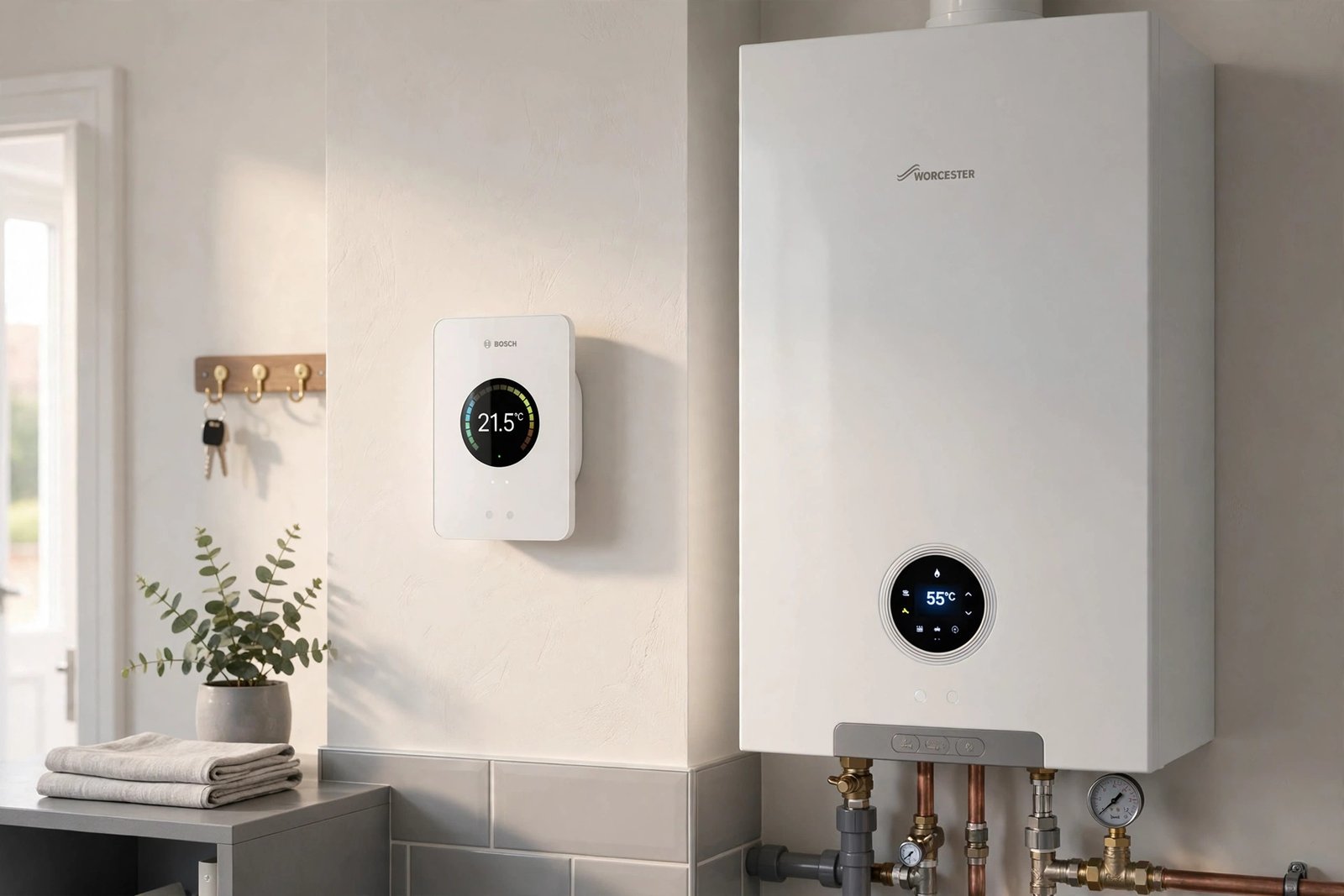
A smart thermostat replaces your existing thermostat, connecting to home WiFi and a smartphone app, allowing remote temperature control from anywhere. Many models also learn your household’s routine over time, automatically adjusting heating schedules, and can detect when the home is empty to reduce unnecessary heating.
Key Smart Thermostat Features
- Remote control: Adjust heating from anywhere via smartphone app
- Scheduling: Set different temperatures for different times of day and days of the week
- Geofencing: Automatically adjusts heating based on your phone’s location, detecting when you are heading home
- Learning algorithms: Some models learn your habits over time and adjust automatically without manual scheduling
- Energy reports: Track heating usage patterns to identify potential savings
- Multi-zone control: Higher-end systems can manage different rooms or zones independently
Compatibility With UK Heating Systems
Most smart thermostats are compatible with standard UK combi and system boilers, though compatibility should always be confirmed for your specific boiler model before purchase. Some heating systems, particularly certain older or less common setups, may need a compatible boiler interface accessory or professional assessment to confirm suitability.
What Is OpenTherm and Why Does It Matter?
OpenTherm is an open communication protocol that lets a smart thermostat do far more than simply switch your boiler on and off. With a basic on/off thermostat, the boiler fires at full power until the target temperature is reached, then shuts down, repeating this cycle all day. An OpenTherm-enabled thermostat instead tells a compatible boiler exactly how much heat is needed, so the boiler modulates its output up and down smoothly, running longer at lower power rather than cycling hard.
This matters because a modulating boiler spends more time in its efficient condensing mode, which is where the real fuel savings come from. The table below shows the practical difference.
| On/off control | OpenTherm modulation |
|---|---|
| Boiler fires at full output, then stops | Boiler output rises and falls to match demand |
| Frequent cycling wears components faster | Gentler running, less stop-start wear |
| Room temperature swings around the setpoint | Steadier, more comfortable room temperature |
| Less time in efficient condensing mode | More time condensing, lower gas use |
To benefit, both the thermostat and the boiler must support OpenTherm, and the feature needs enabling during setup. Many popular smart thermostats sold in the UK support it, including models from Tado, Hive, Google Nest and Honeywell, but not every boiler does, so check your boiler manual or the manufacturer’s compatibility list before buying. If your boiler lacks OpenTherm, a smart thermostat still works in standard on/off mode and still delivers scheduling and remote control benefits.
Smart Thermostat Installation: DIY or Professional?
Installation typically involves replacing the existing thermostat and connecting a small receiver unit near the boiler. Confident DIYers with basic electrical competence can often self-install, though the process involves working with mains-connected wiring, so professional installation is a sensible choice for anyone not fully confident with this type of electrical work.
Smart Thermostat Cost Comparison
| Type | Typical Cost | Key Features |
|---|---|---|
| Basic smart thermostat | £80 to £130 | Remote control, basic scheduling |
| Mid-range with learning | £150 to £220 | Learning algorithm, geofencing, energy reports |
| Multi-zone system | £250 to £500+ | Individual room control, advanced automation |
| Professional installation | £50 to £120 | If not self-installed |
Potential Energy Savings
Savings vary significantly based on your previous heating habits and how effectively you use the smart features. Households previously heating the whole home on a fixed schedule regardless of occupancy tend to see the most significant savings when switching to a smart thermostat’s adaptive, occupancy-aware heating pattern.
Smart Radiator Valves: A Complementary Upgrade
Smart thermostatic radiator valves (TRVs) allow individual room-by-room temperature control, working alongside a smart thermostat to avoid heating unused rooms unnecessarily. This combination offers more granular control than a smart thermostat alone, which typically controls the whole system based on a single reference temperature.
Choosing the Right Smart Thermostat
- Confirm compatibility with your specific boiler and any existing zone valve setup before purchasing
- Consider whether multi-zone control matters for your property, particularly larger homes
- Check which smart home ecosystem, if any, you want the thermostat to integrate with
- Compare app usability and available energy reporting features between different models
Frequently Asked Questions
Will a smart thermostat definitely save me money?
Most households see some saving, but the exact amount depends heavily on previous heating habits, property insulation, and how actively the smart features are used, so results vary between properties.
Can I install a smart thermostat myself?
Many models are designed for DIY installation by confident, competent individuals, though the process involves working with mains electrical connections, so professional installation is recommended if you are not fully confident.
Do smart thermostats work with combi boilers?
Yes, most smart thermostats are compatible with standard UK combi boilers, though checking specific compatibility for your exact boiler model before purchase is always recommended.
What happens if my WiFi goes down?
Most smart thermostats continue operating on their last set schedule even without an internet connection, though remote app control and any cloud-based learning features will be unavailable until connectivity is restored.
Can smart thermostats control multiple rooms independently?
Standard smart thermostats generally control the whole system from a single point, while multi-zone systems or smart radiator valves added alongside a standard thermostat enable independent room-by-room control.
What is OpenTherm in simple terms?
OpenTherm is a standard language that lets a smart thermostat tell a compatible boiler how much heat to produce, rather than just switching it on or off. This modulation keeps the boiler running more efficiently and holds room temperature steadier.
How do I know if my boiler supports OpenTherm?
Check your boiler manual or the manufacturer’s website for OpenTherm compatibility. Many modern condensing combi boilers support it, but some only work with the manufacturer’s own controls, so confirm before buying a third-party smart thermostat for this feature.
Do I need an OpenTherm thermostat to benefit?
Both sides must support it: the thermostat and the boiler. An OpenTherm thermostat connected to a non-OpenTherm boiler simply falls back to standard on/off control, which still gives you smart scheduling and remote control.
Does OpenTherm work with combi boilers?
Yes, combi boilers are the most common application. OpenTherm modulation works on the central heating side, adjusting the boiler’s output to match the heating demand of your home.
Will OpenTherm actually save me money?
It can reduce gas consumption because the boiler spends more time in efficient condensing mode and cycles less. The saving depends on your boiler, insulation and usage patterns, but modulation is widely regarded by heating engineers as one of the more worthwhile efficiency features.
Expert Insight
Heating engineers consistently note that a smart thermostat delivers the most value when genuinely used to its full potential, adjusting schedules to match real occupancy patterns, rather than simply replacing a manual thermostat and leaving it on a similar fixed schedule as before.
Final Thoughts
Smart thermostats offer genuine convenience and realistic potential for energy savings, particularly for households with variable schedules or previously inefficient heating habits. Confirming compatibility with your specific boiler and taking time to actually use the scheduling and learning features fully will determine how much value you get from the investment.
Considering a smart thermostat? Check compatibility with your exact boiler model before purchasing, since this is the most common source of installation issues reported by DIY installers.
Related Guides
- Smart Home Devices: A Complete Beginner’s Guide
- Smart Plugs and Switches: Complete Guide
- EPC Rating Explained
Written by the HometoWorld editorial team, covering home improvement, renovation, and property maintenance across the UK.
About the Author