What Size Boiler Do I Need? UK Sizing Guide for a 3-Bed House (2026)
The short answer for a typical 3-bed house with one bathroom is a 28–30 kW combi boiler, or a system boiler of 15–26 kW with a hot water cylinder. With two bathrooms, the combi figure rises to 30–35 kW, or a system boiler with a cylinder becomes the better choice. Those are the bands every sizing guide in the sources for this article agrees on, and they are the right starting point, but they are only a starting point, because bedroom count is not how a boiler is actually sized.
Here is the point most guides bury and this one leads with: your mains flow decides your combi size, and your heat loss decides your system size. A combi boiler’s kW rating is set by instant hot water, not by heating. A system or regular boiler’s kW rating is set by how much heat your home loses on a cold day, which depends on its size, insulation and radiators. Not on how many bedrooms it has. Two 3-bed houses on the same street can need different boilers, and a bigger boiler is not a better boiler. Get those two ideas straight and the tables below make sense; miss them and you will buy too much boiler for the wrong reason.
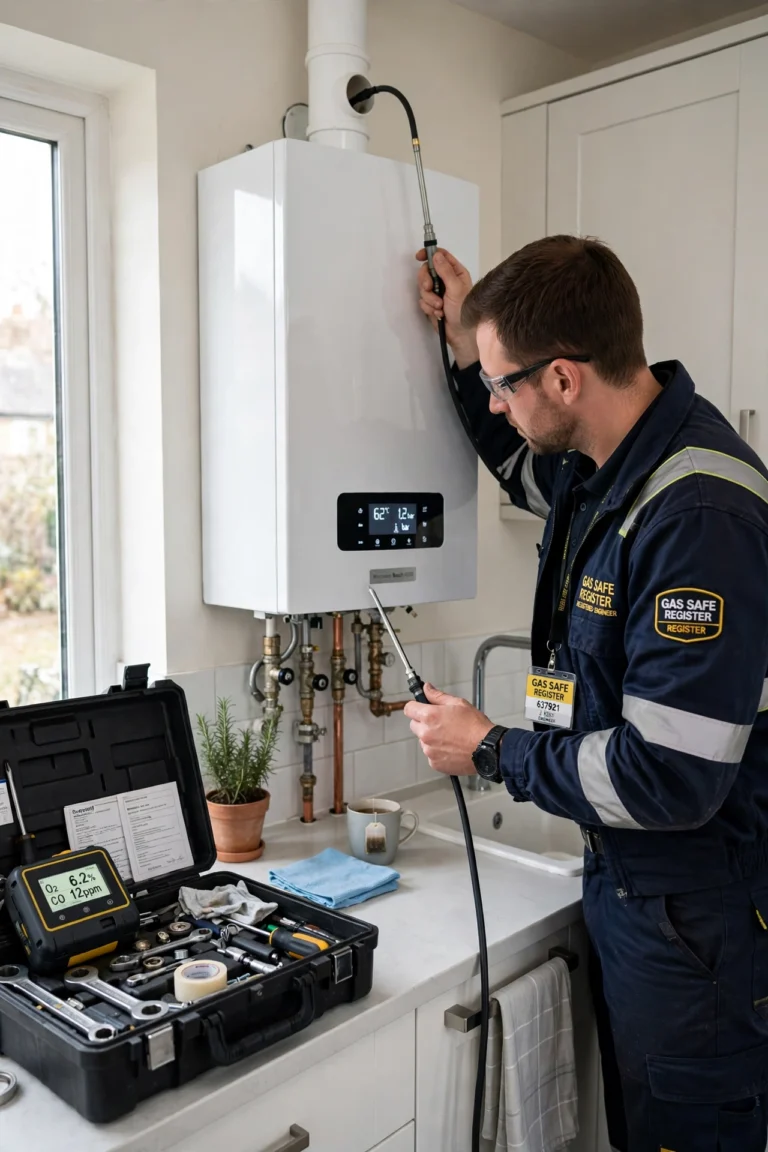
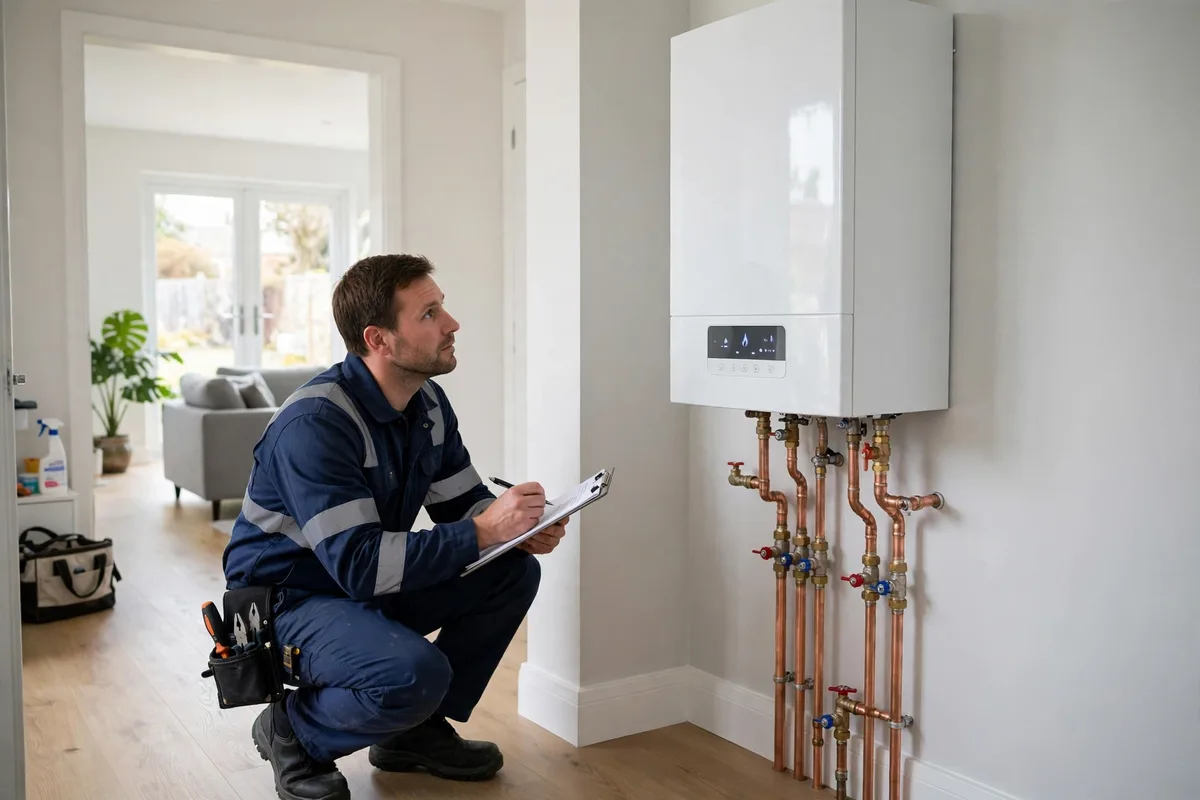
This guide is general information, not a sizing calculation for your home. Every source checked for it says the same thing: a Gas Safe registered engineer must confirm the size with a room-by-room heat-loss calculation before anything is installed. Use this guide to understand the decision and to ask the right questions. Not to order a boiler on your own.
What Size Boiler by Radiators and Bathrooms (kW Bands)
Start with the tables, because they are what most people come for. But read them as bands, not as exact figures. The sources behind them disagree at the edges, and that disagreement is honest: different guides round differently and assume different levels of insulation. Where two sources give different figures for the same house, this guide shows the full spread rather than pretending one number is right.
By radiators
Radiator count is a better starting point than bedroom count, because radiators are what the boiler actually has to heat. The bands below follow Ideal Heating guidance as quoted by Vantage Plumbing and Heating.
| Radiators in the home | Combi boiler | System or regular boiler |
|---|---|---|
| Up to 10 | 24–27 kW | 12–15 kW |
| 10–15 | 28–34 kW | 18–24 kW |
| 15–20 | 32–40 kW | 30–40 kW |
Look at the gap between the two columns and you can already see the combi trap, which the next section explains in full: a combi needs far more kW than a system boiler for the same house, because its kW has to cover instant hot water as well as heating. A system boiler only has to cover heating, because hot water is stored in a cylinder and heated over time.
By bedrooms and bathrooms (the 3-bed house)
For a 3-bed house, the guides checked for this article agree on these bands:
| Home | Combi boiler | System or regular boiler |
|---|---|---|
| 3-bed, 1 bathroom | 28–30 kW | 15–26 kW |
| 3-bed, 2 bathrooms | 30–35 kW, or a system boiler with a cylinder | 18–26 kW with a cylinder |
The system-boiler figure for a 3-bed, 1-bathroom house is the widest spread in this guide: BuildCalcu gives 15–18 kW, while Fix and Repair Engineers gives 18–26 kW for 3–4 bedrooms with 10–15 radiators. Both are quoted here as published, because picking one and hiding the other would be false precision. The right figure for your house sits inside that spread and depends on how well insulated it is and how many radiators it has, which is exactly what a heat-loss calculation works out.
And here is the figure that puts all of this in perspective: most 3-bed homes need only 4–8 kW for central heating on the coldest days (Fix and Repair Engineers). That is the heating load. Everything above that in a combi’s rating is there for hot water. Keep that in mind when you read the next section.
Heating Output vs Hot Water Output: The Combi Trap
This is the single most misunderstood part of boiler sizing, and it is where people overspend. A combi boiler has one kW rating, but it does two jobs, and the two jobs need very different amounts of power.
Heating output is the power needed to keep your home warm. It is small. As above, a typical 3-bed home needs roughly 4–8 kW of heating on the coldest days. A well-insulated home needs less; a draughty one needs more, but the order of magnitude is single figures.
Hot water output is the power needed to heat cold mains water instantly, as it flows through the boiler to your tap or shower. It is large. To give a decent shower, roughly 11–14 litres per minute of hot water, a combi needs 24–35 kW. That is three to five times the heating load, and it is the reason a combi for a 3-bed house is rated at 28–30 kW even though the house itself only needs a fraction of that to stay warm.
So when you buy a 28 kW combi, you are not buying 28 kW of heating. You are buying about 8 kW of heating and about 20 kW of instant hot water, in one box. The kW on the box is the hot-water number. That has three consequences worth knowing before you choose:
1. Do not add bathrooms to the heating figure. A second bathroom does not make your house harder to heat. It makes your hot-water demand higher, and only if two people might use hot water at the same time. That is why the 2-bathroom combi band (30–35 kW) is higher than the 1-bathroom band (28–30 kW). It is about simultaneous use, not about the house getting bigger. If your second bathroom is a rarely used guest bathroom, a 28–30 kW combi may still be right, and your installer should be asking about how you actually use the house, not just counting rooms.
2. A system boiler escapes the trap. A system or regular boiler heats a cylinder of stored hot water slowly, over an hour or so, so it only needs enough power for the heating load plus a modest allowance to reheat the cylinder. That is why its kW is so much lower, 15–26 kW for the same 3-bed house. The trade-off is space for a cylinder and a slower recovery if the cylinder runs out, but the boiler itself can be much smaller. This is the decision our guide to combi vs system boilers works through in full, including the space and cylinder questions.
3. The flow rate is the real limit, not the kW. A 35 kW combi cannot give you more hot water than your mains supply can deliver. If your cold water only arrives at 10 litres per minute, a bigger combi will not make it arrive faster. That is the flow-rate caveat, and it gets its own section below, because it is the check most people skip.
Why Oversizing Wastes Money
It is tempting to buy a bigger boiler “just to be safe”. Every source checked for this article says the same thing: do not. Oversizing wastes money in three ways, and none of them is obvious at the point of purchase.
You pay more for the boiler itself. A 35 kW combi costs more than a 28 kW combi, and a 40 kW model costs more again. If your mains flow cannot support the bigger unit’s output, that extra money buys you nothing at all. The boiler can only heat the water that arrives, and the water arrives at the same rate whatever the boiler’s rating. The price difference is real money spent on capacity you cannot use, and the running costs are set out in our guide to new boiler costs in the UK.
An oversized boiler cycles. A boiler that is far too big for the heating load cannot run gently. It fires up, heats the water too quickly, hits its target temperature and switches off, then fires up again, over and over, all day. This short-cycling is inefficient, because a boiler is least efficient in the moments just after it fires, and it wears components faster than steady running. Modern boilers can modulate down to a low output, which helps, but a boiler sized at five times the heating load is still spending its life switching on and off instead of running steadily.
It does not make your home warmer. A bigger boiler does not make radiators hotter or rooms warmer. Radiators can only give out as much heat as their size allows, and rooms can only hold as much heat as their insulation allows. Once the radiators are up to temperature, extra boiler power has nowhere to go. If your home is slow to warm up, the cause is usually radiator size, balancing or insulation. Not boiler size. A bigger boiler will not fix a cold room, and it will not fix radiators that are too small for the room they serve, which is a sizing question of its own, covered in our guide to radiator replacement costs and sizing.
The honest version of “just to be safe” is this: size the boiler for the hot water you actually use, at the flow rate your mains actually delivers, and let the heating load be what it is. A Gas Safe registered engineer should be doing a heat-loss calculation room by room and checking your mains flow before recommending a size. If an installer quotes a kW figure without doing either of those things, ask why.
The Flow-Rate Caveat: Your Mains Decides Your Combi Size
This is the check that decides whether a combi boiler will actually work well in your home, and it takes two minutes with a measuring jug and a stopwatch.
How much hot water does each kW give you?
A combi boiler heats water as it flows through, so its output is measured in litres per minute at a given temperature rise. The standard figure quoted is a 35°C rise, cold mains water at around 10°C heated to around 45°C at the tap. On that basis, the guides checked for this article give:
- 28–30 kW combi: roughly 11.5–12.5 litres per minute
- 32–35 kW combi: roughly 13–14.5 litres per minute
(Boiler Central.) A decent shower uses roughly 8–12 litres per minute, so a 28–30 kW combi gives you a good single shower with a little to spare. It does not give you two good showers at once. Two showers at once usually exceeds what a combi and the mains can deliver (Fix and Repair Engineers; Boiler Central), and that is the point at which a system boiler with a stored cylinder becomes the better answer. The cylinder can feed two showers because the hot water is already made and stored, not being made on demand.
Measure your mains flow first
Before you choose a combi size, measure what your mains actually delivers. Put a 1-litre jug under the kitchen cold tap, turn it on fully, and time how long it takes to fill. If it takes 6 seconds, that is 10 litres per minute. If it takes 4 seconds, that is 15 litres per minute. Do it at a time of day when water is being used normally in your home, and remember that the flow at the kitchen tap is the best case. The flow upstairs, at the shower, will be a little lower.
The guides checked for this article match mains flow to combi size like this (Challenger Heating; Fix and Repair Engineers):
| Your mains flow | Combi size that suits it |
|---|---|
| 8–10 litres per minute | 24 kW |
| 10–14 litres per minute | 30 kW |
| 14–16 litres per minute | 35–36 kW |
Read that table carefully, because it is the opposite of how most people shop. You do not pick a big combi and hope your mains keeps up. You measure your mains and pick the combi it can support. If your mains delivers 10 litres per minute and you buy a 35 kW combi, you have paid for 14 litres per minute of hot water and you will still only get 10. The extra 5 kW is wasted money, and it will not make your shower any stronger.
If your mains flow is low, below 8 litres per minute, talk to your installer before choosing a combi at all. A system boiler with a cylinder does not depend on mains flow in the same way, because the cylinder is filled slowly and the hot water is stored. Low mains flow is also worth investigating in its own right: it can be a supply pipe issue, a partially closed stopcock, or a shared supply, and it is worth ruling those out before you spend money on a boiler that cannot do its best work.
The worked example: a typical 3-bed house
Put it all together for a typical 3-bed, 1-bathroom house with 10–12 radiators and a mains flow of around 12 litres per minute:
- Heating load: roughly 4–8 kW on the coldest days.
- Hot water need: one good shower at a time, roughly 11–12 litres per minute.
- Combi size: 28–30 kW, which gives roughly 11.5–12.5 litres per minute at a 35°C rise, matched to the mains flow, not above it.
- System boiler alternative: 15–26 kW with a cylinder, sized by heat loss, with hot water stored rather than made on demand.
That is the answer the tables point to, and it is also the answer the flow check confirms. If your house has two bathrooms that are used at the same time, or a mains flow above 14 litres per minute, the numbers move up. If it has one bathroom and a mains flow of 9 litres per minute, a 24 kW combi may be the honest choice. Smaller, cheaper, and matched to what your home can actually deliver.
FAQs
What size boiler do I need for a 3-bed house?
For a typical 3-bed house with one bathroom, a 28–30 kW combi boiler or a 15–26 kW system boiler with a hot water cylinder. With two bathrooms, a 30–35 kW combi, or a system boiler with a cylinder. These are indicative bands from the sizing guides checked for this article; a Gas Safe registered engineer should confirm the size with a room-by-room heat-loss calculation and a mains flow check before installation.
Is a 30 kW boiler enough for a 3-bed house?
Yes, for most 3-bed houses with one bathroom. A 28–30 kW combi gives roughly 11.5–12.5 litres per minute of hot water at a 35°C rise, which is a good single shower. The heating load of a typical 3-bed home is only 4–8 kW on the coldest days, so 30 kW is far more than the heating needs. The kW is there for hot water. The real question is whether your mains flow can support it: if your mains delivers less than 10 litres per minute, a 30 kW combi will not perform any better than a 24 kW one.
What size boiler do I need for 10 radiators?
By the Ideal Heating guidance quoted by Vantage Plumbing and Heating, up to 10 radiators means a 24–27 kW combi or a 12–15 kW system boiler. With 10–15 radiators, the bands rise to 28–34 kW for a combi and 18–24 kW for a system boiler. Radiator count is a better guide than bedroom count, because radiators are what the boiler has to heat, but the bands are still indicative, and a heat-loss calculation is what settles it.
Is a bigger boiler better?
No. A bigger boiler costs more to buy, cycles on and off more often because it is far too powerful for the heating load, and does not make your home warmer. Radiators and insulation set that limit, not the boiler. A bigger combi also cannot overcome a poor mains supply: if your cold water arrives at 10 litres per minute, a 35 kW combi will give you no more hot water than a 30 kW one. Size for the hot water you actually use, at the flow rate your mains actually delivers.
Can a combi boiler run two showers at once?
Usually not well. Two showers at once usually exceeds what a combi and the mains can deliver, because a combi makes hot water on demand and is limited by both its kW and your mains flow rate. If two showers running at the same time is a normal part of your household routine, a system boiler with a stored hot water cylinder is usually the better choice, because the cylinder can feed both showers from water that is already heated and stored.
Do I need a Gas Safe engineer to size my boiler?
Yes. Every sizing guide checked for this article says a Gas Safe registered engineer must confirm the size with a room-by-room heat-loss calculation before installation. The tables in this guide are indicative bands from published sources that disagree at the edges. Only a heat-loss calculation takes account of your home’s actual insulation, window sizes, room volumes and radiator sizes, and only a Gas Safe registered engineer may legally work on a gas boiler. Keeping the boiler in good order afterwards matters too, which is why our guide to boiler service costs explains what an annual service includes and what it should cost.
About the Author