A boiler that keeps losing pressure is losing water from a sealed heating system, or it has let air out of it. That is the short answer, and it matters because it tells you what topping up can and cannot do. Topping up puts water back in and gets the heating running again, but it does not fix the cause. If the pressure falls again, water is still getting out somewhere, and the job is to find where.
Most sealed systems in UK homes sit between 1 and 1.5 bar with the heating off, and rise a little when hot. A healthy system holds that pressure for months. If yours needs topping up more than once or twice a year, something is wrong, and this guide works through it in the order a heating engineer would: what normal looks like, what the gauge is telling you, each cause in turn, how to top up safely, and when to stop checking things yourself and call a Gas Safe registered engineer.
What Is Normal Boiler Pressure?
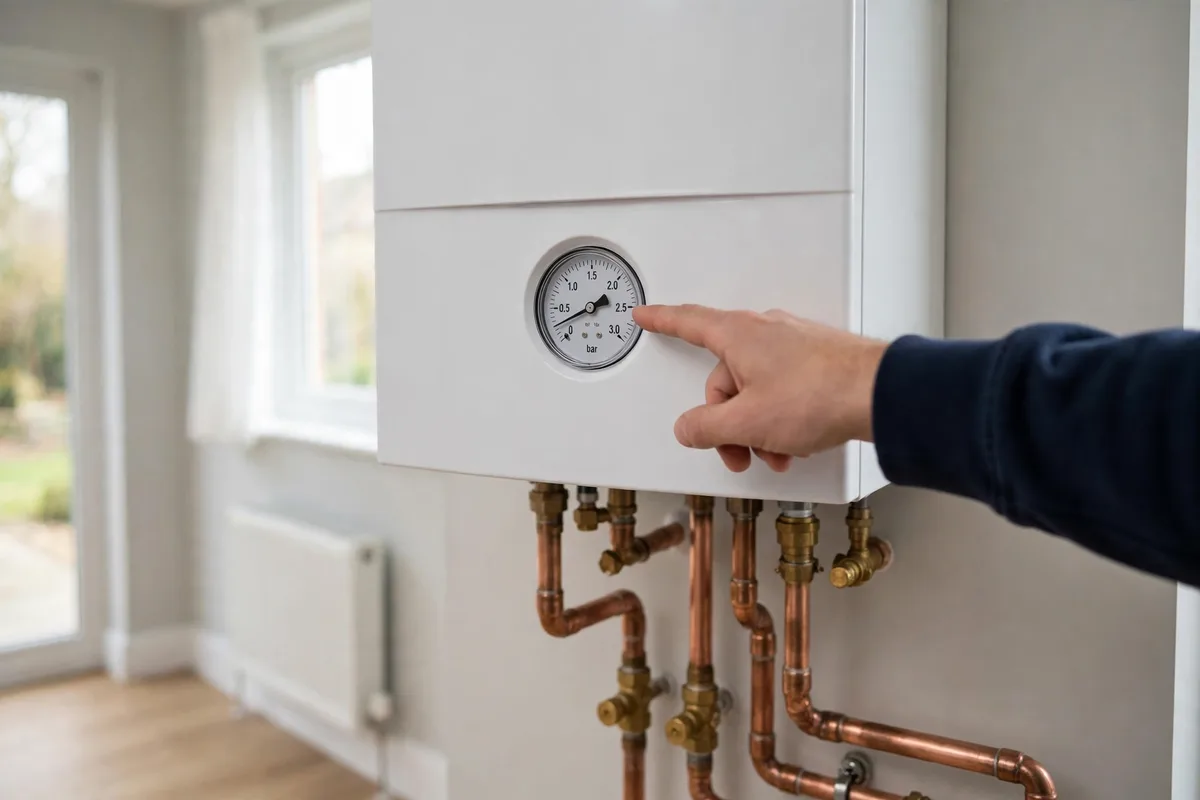
Look at the pressure gauge on the front of the boiler, or on the pipes below it. On most sealed systems, combi and system boilers alike, the figures are the same across the guides that publish them:
| Gauge reading (heating off) | What it means | What to do |
|---|---|---|
| Below 0.5 bar | Very low. The boiler has probably locked out | Top up, then look for the cause |
| 0.5 to 1 bar | Low. The heating may cut out | Top up to around 1.2 bar |
| 1 to 1.5 bar | Normal | Nothing |
| 1.5 to 2 bar | High but often fine when the system is hot | Watch it; if it stays high when cold, investigate |
| Above 2.5 to 3 bar | Too high. The boiler should cut out as a safety measure | Switch the boiler off and call an engineer |
Cold means the heating has been off for a while, usually overnight. Hot means the radiators have been running. A cold reading of 1 to 1.5 bar that rises towards 2 bar when hot is normal. Vaillant’s UK advice, quoted in several of the guides checked for this article, puts a normal cold reading at 1 to 1.5 bar, and British Gas gives the same cold range. Your own boiler’s manual has the figure for your model, and the manual wins over any general guide, this one included.
Two numbers are worth remembering. Below about 0.5 bar, most boilers lock out and the heating stops. Above about 2.5 to 3 bar, the pressure relief valve opens to protect the system. Between those two, the gauge is a diagnostic tool: how fast the pressure falls, and whether it falls when the system is cold or hot, points at the cause before anyone opens a toolbox.
What You See Tells You the Cause
This is the part most guides skip, and it is the quickest way to narrow the problem down. Match what you are seeing to the table, then read the matching cause below.
| What you see | Likely cause | First step |
|---|---|---|
| Pressure fine cold, very high hot, then low again | Expansion vessel has lost its charge | Engineer: recharge or replace the vessel |
| Steady slow drop over days or weeks | Small leak on a radiator, valve or pipe | Check visible joints and valves, then engineer for hidden pipework |
| Drop right after bleeding a radiator | Normal: air came out, water must replace it | Top up once to 1 to 1.5 bar |
| Pressure drops to zero overnight | Pressure relief valve letting water out, or a significant leak | Check the outside discharge pipe for dripping, then engineer |
| Pressure drops within a day or two of topping up | An active fault, not normal loss | Do not keep topping up; call an engineer |
| Water visible inside the boiler casing | Leak inside the boiler | Switch off and call a Gas Safe engineer |
| Pressure drops after recent work on the system | Air released, or a disturbed joint | Top up once, check the work area, call the installer if it keeps falling |
If none of these rows matches, note the pattern anyway: the reading cold, the reading hot, and how long it takes to fall. An engineer will ask for exactly that, and it saves a diagnostic visit turning into two.
Cause 1: You Have Just Bled a Radiator
This is the most common cause and the easiest to fix, and it is not a fault at all. When you bleed a radiator you let trapped air out, and a splash of water follows it. Both were taking up space in the system, so the pressure falls. Every time you bleed a radiator, expect the gauge to drop, and topping the boiler back up once afterwards is normal.
The test is simple. Top up once to around 1 to 1.5 bar, then leave it. If the pressure holds for weeks, the bleed was the whole story. If it falls again within days, something else is going on, and the other causes below apply.
Bleeding is also the first check when a radiator is cold at the bottom, because trapped air and sludge show up in similar ways. Our guide to why your radiator is cold at the bottom (https://hometoworld.co.uk/why-is-my-radiator-cold-at-the-bottom/) walks through the quick checks in order, so you can tell a bleed job from a sludge job before you call anyone.
Cause 2: A Leak on a Radiator, Valve or Pipe
Small leaks are behind most repeat pressure loss. They are often tiny weeps that evaporate before you notice a puddle, so a dry floor does not prove there is no leak. A sealed system only needs to lose a small amount of water for the gauge to move, which is why a slow drop over days or weeks points here first.
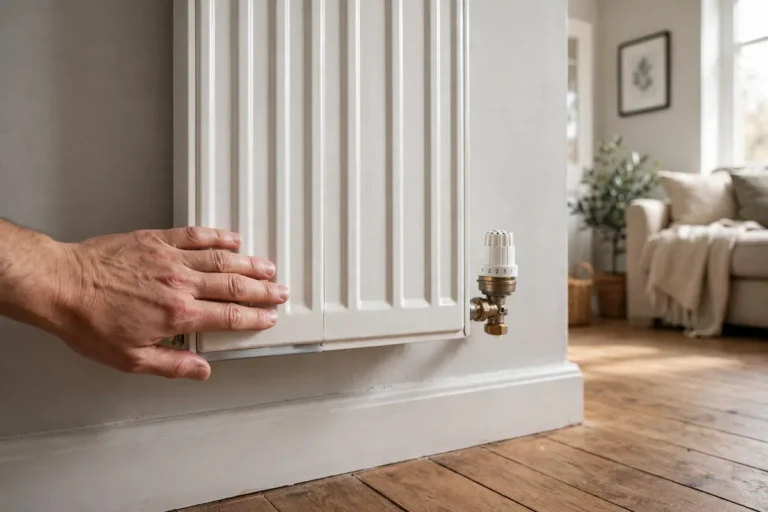
Check the places you can see. Run a finger under each radiator valve, where the valve meets the radiator and where the pipe meets the valve. Look for green or white crust around joints, which is dried residue from a slow weep, and for damp patches or staining on the wall behind a radiator. Check the pipework under the boiler, around the filling loop, and at any joint you can reach. A radiator valve that weeps only needs a new valve, and the repair cost guides put a weeping valve or compression joint at around £80 to £180 fitted, depending on access.
The harder case is a hidden leak: pipework under floorboards, boxed in behind walls, or buried in a concrete floor. The signs are a damp patch on a ceiling below, a musty smell in a room, floorboards that feel springy, or a patch of plaster that keeps going damp. Finding one of those is engineer work, and it may involve a leak detection visit before any repair. Do not lift floorboards or cut into walls yourself to chase it. A significant leak that will not hold pressure at all sits at the expensive end of the repair guides, around £150 to £600 or more, because the cost is mostly in finding it.
One more place to look: the filling loop itself. If its valves are not fully closed, or the loop is left connected and passing, water can creep out of the system through it. Check that both filling loop valves are shut tight after every top up. It is a small check that catches a surprising number of slow drops.
Cause 3: The Pressure Relief Valve Is Letting Water Out
Every sealed boiler has a pressure relief valve, usually called a PRV. Its job is to let water out if the pressure ever climbs too high, through a small copper pipe that usually runs from the boiler to an outside wall and ends outside. It opens at around 3 bar. Once it has opened a few times, grit or scale can stop it sealing again, and then it keeps dribbling water out even at normal pressure.
The check is outside. Look at the end of the discharge pipe on your outside wall, the short copper pipe that points down. If it is dripping, or the wall below it is wet or stained when it has not rained, the relief valve is passing. That is also the fastest way to confirm this cause: a valve that drips after the heating has been on, and a gauge that drops to zero overnight, go together.
A faulty relief valve is a cheaper suspect and worth ruling out first, before anyone starts looking for hidden leaks. The repair guides cross-checked for this article put a replacement relief valve at £90 to £200 fitted, including parts and labour, with MyJobQuote and CBS Southampton both in that range and Selectra at £90 to £140. The part itself is cheap, a universal valve costs £5 to £15 and a manufacturer branded one £15 to £60, so most of the bill is the engineer’s visit. Do not try to adjust, clean or replace the relief valve yourself. It is a safety device, and work on it belongs to a Gas Safe registered engineer.
Cause 4: The Expansion Vessel Has Lost Its Charge
The expansion vessel is a small tank inside or next to the boiler, with air on one side of a rubber diaphragm and system water on the other. Its job is to absorb the extra volume when water heats up and expands. Over time the air leaks out, and the vessel loses its charge.
The telltale sign is a gauge that swings a lot between cold and hot: normal when cold, very high when hot, then low again once everything cools. Here is what happens. With no air cushion left, the pressure shoots up as soon as the heating comes on. The relief valve opens at around 3 bar to protect the system and lets water out. When the system cools, the pressure has dropped, because that water is gone. So the same fault shows up as pressure too high and pressure too low, on the same day.
This is not a job for a homeowner. Recharging or replacing an expansion vessel means working inside the boiler, and on some models the boiler has to come off the wall to reach it. The repair guides put recharging or replacing a vessel at £120 to £350 fitted, depending on access, with London prices higher. If the vessel is inside an old boiler and access is poor, the labour can push the bill up, and that is the point where the repair-or-replace question in the later section starts to matter.
Cause 5: A Leak Inside the Boiler
If water is visible inside the boiler casing, or the pressure falls and every external check comes back clean, the leak may be inside the boiler itself. Common culprits are the heat exchanger, the pump seals, or an internal joint that has failed. A leaking heat exchanger is the serious one: it is the most expensive part in the boiler, and the repair guides put a heat exchanger replacement at £500 to £900 fitted.
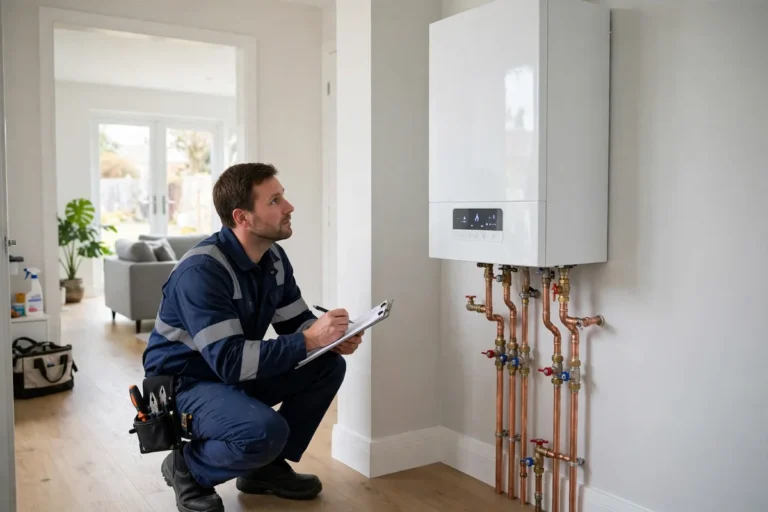
Do not take the boiler casing off to look. Work inside a gas boiler, including the expansion vessel and the relief valve, must be done by a Gas Safe registered engineer. If you can see water inside the casing, switch the boiler off, do not use it, and call an engineer. If you smell gas at any point, leave the property and call the National Gas Emergency Service on 0800 111 999. That number is for gas emergencies, and a smell of gas is always one.
How to Top Up Your Boiler Pressure
Topping up is something most owners can do, and your boiler’s manual shows the exact steps for your model. Check the manual first, because filling loop designs differ: some boilers have an external braided hose with two valves, some have a built-in key. The steps below cover the common external loop, and they follow the guidance from British Gas, YourRepair, iHeat and Plumber in Sheffield.
- Switch the heating off and let the system cool. YourRepair says let the boiler cool for four to six hours first, so the cold reading is a true one.
- Find the filling loop, usually a short braided silver hose below the boiler with a valve at each end.
- Open the filling loop valves slowly, one at a time if there are two. You will hear water entering the system.
- Watch the gauge and close both valves when it reaches about 1 to 1.5 bar. Do not overfill it.
- Switch the heating back on and check the gauge again once the system is hot. It should sit a little higher, often up to around 2 bar.
- Note the reading and the date. Check it again in 24 hours. If it has held, you are done. If it has fallen, work through the fix ladder below.
Two warnings apply to every top up. First, close both filling loop valves fully when you finish, and do not leave the loop connected and passing, or the system can over-pressurise or lose water through it. Second, never take the boiler casing off, and never touch anything inside the boiler. Topping up is the one pressure job a homeowner is expected to do. Everything past the filling loop is Gas Safe work.
The Fix Ladder: What to Do in Order
Work through these steps in order, and stop at the step that fixes it. The point of the ladder is to spend five minutes on the checks you can do, before paying for a visit.
- Top up once, to 1 to 1.5 bar, and note the reading and the date.
- Check every visible radiator valve and joint for weeps, and look for damp patches, staining or green crust.
- Check the outside discharge pipe for dripping. If it is dripping, the relief valve is the prime suspect.
- Watch the gauge cold and hot. A big swing between cold and hot points at the expansion vessel.
- Check the reading again after 24 hours. If it has held, the cause was probably a bleed or recent work. If it has fallen again, call an engineer and tell them the cold reading, the hot reading and how fast it fell.
- If the pressure drops to zero overnight, or you can see water inside the boiler, skip the rest of the ladder and call an engineer now.
A sealed heating system should not need regular repressurising. That is the line every installer guide agrees on. Topping up once after bleeding a radiator is normal. Topping up every week is not, and it is the sign that the cause still needs finding.
What It Costs to Fix
Repair costs vary by fault, by boiler model and by where you live, with London and the South East typically 20 percent higher than the rest of the UK. The table below is built from the repair cost guides that publish real figures, CBS Southampton, MyJobQuote, Selectra and 247 Home Rescue, and the ranges are for parts and labour together unless stated otherwise.
| Fault | Typical fitted cost | Notes |
|---|---|---|
| Simple repressurise by an engineer | £80 to £150 | The visit, not a repair; only worth it if you cannot top up yourself |
| Weeping radiator valve or joint | £80 to £180 | A new valve and a top up; leaking valve or pipework up to £300 |
| Pressure relief valve replacement | £90 to £200 | Part is cheap; most of the bill is the visit |
| Expansion vessel recharge or replacement | £120 to £350 | Higher if the boiler must come off the wall to reach it |
| Significant or hidden leak | £150 to £600 or more | Most of the cost is finding it |
| Heat exchanger replacement | £500 to £900 | Often the point where replacement makes more sense |
For context, the average boiler repair in the UK sits around £300 to £350, according to MyJobQuote’s figures from real quotes, with a typical range of £150 to £700 depending on the fault. Most pressure-loss cases are fixed with a new valve, a recharged expansion vessel or a repaired joint, and the majority land in the £80 to £350 band.
If the fault turns out to be sludge, repeated topping up leaves a different bill behind it. Fresh water brings oxygen into the system, and oxygen speeds up corrosion and sludge, which is why a power flush can enter the conversation. Our power flush cost guide (https://hometoworld.co.uk/power-flush-cost-uk/) puts a flush at £300 to £800 by radiator count, and explains when a flush is the wrong fix as well as when it is the right one.
When to Call a Gas Safe Engineer
Call an engineer if any of these apply. They are the same triggers in every guide checked for this article, from YourRepair to iHeat to Plumber in Sheffield.
- The pressure drops more than once or twice a year.
- It drops again within a day or two of topping up.
- The relief pipe outside is dripping.
- The gauge swings a lot between cold and hot.
- You can see water inside the boiler.
- You have had recent work done and the pressure keeps falling after it.
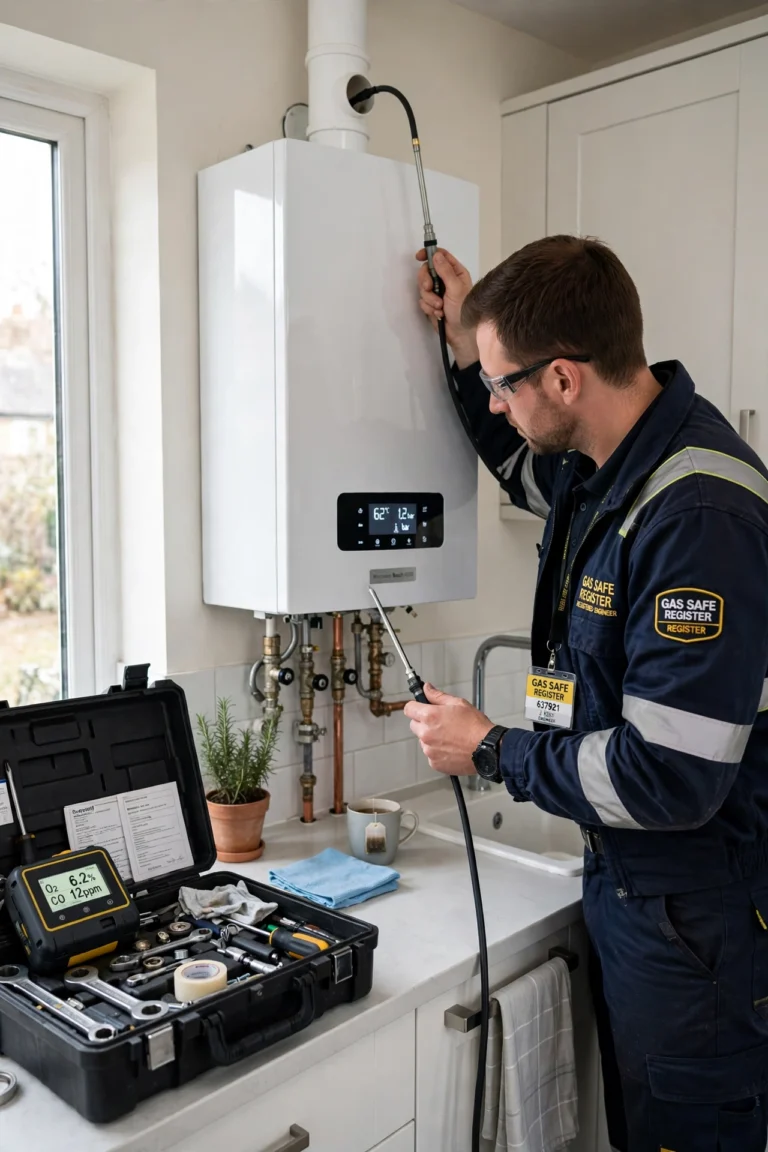
When you call, ask to see the engineer’s Gas Safe ID card when they arrive, and check that the work they are doing is on the back of the card. Any work inside a gas boiler must be done by a Gas Safe registered engineer, and that includes the expansion vessel, the relief valve and anything behind the casing.
A service visit is also the right moment to catch pressure problems early, because the engineer checks the vessel charge and the relief valve as part of the service. Our boiler service cost guide (https://hometoworld.co.uk/boiler-service-cost-uk/) sets out what a service actually includes, what a one-off service costs, and the warranty conditions that make an annual service worth keeping up.
Why You Should Not Keep Topping Up
It is tempting to treat the filling loop as the fix. The heating comes back on, the house warms up, and the problem feels solved. It is not, and doing it for months causes a second problem on top of the first.
Every top up adds fresh water to the system, and fresh water brings oxygen with it. Oxygen speeds up corrosion inside radiators and pipework, and corrosion makes sludge. Sludge blocks radiators from the bottom up, makes the boiler work harder, and eventually needs a flush to clear. So a leak that would have cost £80 to £180 to fix can turn into a leak plus a flush, and a flush runs £300 to £800.
There is a second cost. A system that keeps losing pressure is losing water somewhere, and water going into a floor, a wall or a ceiling does damage quietly. A weep under floorboards can soak joists for months before anyone sees a stain. Finding the cause early is almost always cheaper than topping up and waiting, even when the cause turns out to be a simple valve.
Repair or Replace the Boiler?
Most pressure-loss faults are worth repairing. A valve, a relief valve or a recharged vessel costs £80 to £350 fitted, and none of those is a reason to replace a boiler. Replacement starts to make sense when the numbers stack up against the boiler rather than for it.
The decision guides agree on the rough shape of it. If the boiler is over ten years old and needs a heat exchanger at £500 to £900, or more than one major component at once, replacement is usually the cheaper decision within a year or two. A replacement combi boiler fitted typically costs £1,800 to £3,000, according to CBS Southampton, and our own new boiler cost guide (https://hometoworld.co.uk/new-boiler-cost-uk/) puts a like-for-like combi at £2,000 to £3,500 installed, with the full range by boiler type and the conversion costs that push a quote up.
Age matters for another reason. An old boiler that keeps losing pressure may also be losing efficiency, and the parts for it may be harder to source. If you are weighing repair against replacement, check the sizing at the same time, because a boiler that is too big for the house wastes money every year it runs. Our guide to what size boiler you need (https://hometoworld.co.uk/what-size-boiler-do-i-need/) works through kW bands by radiators and bathrooms, and the flow-rate check that decides a combi.
FAQs
Is it dangerous if my boiler keeps losing pressure?
Low pressure itself is not dangerous, but it will eventually stop the boiler working, because most boilers lock out below about 0.5 bar. The danger is in the cause, not the reading: a leak inside the boiler, a faulty relief valve or a failed vessel all need a Gas Safe engineer. If you smell gas, leave the property and call the National Gas Emergency Service on 0800 111 999.
How often should I need to top up my boiler?
A healthy sealed system holds its pressure for months, and topping up more than once or twice a year means something is wrong. Topping up once after bleeding a radiator is normal. Topping up every week is not, and it should be investigated rather than repeated.
Can I top up my boiler pressure myself?
Yes, topping up through the filling loop is a job most owners can do, and your boiler’s manual shows the exact steps for your model. Switch the heating off, let the system cool, open the loop valves slowly, watch the gauge to 1 to 1.5 bar, and close both valves. Never take the boiler casing off, and never work on anything inside the boiler.
Why does my boiler lose pressure overnight?
A drop to zero overnight usually points at the pressure relief valve letting water out through the outside discharge pipe, or a significant leak. Check the discharge pipe for dripping first. If it is dripping, or the pressure will not hold at all, call a Gas Safe engineer rather than topping up again.
Why is my boiler pressure high when hot and low when cold?
That swing is the classic sign of an expansion vessel that has lost its charge. With no air cushion left, pressure shoots up when the heating comes on, the relief valve opens and lets water out, and the pressure falls once the system cools. An engineer can recharge the vessel or replace it, typically for £120 to £350 fitted.
Will a power flush fix low boiler pressure?
Not on its own. A power flush clears sludge, and sludge can cause pressure problems indirectly, but it does not fix a leak, a relief valve or a vessel. Find the cause first, using the diagnosis table in this guide, and only flush if sludge is actually the problem.
Does losing pressure mean I need a new boiler?
Usually not. Most pressure loss is a valve, a relief valve or an expansion vessel, and those repairs cost £80 to £350 fitted. Replacement only makes sense when the boiler is old and needs an expensive repair such as a heat exchanger, or when several major parts fail together.
About the Author