How Much Does a Roof Lantern Cost?
A roof lantern typically costs £1,000 to £4,000+ in the UK. Supply-only kits start around £800 to £1,500; professionally supplied and fitted, expect £1,800 to £4,000+ depending on size and frame material. Aluminium is the most popular choice and sits in the middle of the range.
| Lantern size | Supply only | Supplied and fitted |
|---|---|---|
| Small (1m x 1m) | £800 to £1,200 | £1,800 to £2,500 |
| Medium (1.5m x 2m) | £1,200 to £2,000 | £2,500 to £3,500 |
| Large (2m x 3m+) | £1,800 to £3,000 | £3,500 to £5,000+ |
Important: many guides mix supply-only and fitted prices in one range, which is why quotes seem to vary wildly. Always check which one a figure refers to before comparing.
Cost by Frame Material
- Aluminium: the default purchase for most UK extensions. Slim sightlines, strong enough for large spans, £1,200 to £3,000 supply depending on size. Named systems (Korniche, Atlas, Brett Martin) cost more than unbranded kits but offer better guarantees and tested performance.
- uPVC: cheapest option, £800 to £1,800 supply. Bulkier frames and limited size range; fine for small openings on a budget.
- Timber: premium traditional look, £2,000 to £4,000+ supply. Needs maintenance; usually chosen for heritage properties.
Roof Lantern vs Skylight: Which Is Better?
| Roof lantern | Flat skylight | |
|---|---|---|
| Look | Raised pyramid; architectural feature | Flush; minimalist |
| Light | More (three-dimensional capture) | Good, single plane |
| Cost | Higher | Lower |
| Best for | Extensions as a centrepiece | Lofts, low budgets, modern minimalism |
Do You Need Planning Permission?
Usually no. Roof lanterns on rear extensions normally fall within permitted development, provided the extension itself is permitted and the lantern does not project more than 150mm above the roof plane. Always confirm with your local planning authority, especially in conservation areas or for listed buildings.
Building Regulations: What Applies
Even without planning permission, building regulations apply. Key points: glazing must meet Part L thermal standards (around 2.2 W/m²K for replacement/additional glazing), and Part F ventilation means considering trickle vents or openable sections. Your installer or building control officer will confirm compliance; FENSA-registered installers can self-certify. For the wider roof budget, see our new roof costs guide and flat roof insulation guide.
Sizing: The 20 to 25 Percent Rule
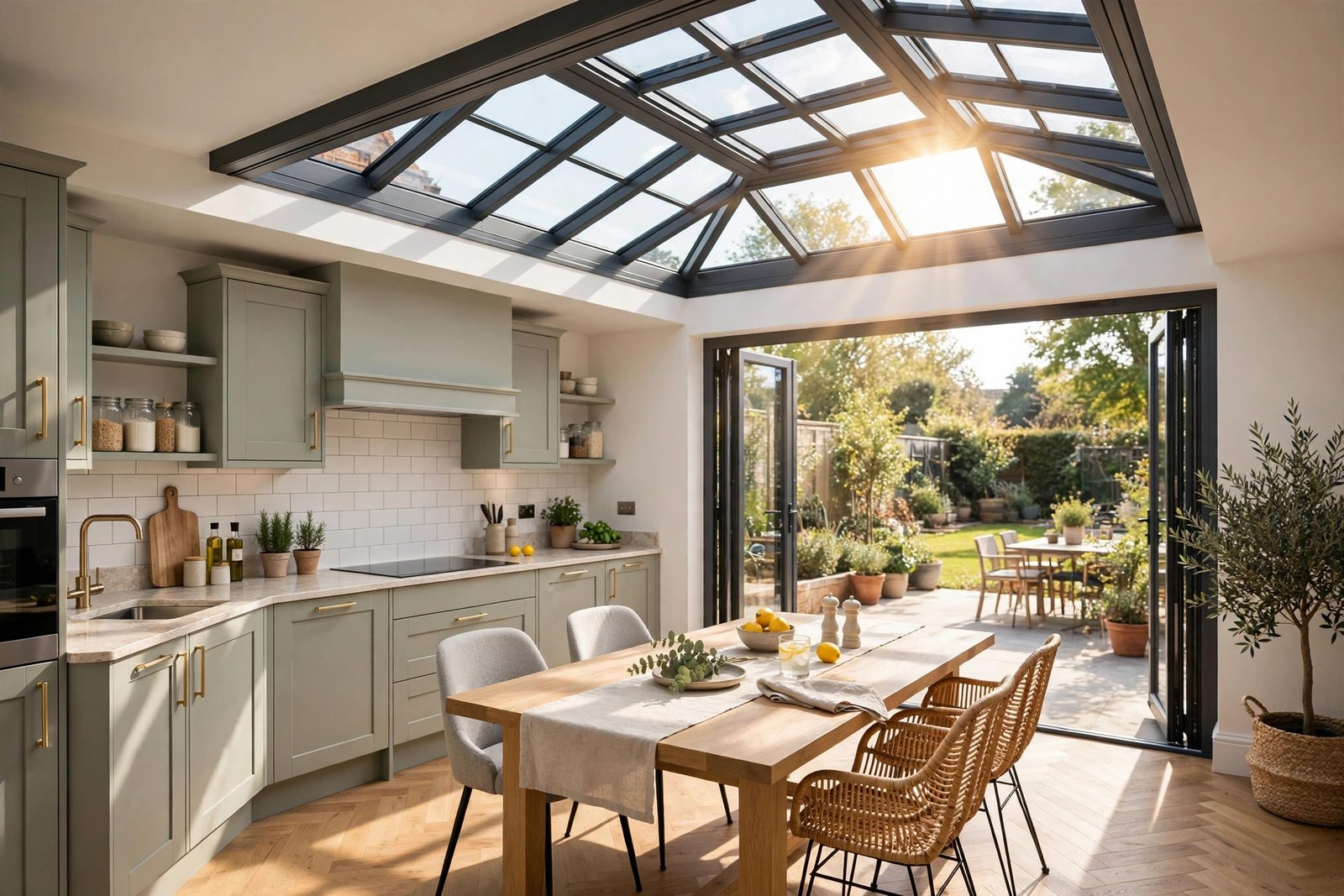
A useful rule: the lantern’s glazed area should be roughly 20 to 25 percent of the room’s floor area. For a 20m² kitchen extension, that means 4 to 5m² of lantern. Go much bigger and you risk overheating in summer; much smaller and the “wow” effect disappears. South-facing rooms need solar-control glass or blinds factored into the budget.
Overheating and Solar Gain
The question nobody asks until July. Large south-facing lanterns can turn extensions into greenhouses. Mitigate with solar-control glass (adds 10 to 15 percent), external blinds, or openable vents for stack ventilation. Discuss orientation with your supplier before ordering, not after installation.
Installation: What Is Involved
- Structural opening formed in the flat roof (may need a structural engineer’s calculations: £300 to £600)
- Upstand kerb built to the lantern manufacturer’s dimensions
- Lantern craned or lifted into place and sealed
- Internal plastering and finishing around the opening
Allow 1 to 2 days for the lantern installation itself, within a longer extension programme. Structural engineer fees and interior finishing are often excluded from “fitted” quotes: check.
Roof Lantern FAQs
How much does a roof lantern cost in the UK?
Typically £1,000 to £4,000+: £800 to £1,500 supply-only, £1,800 to £4,000+ supplied and fitted, depending on size and material.
Are roof lanterns worth it?
For extensions, yes: they transform natural light and add a strong selling point. Budget carefully for the fitted total, not just the kit price.
Do roof lanterns need planning permission?
Usually not under permitted development, provided the lantern projects no more than 150mm above the roof plane. Confirm locally for conservation areas.
Aluminium or uPVC roof lantern?
Aluminium for slim frames, large spans and longevity; uPVC for budget small openings. Named aluminium systems offer better guarantees.
Do roof lanterns make rooms too hot?
They can on south-facing elevations. Solar-control glass, blinds and openable vents manage it; discuss orientation before ordering.
How long does installation take?
The lantern itself takes 1 to 2 days; allow extra for the structural opening, engineer’s calculations and interior finishing.
What size roof lantern do I need?
Aim for glazed area around 20 to 25 percent of the room’s floor area as a starting point.
Can you open a roof lantern?
Many models offer openable vents for ventilation. Fully opening lanterns are rare; consider the ventilation strategy with your supplier.
About the Author