How Long Does Planning Permission Take? The Short Answer
Councils aim to decide householder applications within 8 weeks and major applications within 13 weeks. In practice, straightforward extensions often take 8 to 12 weeks, while complex or controversial schemes can take 4 to 6 months or more. The clock starts when the council validates your application, not when you submit it.
| Application type | Statutory target | Realistic range |
|---|---|---|
| Householder (extension, loft) | 8 weeks | 8 to 12 weeks |
| Full planning (new build, conversion) | 8 weeks (13 for major) | 10 to 16 weeks |
| Outline (with reserved matters later) | 8/13 weeks | 12 to 20 weeks |
| Prior approval / permitted development checks | 42 days / 56 days | 6 to 10 weeks |
When Does the Clock Actually Start? Validation
This is the detail that confuses everyone. The 8-week target runs from validation: the point at which the council confirms your application is complete and registers it. Submit with missing drawings, wrong fees or no design statement and validation can take weeks by itself. A complete, well-prepared submission is the single biggest lever on speed.
Timelines by Project Type
House extensions
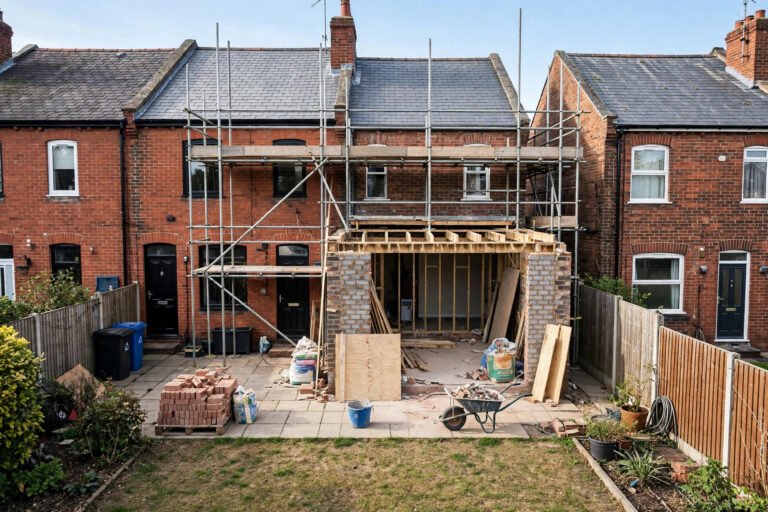
The most common application and the fastest: 8 to 12 weeks for a typical rear or side extension, assuming no objections and no conservation constraints. Objections from neighbours add a committee cycle: 4 to 8 weeks more.
Loft conversions
Similar to extensions at 8 to 12 weeks. Many lofts fall under permitted development (no application needed), but where permission is required, dormers facing highways attract the most scrutiny. See our loft conversion cost guide for the budget side.
New builds and major developments
Expect 13 to 26 weeks. Major applications involve statutory consultees (highways, environment agency, heritage), each adding time. Section 106 negotiations can extend this further.
Outline permission
Outline establishes the principle of development; reserved matters (appearance, layout, scale) follow later. Allow 3 to 5 months for outline, then a similar cycle for reserved matters.
Why Do Applications Take Longer Than 8 Weeks?
- Invalid submissions: missing documents stall validation
- Neighbour objections: trigger committee referral in many councils
- Conservation areas and listed buildings: extra consultations
- Statutory consultees missing their own deadlines
- Officer caseloads: some London boroughs run months behind target
- Requests for amendments: each redesign restarts parts of the clock
How to Speed Up Your Application
- Get pre-application advice (£100 to £500 typically): surfaces objections before you formally apply
- Submit a complete, professional package: drawings, design and access statement, correct fee
- Talk to neighbours before submitting, not after objections land
- Respond to officer queries within days, not weeks
- Consider a planning consultant for complex sites: their relationships and packaging genuinely accelerate decisions
If the Council Misses the Deadline
You have rights. If the 8/13-week target passes with no decision and no agreed extension of time, you can appeal for non-determination to the Planning Inspectorate. The planning guarantee also means councils should refund the fee if applications go undecided beyond 26 weeks without agreement. In practice, agreeing a short extension of time with the officer is often faster than appealing.
How Long Does Planning Permission Last?
Once granted, planning permission normally lasts 3 years: you must make a “material start” on the works within that period or it lapses. Outline permissions typically allow 3 years to submit reserved matters and 2 further years to start. A material start means substantive works (foundations, not just clearing the site). If permission lapses, you reapply from scratch under whatever policies then apply. Budget the project with our home renovation costs guide.
| Permission type | Validity |
|---|---|
| Full / householder | 3 years to start |
| Outline | 3 years to submit reserved matters, then 2 years to start |
| Listed building consent | 3 years (usually) |
Planning Permission FAQs
How long does planning permission take for an extension?
Typically 8 to 12 weeks from validation for a householder extension, longer if neighbours object or the property is in a conservation area.
What is the 8-week rule for planning permission?
Councils target decisions within 8 weeks of validation for householder and minor applications (13 weeks for major). It is a target, not a guarantee.
Can I start building before permission is granted?
No, not for work requiring permission. Starting early risks enforcement action. Permitted development work is different: no application needed at all.
How long does planning permission last once granted?
Usually 3 years to make a material start. Outline permissions give 3 years for reserved matters plus 2 years to start.
What happens if planning permission expires?
It lapses and you must reapply under current policies, which may have changed. Keep evidence of your material start date.
Do I need planning permission for a loft conversion?
Often not: many fall under permitted development. Dormers facing the highway or in conservation areas usually need permission.
How much does a planning application cost?
Householder applications currently cost a few hundred pounds (fees are set nationally and rise periodically); check the Planning Portal for current figures.
What is pre-application advice?
Paid informal guidance from the council before you apply (£100 to £500 typical). It flags likely objections and dramatically improves first-time approval odds.
About the Author