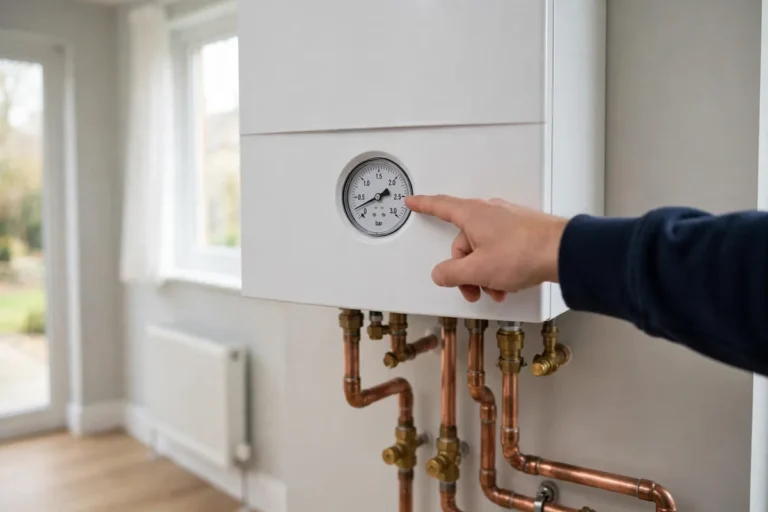

A magnetic filter is a small canister fitted to the pipework of your central heating system that catches black iron sludge before it can reach your boiler. It is one of the cheapest pieces of protection you can buy for a heating system, it is now treated as a standard part of a new boiler installation in England, and most boiler manufacturers require one as a condition of their longer warranties. Yet many homeowners have never heard of it, and many older systems still run without one.
This guide explains what a magnetic filter is, where the sludge it catches comes from, what it costs in the UK, what the British Standard and Building Regulations actually say about it, and how to tell whether your system needs one.
Short Answer: A Magnet That Catches Sludge Before It Reaches Your Boiler
A magnetic filter is a cylindrical device containing a powerful magnet, usually neodymium, fitted in line on the return pipework of a central heating system. As the water circulates back from your radiators to the boiler, it passes through the filter. The magnet pulls tiny particles of iron oxide out of the water and holds them there, so they never reach the boiler’s heat exchanger, the pump or the radiators.
The sludge it catches is called magnetite. It is a fine black iron oxide that forms when steel radiators and pipework slowly corrode from the inside. Left to circulate, magnetite settles in the bottom of radiators, clogs the narrow waterways inside a modern boiler, wears out pumps and makes the whole system work harder to heat the house. A magnetic filter removes that debris continuously and passively, every hour the heating runs, for the life of the installation.
The filter does not stop corrosion. That is the job of the inhibitor chemical dosed into the system water. The filter’s job is to catch the debris that corrosion has already produced, before it does harm.
Where the Sludge in Your Heating Comes From
Most radiators, and many of the fittings in a heating system, are made of steel. Over the years the water inside the system slowly corrodes them from the inside. The corrosion makes magnetite, a black iron oxide that looks like fine black mud. It starts as particles too small to see and builds up over years into a thick deposit.
Three things speed it up. Air getting into the system, which happens through small leaks and every time the system is drained and refilled. A system that has never been dosed with inhibitor, or whose inhibitor has broken down over time. And old radiators that have been corroding for a decade or more without a clean.
The sludge does not stay evenly spread. It settles where the water moves slowest, which is the bottom of radiators and the inside of the boiler’s heat exchanger. That is why the classic symptom of a sludged system is a radiator that is warm at the top and cold at the bottom, and why a boiler can start kettling, the banging and gurgling noise made when water boils unevenly over a scaled or sludged heat exchanger.
How a Magnetic Filter Works
The filter sits on the return pipe, usually just below the boiler, so all the water coming back from the radiators passes through it before re-entering the boiler. Inside the canister is a magnetic rod inside a plastic sleeve. As water flows past, the magnet pulls magnetite particles out of the flow and holds them against the sleeve.
Many filters also have a chamber that slows the water down, so heavier non-magnetic dirt drops to the bottom of the canister instead of circulating. Everything the filter catches stays there until an engineer cleans it out, instead of going round and round your system and through your boiler.
Fitting one is a job for a Gas Safe registered engineer. The filter is installed on pipework that carries heating water under pressure, right next to your boiler, and the system has to be drained or isolated to fit it. Do not open a filter yourself. An engineer will fit isolation valves either side of it, so it can be cleaned at the annual boiler service without draining the whole system.
A magnetic filter can be fitted to almost any wet central heating system, including combi, system and regular boilers. It is not a boiler part. It is a system part, and it protects whatever boiler it serves.
What Does a Magnetic Filter Cost in the UK?
A magnetic filter is cheap next to the boiler it protects, which is the whole point of fitting one. The published ranges below come from UK installer and manufacturer guides, and they are presented as sourced ranges, not quotes. Always get a local price, and expect the final figure to follow access and pipe size.
| Option | Sourced cost range | Source |
|---|---|---|
| Filter unit only (branded, e.g. Adey MagnaClean, Fernox, Sentinel) | £60 to £150 | Boiler Central; Clever Energy Boilers |
| Fitted on its own to an existing system | £150 to £250 | Clever Energy Boilers |
| Fitted as part of a new boiler installation | Usually included at no additional cost | Boiler Central |
The last row is the one that matters most. When a new boiler goes in, the filter is normally included in the quoted price, so there is no separate decision to make. The decision only arises on its own when you already have a boiler and no filter, and even then £150 to £250 is a small sum against a boiler repair or a replacement that sludge has shortened.
The brands most UK engineers specify are Adey, Fernox and Sentinel. Adey’s MagnaClean is the most widely specified filter in the UK heating industry and the one most often included with new boiler installations by professional engineers. Which brand you get matters less than the fact that one is fitted and cleaned every year.
For the full picture of what a new boiler costs, including the filter, see our guide to new boiler cost, which prices the whole job by boiler type.
Do You Need One? The UK Rules and Warranty Conditions
This is where a magnetic filter stops being an optional extra and becomes something close to expected. The rules work in three layers: a British Standard, the Building Regulations guidance, and the boiler manufacturer’s warranty.
BS 7593:2019 is the British Standard code of practice for treating water in domestic heating systems. It recommends that the system is cleaned and flushed, dosed with inhibitor and fitted with a permanent in-line filter. It is a code of practice, not a law, but it is the standard that good engineers work to.
Part L of the Building Regulations changed the position in England in June 2022. The official guidance that supports Part L now references BS 7593, so a filter is treated as part of a compliant new boiler installation rather than an optional extra. Boiler Plus, introduced in England in 2018, set minimum efficiency and control standards for new boilers rather than filter rules as such, so do not confuse the two. The filter requirement comes through BS 7593 and Part L, not through Boiler Plus.
Boiler warranties are the most practical reason of all. Most major boiler manufacturers, including Worcester Bosch, Viessmann, Ideal, Vaillant, Baxi and Alpha, either require a magnetic filter for their extended warranty or recommend one strongly as a warranty condition. Vaillant offers an extended 10-year warranty on some of its boilers when installed with a boiler protection kit that includes a magnetic filter. Repairs caused by sludge may not be covered at all if no filter was fitted, so check your guarantee paperwork before assuming a breakdown is covered.
If you already have an older boiler without a filter, no rule forces you to add one. But it is cheap protection, and it is worth fitting at the next service or the next time the system is drained for other work.
Signs Your System Needs One
A filter is worth fitting sooner rather than later if your system shows any of these signs:
- Radiators that are cold at the bottom but warm at the top, because sludge settles in the lowest part. Our guide to why your radiator is cold at the bottom walks through the checks in order.
- Brown or black water when radiators are bled, which is magnetite coming out with the water.
- Gurgling or kettling noises from the boiler or pipework, which point to sludge or scale inside the heat exchanger.
- Recurring pump failures, or a pump that has been replaced more than once.
- A system that takes longer and longer to heat the house, for no other obvious reason.
The longer these issues are left, the more damage sludge can do to the boiler. That damage shows up first as higher energy bills, because a sludged system has to work harder, and later as expensive repairs or a boiler that needs replacing years early.
One caution. If your system already shows these signs badly, a filter on its own will not fix it. A filter catches what is moving in the water. It will not shift sludge that has already settled in your radiators. That job needs a system clean first, and the filter then keeps the system clean afterwards.
Filter vs Power Flush: Different Jobs
A magnetic filter and a power flush are often mentioned together, and they are often confused. They do different jobs, and a healthy system usually needs both, in the right order.
A power flush removes the sludge that is already in the system. A machine pumps water and cleaning chemicals through the radiators at high velocity, lifting settled magnetite out of the bottom of radiators and the boiler, and flushing it away. It is a one-off clean, priced in our guide to power flush cost, which also explains when a power flush is the wrong fix.
A magnetic filter prevents new sludge from reaching the boiler. It works continuously, catching particles as they form, but it cannot remove a deposit that has already settled. Fitting a filter to a heavily contaminated system without cleaning it first will make the filter clog rapidly and is far less effective than combining a flush with a filter.
The right order is: clean the system first, fit the filter, dose the inhibitor, then keep the filter clean. That sequence is also what BS 7593 describes, and it is what a good engineer will recommend when a system is badly sludged.
Cleaning and Maintenance
A magnetic filter only works while it is cleaned. A full filter stops catching dirt and can slow the water down, so regular cleaning is not optional. The good news is that it is a small job, and it is normally done as part of work that is already happening.
The filter should be cleaned at every annual boiler service. The engineer isolates the filter, removes the magnet, flushes the collected sludge out of the canister and puts it back. It takes minutes, and it is usually included in the service price. Our guide to boiler service cost explains what a service includes and what it should cost.
Do not open the filter yourself to clean it. It holds heating water under pressure, right next to your boiler, and opening it without isolating the system will flood the area and can scald. Leave it to the engineer at the service.
With annual cleaning, most filters last around ten years. The magnet itself does not wear out, but the seals and the canister age, and a filter that has been in place for a decade is worth checking at the service. If the system water is still coming out black at every service, the filter is doing its job, and the inhibitor level should be checked too, because the two work together.
When a Filter Is Not the Answer
A magnetic filter is a good protector, but it is not a cure, and it is worth knowing its limits before you pay for one.
- It will not shift sludge that has already settled in your radiators. It only catches what is moving in the water. A badly sludged system needs a flush first.
- It will not remove limescale already stuck to the inside of the boiler. Limescale is a different problem, common in hard water areas, and it needs its own treatment.
- It does not replace inhibitor. The two work together. Inhibitor slows corrosion, the filter catches the debris that corrosion still produces. A system with a filter but no inhibitor will keep making sludge.
- It only works while it is cleaned. A filter that has not been cleaned in years can fill up and restrict the flow, which is worse than having no filter at all.
There is one more honest limit. If your system has already been treated with corrosion inhibitor and the water runs clear when radiators are bled, a filter is less urgent, though it is still cheap insurance. The strongest case for one is a new boiler, a system that has just been flushed, or an older system with steel radiators that shows any of the sludge signs above.
FAQs
What is a magnetic filter?
A magnetic filter is a device fitted to the return pipework of a central heating system that uses a powerful magnet to attract and capture iron oxide particles, magnetite sludge, from the circulating water before they can accumulate in the boiler, pump or radiators. It is fitted in line on the return pipe, usually just below the boiler.
Do I need a magnetic filter on my boiler?
For a new boiler installation in England, yes, an in-line filter is now treated as a standard part of the job. BS 7593:2019 recommends a permanent in-line filter, and the Part L guidance updated in June 2022 references that standard. Most manufacturers also require one for their extended warranty. On an older boiler there is no rule forcing you to add one, but it is cheap protection, especially if you see black water when bleeding radiators or cold spots at the bottom of them.
How much does a magnetic filter cost in the UK?
A branded filter unit costs £60 to £150 to buy, according to Boiler Central and Clever Energy Boilers. Having one fitted on its own to an existing system usually comes to £150 to £250. Fitted as part of a new boiler installation, it is normally included at no additional cost.
How often should a magnetic filter be cleaned?
Every year, at the same time as the boiler service. The engineer isolates the filter, removes the collected sludge and puts it back, which takes minutes and is usually included in the service price. A filter that is never cleaned fills up, stops catching dirt and can slow the water down.
Will a magnetic filter fix cold radiators?
Not on its own. Cold radiators at the bottom are usually caused by sludge that has already settled, and a filter only catches particles that are still moving in the water. A sludged system usually needs a power flush first, and the filter then keeps it clean afterwards. See our guide to power flush cost for the prices and the signs that a flush is actually needed.
Does a magnetic filter replace inhibitor?
No. Inhibitor is a chemical dosed into the system water that slows corrosion in the first place. The filter catches the debris that corrosion still produces. The two work together, and BS 7593:2019 recommends both: a cleaned system, dosed with inhibitor, fitted with a permanent in-line filter.
Can a magnetic filter be fitted to any boiler?
It can be fitted to almost any wet central heating system, including combi, system and regular boilers. It must be fitted by a Gas Safe registered engineer, because it is installed on pressurised pipework next to the boiler. If there is not enough space on the return pipe, the engineer will advise on the best position.
About the Author