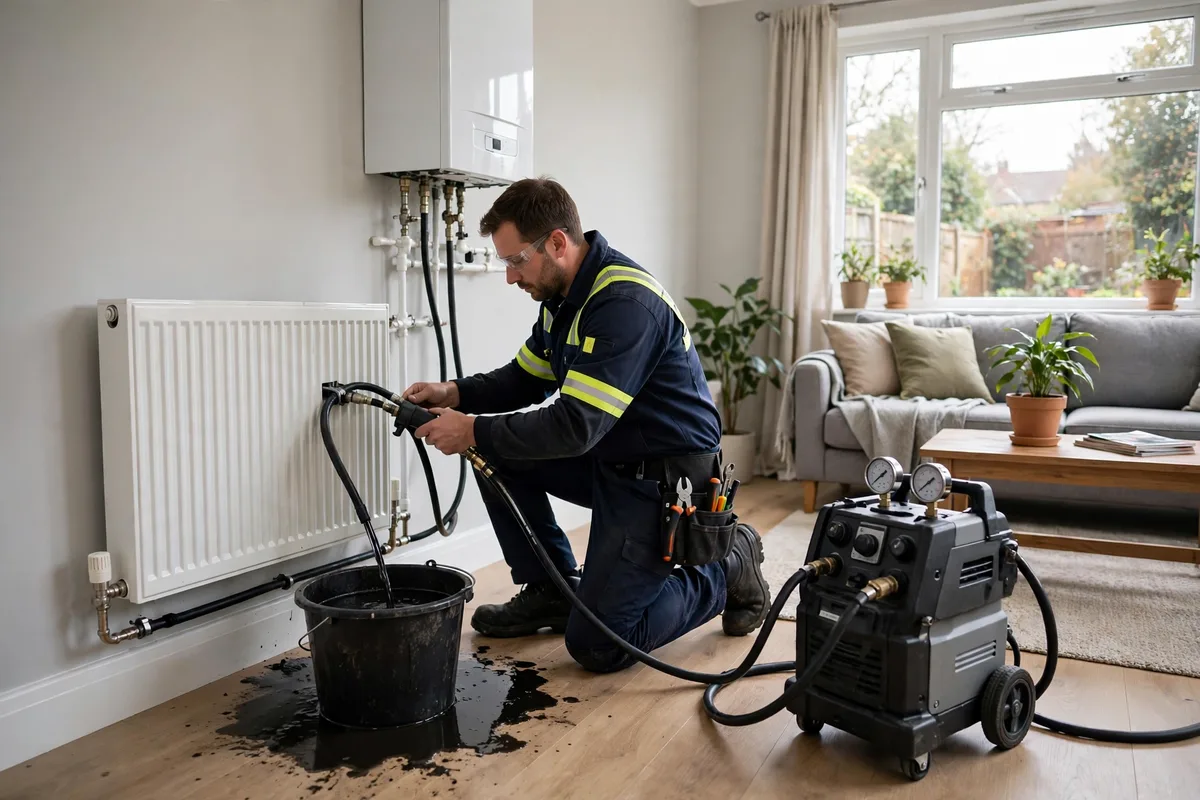
A power flush is a deep clean of the water side of your central heating system, and the honest answer to how long it takes is that it depends on how many radiators you have, how dirty the water is, and what kind of system you have. For a typical three bedroom home the job takes most of a working day. A small flat can be done in half a day. A large house with badly sludged radiators can run to two days.
This guide gives you the times by radiator count, explains why a vented system takes longer than a combi system, why underfloor heating takes longer still, and lists the things that push a one day job into a second visit, so you can judge a quote and plan your day.
Short Answer: Time by Radiator Count
The number of radiators is the main thing that decides the time, because the engineer flushes each radiator individually. The ranges below are drawn from the published UK sources listed at the end of this article, and they agree with each other closely enough to use as a planning guide.
| Radiators | Typical home | Typical time |
|---|---|---|
| Up to 6 | 1-2 bedroom flat or small house | 3-5 hours, about half a day |
| 7-10 | 2-3 bedroom house | 4-6 hours, most of a working day |
| 11-15 | 3-4 bedroom house | 6-8 hours, a full day |
| 16 or more | Large house | A full day to two days |
British Gas puts a typical powerflush at around eight hours. Worcester Bosch, quoted by Hughes Heating, gives six to ten hours for a thorough flush. JF Plumbing and Heating gives four to six hours for a three bedroom home with eight to ten radiators, and a full day for larger or heavily contaminated systems. Checkatrade’s cost guide, updated in June 2026, lists one day for homes up to ten radiators and one to two days for a four bedroom house with fifteen radiators. MyJobQuote, quoted by Hinckley Plumbing, puts most jobs at three to nine hours depending on the number of radiators.
These are guide times, not quotes. Two homes with the same number of radiators can take very different times if one system is mildly dirty and the other has sludge that has been building up for fifteen years. The next sections explain the differences that matter.
For what the job costs at each radiator count, see our guide to power flush cost, which prices the same bands.
Vented vs Sealed and Combi: Which Takes Longer
The type of system you have changes the time by an hour or two, and it is the difference most guides skip.
A vented system, the older type with a feed and expansion tank in the loft and usually a regular boiler with a hot water cylinder, takes longer. YourRepair puts a three bedroom vented system at around five to six hours. The engineer has to cap off the expansion pipe and the cold feed before the machine can be connected, and those are extra steps a sealed system does not need.
A sealed system, which includes most combi boilers and system boilers, is quicker. The same three bedroom home on a sealed or combi system takes around four to five hours, according to YourRepair, because there is no feed and expansion tank to isolate. The system is already pressurised and closed, so the machine connects and the work starts sooner.
That does not mean a combi system is always faster in practice. A combi boiler has a narrow heat exchanger that is very sensitive to dirty water, so an engineer may spend longer flushing individual radiators on a combi system to make sure the water runs clear before reconnecting the boiler. The system type sets the starting point. The condition of the water decides the finish.
If you are not sure which type you have, look in the loft. A small tank with a ball valve is the sign of a vented system. No tank, and a pressure gauge on the boiler, means sealed.
Underfloor Heating Takes Longer Still
Underfloor heating can be power flushed, but the job is different and slower than flushing radiators. The pipes are thinner and much longer than radiator circuits, and too much pressure can damage them, so each loop has to be flushed individually rather than the whole system being done at once. It needs an engineer who knows underfloor systems, not just radiators.
YourRepair puts a full flush of underfloor heating throughout a three to four bedroom home at six to ten hours. That is longer than the same size home with radiators, and it is before any radiator circuits in the same house are counted. A mixed system, radiators downstairs and underfloor heating upstairs, for example, takes the radiator time plus the underfloor time.
Underfloor heating is also harder to judge by eye. There are no radiators to feel for cold spots, so the engineer relies on flow rates and water samples to tell whether each loop is clean. If you have underfloor heating, ask specifically whether the quote covers flushing each loop separately, because a quote that treats it like a radiator system is not quoting the same job.
What Happens Hour by Hour on the Day
Knowing the shape of the day helps you tell a proper job from a rushed one. A real power flush follows the same sequence on most systems, and each step takes real time.
First hour: set up and test. The engineer connects the flushing machine to the system, usually at the pump or at a radiator valve, adds cleaning chemicals, and takes a water sample. The sample shows how dirty the water is and sets the plan for the day. If the water is black and thick, the engineer knows it will be a long job before a single radiator is flushed.
Next hours: radiator by radiator. Each radiator is flushed individually. The machine drives water and cleaning chemicals through it at high flow but low pressure, first in one direction and then reversed, until the water coming out runs clear. A radiator with heavy sludge takes longer than a clean one, and the engineer will often tap or vibrate a stubborn radiator to loosen deposits. This is the bulk of the day, and it is why radiator count decides the time.
Then: system flush, neutraliser and refill. Once every radiator is clean, the whole system is flushed through, the cleaning chemical is neutralised if the product used requires it, and the system is drained and refilled with clean water.
Last hour: inhibitor, balancing and testing. Inhibitor is added to the clean water to slow future corrosion, the radiators are bled, the system is balanced so each radiator gets its fair share of flow, and the boiler pressure is set. A magnetic filter, if one is fitted, is cleaned at the same visit. Our guide to what a magnetic filter is explains what it does and why it matters after a flush.
If an engineer promises a full power flush in an hour, that is not a power flush. That is a drain down, and it will not shift sludge that has settled in the bottom of your radiators.
What Makes a Flush Take Longer
Five things stretch the job, and four of them are visible before the engineer starts.
Heavy sludge. The biggest factor. A system that has never been cleaned, or that has run for years without inhibitor, has deposits that need several flush cycles per radiator instead of one. JF Plumbing and Heating notes that a very badly sludged system may need a two day treatment rather than a single long day.
Microbore pipework. The narrow 8mm or 10mm copper pipe common in UK homes built between the 1960s and 1980s clogs more easily and flushes more slowly than standard 15mm pipe. It also limits how hard the machine can push water through, so each radiator takes longer.
Radiators that will not clear. Some radiators are so badly blocked that flushing alone will not clear them. The engineer may need to take a radiator off the wall and flush it outside, or advise replacing it. Each radiator removed adds time, and a replacement adds a parts delay.
Poor access. Radiators boxed in behind furniture, a boiler in a tight cupboard, or a system with no convenient connection point all slow the set up. Clearing access before the engineer arrives is the easiest way to keep the job on schedule.
Extra work found on the day. A leaking valve, a seized thermostatic radiator valve, or a pump that is failing will be found during the flush. Fixing them is sensible while the system is drained, but it adds time and cost that was not in the original quote.
When the Job Stretches to a Second Day
A second day is not a sign that something has gone wrong. It usually means one of three things.
First, size. A house with fifteen or more radiators is a one to two day job in Checkatrade’s guide, and a very large system with several zones can need two full days even when the water is not especially dirty.
Second, contamination. A system with heavy sludge may need the cleaning chemicals left to circulate overnight, or a second pass the next day after the first flush has loosened deposits that the first pass could not shift.
Third, parts. If a radiator needs replacing, or a valve or pump fails during the work, the engineer may need to order a part and return. That is a second visit, not a second day of flushing, but it still means the heating is off for longer.
Ask before the work starts what happens if the job overruns. A good engineer will tell you whether a second day is charged as extra labour or included in a fixed price, and whether you will have heating overnight. Get that answer in the quote, not on the day.
Power Flush vs Chemical Flush: Time Compared
A chemical flush, sometimes called a chemical cleanse, is the gentler alternative, and it takes less engineer time on the day. Cleaning chemicals are added to the system water and left to circulate, usually for days, before the system is drained and refilled with clean water and inhibitor. The engineer is on site for a shorter visit, but the process takes longer overall because the chemicals do the work while the heating runs normally.
A power flush is the stronger clean. It takes most of a day for a normal home and up to two days for a large one, but the work is finished in one visit. It suits a system with heavy sludge, cold bottoms on several radiators, and dark water throughout. That is why it is the standard recommendation when a new boiler is being fitted to an old system.
The time difference matters when you are choosing between them. If you need the heating back the same day and the system is only mildly dirty, a chemical flush may be enough. If several radiators are cold at the bottom, a chemical flush alone is unlikely to clear them. Our guide to why your radiator is cold at the bottom walks through the checks that tell you which situation you are in.
How to Prepare So the Job Finishes on Time
A little preparation on your side can save an hour or more on the day.
- Clear access to every radiator, the boiler, and the pump. Move furniture and anything stored in front of radiators the night before.
- Make sure the engineer can get to the outside drain and has somewhere to run a hose.
- Tell the engineer in advance about any radiators that never heat up, any that have been replaced recently, and whether the system has microbore pipework if you know.
- Expect the heating to be off all day. Plan for a cold house, and if the job may run to a second day, ask whether you will have heating overnight.
- Ask what the quote includes: the flush itself, inhibitor, cleaning an existing magnetic filter, and balancing. Quotes that differ by £150 often differ only on these lines.
- Book the annual boiler service for the same period if it is due soon, since the filter clean and the inhibitor check overlap with the flush. Our guide to boiler service cost explains what a service includes.
FAQs
How long does a power flush take for a 3 bedroom house?
For a three bedroom house with eight to ten radiators, expect four to six hours, or most of a working day. A vented system takes around five to six hours, a sealed or combi system around four to five hours, according to YourRepair. If the system is heavily sludged, allow a full day.
How long does a power flush take for a flat?
A one or two bedroom flat with up to six radiators usually takes three to five hours, about half a day. Checkatrade lists one day for a two bedroom flat, which allows for set up, flushing, refilling and balancing.
Can a power flush be done in a day?
Yes, for most homes. Systems up to about ten radiators are normally finished in one day. Larger systems with fifteen or more radiators, very badly sludged systems, and homes with underfloor heating throughout may need one to two days.
Does a power flush take longer on a vented system?
Yes, usually by about an hour. A vented system has a feed and expansion tank in the loft, and the engineer has to cap off the expansion pipe and the cold feed before the machine can be connected. A sealed system, including most combi boilers, does not need those steps.
How long does a power flush take on underfloor heating?
For underfloor heating throughout a three to four bedroom home, expect six to ten hours, according to YourRepair. Each loop is flushed individually at low pressure, which takes longer than flushing radiators, and a mixed system takes the radiator time plus the underfloor time.
Will I have heating on the day of a power flush?
No. The heating is off for the whole job, and the house will cool down. Plan for that, and if the job may run to a second day, ask the engineer before work starts whether you will have heating overnight.
What if the engineer says the flush will only take an hour?
Be cautious. A full power flush of a normal home takes most of a day. A one hour job is a drain down, not a power flush, and it will not remove sludge that has settled in the bottom of your radiators. Ask what the price covers, radiator by radiator flushing included, before agreeing.
About the Author