Quick Answer: What Floor Insulation Costs in the UK
Floor insulation in the UK costs roughly £1,000 to £6,000 for a typical house, and the reason the range is that wide is that ‘floor insulation’ covers three different jobs. Insulating a suspended timber floor from below costs £60 to £90 per square metre. Lifting the floorboards and insulating from above costs £70 to £110 per square metre. Insulating a solid concrete floor with rigid board costs £80 to £120 per square metre. A typical three-bedroom ground floor works out at £2,500 to £6,000, according to a London installer pricing from its own quote book in 2026, with a median quote of £4,320 across 59 priced jobs.
| Floor type | Route | Typical cost per m2 | Typical whole ground floor |
|---|---|---|---|
| Suspended timber | Insulated from below, through the void | £60 to £90 | £2,500 to £4,500 |
| Suspended timber | Boards lifted, insulated from above | £70 to £110 | £3,000 to £5,500 |
| Solid concrete | Rigid board, floating floor | Around £80 | £2,500 to £4,500 |
| Solid concrete | Rigid board with new screed | Around £90 | £3,000 to £6,000 |
The figures in this guide come from 2026 cost guides published by the Energy Saving Trust, Uswitch, MyJobQuote, PriceYourJob and Stay Warm Insulation, cross-checked against each other. They are not our own survey, and they disagree with each other in places. The Energy Saving Trust puts a typical job at £1,000 to £2,500, while a London installer pricing from its own quotes puts a three-bedroom ground floor at £2,500 to £6,000. Both can be right at the same time: the lower figure is a smaller house, a simpler route and work outside London, while the higher figure is a larger floor area, a harder route and London and South East labour rates. This guide separates the routes, so you can see which figure applies to your floor, and why the cheapest headline number on a cost site is rarely the price of a whole house.
One thing to settle first: what kind of floor you have. Most houses built before the 1970s have suspended timber ground floors, floorboards on joists with a ventilated void underneath. Most houses built after that have solid concrete ground floors. If you can lift a corner of carpet and see floorboards, or if you can get under the floor through a hatch and see joists and a gap below them, you have a suspended floor. If the ground floor is concrete with no void, you have a solid floor. The two need completely different work, and the price difference between them is the first thing a quote should explain.
Suspended Timber Floors: Insulating From Below
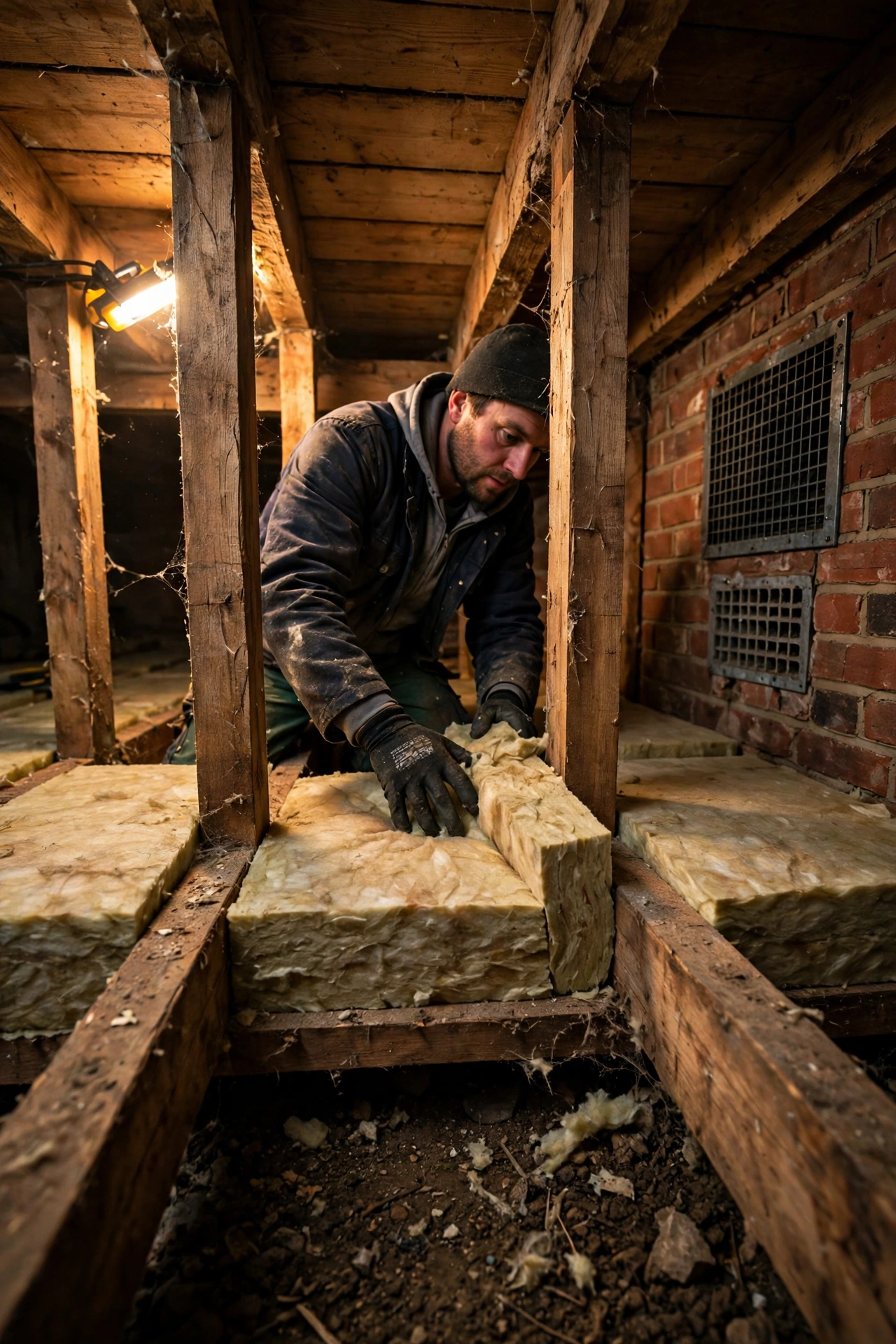
Insulating a suspended timber floor from below is the cheapest route, and it is the one to choose whenever the void underneath is deep enough to work in. The installer gets into the void, usually through a hatch or by lifting a small section of boards, and fits insulation between the joists, held in place with netting or battens, or sprays insulation onto the underside of the boards. Nothing in the room above is disturbed, so there is no need to move furniture out, lift carpets or refit skirting boards.
The price is £60 to £90 per square metre, from Stay Warm Insulation’s 2026 guide, which prices from its own quote book. Uswitch, citing Checkatrade, puts the same route at around £105 per square metre, which shows how much the figure moves with region and with what the quote includes. The lower end of the range is a straightforward void with good access and mineral wool batts fitted between the joists. The higher end is a tight void, sprayed insulation, or a job where the installer has to create access first. London and the South East sit at the top of the range, and a day rate of £150 to £200 for the installer, from MyJobQuote, explains part of that gap.
Before any insulation goes in, the void has to be checked. This is the step the cheapest quotes skip, and it is the one that matters most on a suspended timber floor. The void needs ventilation, through air bricks in the walls, so that moisture can escape and the joists do not rot. If the insulation blocks the air bricks, or if the void is damp and the joists are already showing signs of rot, insulating over the problem makes it worse, not better. A proper installer checks the air bricks, checks the joists for damp and woodworm, and makes sure the insulation does not bridge the ventilation gap. If a quote does not mention ventilation at all, it is not a complete quote.
The other check is pipes and cables. The void under a suspended floor often carries central heating pipes, water pipes and electrical cables. Insulation fitted tightly around a hot central heating pipe is fine, but insulation packed around a cold water pipe in a draughty void can leave the pipe colder than it was, and in a cold snap that is how pipes freeze. A good installer leaves the pipes on the warm side of the insulation where possible, or lags them separately. Ask the installer how they will deal with the pipes and cables in the void before you accept the price.
From below is also the least disruptive route in terms of time. A typical ground floor takes one to two days, and the house stays usable throughout, because all the work happens underneath. The disruption is noise and dust from below, and the need for the installer to get in and out through the hatch. If the void is too shallow to work in, usually less than about 400mm of clear space, this route is not possible, and the boards have to come up instead.
Suspended Timber Floors: Lifting the Boards and Insulating From Above
When the void is too shallow to work in, or when the floor is being replaced anyway as part of a renovation, the boards come up and the insulation is fitted from above. The floorboards are lifted, insulation is fitted between the joists, a vapour control layer is laid over the top, and the boards go back down, or new boards go down if the old ones are not worth saving. This route costs £70 to £110 per square metre, more than working from below, because lifting boards, refitting them and making good takes longer.
The higher price buys two things. First, the installer can see the joists properly, check every one for rot and woodworm, and replace any that are damaged. On an old floor that has never been looked at, that inspection alone is worth having. Second, the insulation can be fitted more neatly, with a continuous vapour control layer over the joists, which is harder to achieve from below. The result is a better seal against draughts, which is half the point of floor insulation in the first place, because a suspended timber floor loses heat through gaps and draughts as well as through the boards themselves.
The disruption is the trade-off. The room has to be emptied, the carpets and underlay come up, the boards come up, and the room is out of use for the duration of the job, usually two to four days for a ground floor. If the floor is being insulated as part of a wider renovation, when the room is already empty and the boards are already up, this route is the obvious choice, and the extra cost over the from-below route is small, because the lifting and refitting is happening anyway. If the room is furnished and in daily use, the disruption alone is a reason to prefer the from-below route, or to wait until the room is being redecorated.
One practical point about lifting boards: old floorboards break. Tongue and groove boards that have been down for decades often split when they are lifted, and some will need replacing. A quote should say whether replacement boards are included, and what happens if more boards break than expected. It should also say whether the quote includes refitting the skirting boards, which have to come off to lift the boards at the edges, and whether the floor will be sanded or finished afterwards. Those finishing items are where a low quote grows, so get them in writing before the work starts.
Solid Floors: Rigid Board, Screed and the Raised-Floor Problem
A solid concrete floor cannot be insulated from below, because there is no void. The insulation goes on top of the concrete, under the floor finish, which means the floor level rises. That is the central fact of solid floor insulation, and it is what makes it more disruptive and often more expensive than it first looks. Rigid insulation board, usually PIR board, is laid on the concrete, a damp-proof membrane and a vapour control layer go over it, and then either a new screed is poured on top, or a floating floor of chipboard is laid directly on the board.
The two finishes are priced differently. Uswitch, citing Checkatrade, puts a floating floor at around £80 per square metre and a screeded floor at around £90 per square metre. Stay Warm Insulation puts rigid board on a solid floor at £80 to £120 per square metre, with the higher end covering thicker board, a new screed and the making good that goes with it. The board itself is only part of the cost: PIR board runs £7 to £20 per square metre, polystyrene £5 to £15, and the rest is labour, screed, membranes and finishing.
The raised floor level is the problem to plan around. Board plus screed adds 70mm to 100mm to the floor height, and board plus a floating floor adds 50mm to 70mm. That means doors have to be trimmed or rehung, skirting boards have to be refitted higher, and the step at the front door and at the threshold to any uninsulated room changes. In a kitchen, the worktop height stays the same while the floor rises, which changes the working height by the thickness of the insulation. None of this is a reason not to insulate a solid floor, but all of it should be in the quote, because it is real work that a bare per-square-metre figure does not include.
Building Regulations set the standard the finished floor has to meet. For a ground floor, the target U-value is 0.13 to 0.18 W/m2K, and reaching it typically takes around 70mm of foam board or 150mm of mineral wool, according to UK Calculator’s guide. A Building Control application is not always needed for floor insulation on its own, but if the work is part of a larger renovation, or if it changes the floor level at a fire escape route, check with the local council first. The installer should be able to say whether the job needs to be notified, and if they cannot, that is a reason to choose a different installer.
Solid floor insulation is at its cheapest when it is done as part of a job that is already lifting the floor finish. If the kitchen is being refitted, or the ground floor is being re-screeded, the insulation board goes down while the floor is already open, and the extra cost is mostly the board itself. Done on its own, in a finished room, the same job also means lifting the existing floor finish, disposing of it, and refitting it, which is why the per-square-metre figure on a cost site and the price on a real quote can be so far apart.
What the Materials Cost per Square Metre
The material is a small part of the total price, but it is the part that varies most, and knowing the figures helps you read a quote. MyJobQuote’s 2026 guide gives these material prices per square metre: glass mineral wool £4 to £5, mineral wool slabs £6 to £8, sheep wool £18 to £25, PIR board £7 to £20, polystyrene £5 to £15, and spray-on insulation £35 to £70.
Mineral wool is the cheapest and the most common choice for a suspended timber floor, because it is easy to cut between joists and it also helps with sound. PIR board is the most common choice for a solid floor, because it gives the most insulation for the least thickness, which matters when every millimetre raises the floor level. Sheep wool costs several times more than mineral wool, and installers who recommend it usually do so because it handles moisture well in an old house, not because it insulates better. Spray-on insulation is the dearest per square metre, and it is usually chosen for awkward voids where batts cannot be fitted neatly, rather than as the default option.
The material price is not the job price. Labour, access, membranes, fixings, waste disposal and making good are usually more than half of what you pay, which is why a job priced at £60 per square metre can use materials that cost £5 per square metre and still be fairly priced. What matters is whether the quote breaks the price down, so you can see what the labour and the materials each cost, and whether the quote includes VAT. Most floor insulation work is charged at the standard rate of 20 percent, unless it qualifies for the 0 percent VAT rate on energy-saving materials, which is covered in the grants section below.
A word on DIY. Insulating a suspended timber floor is one of the more realistic DIY insulation jobs, because the materials are cheap and the work is straightforward if the void is accessible. PriceYourJob puts a DIY job at around £100 for the boards plus around £20 of gap-filling materials for a small area. But DIY only makes sense if the void can be reached safely, the ventilation check has been done, and the pipes and cables in the void have been dealt with. If the void is shallow, damp or full of services, or if the floor is solid and needs a screed, it is a job for a professional, and the saving from doing it yourself is not worth the risk of blocking ventilation or trapping damp against the joists.
What a Whole House Costs, by House Type
Per-square-metre figures are useful for comparing quotes, but most people want to know what the whole job costs for a house like theirs. PriceYourJob’s 2026 guide gives these whole-house figures: a small flat £500 to £750, a terraced house £800 to £1,150, a semi-detached house £1,200 to £3,000, and a detached house £1,600 to £4,700. The Energy Saving Trust’s figure of £1,000 to £2,500 sits in the middle of that range, and it is a fair guide for a smaller house outside London with a straightforward suspended floor.
The London installer’s figures are higher, and the difference is worth understanding rather than dismissing. Stay Warm Insulation, pricing from 59 jobs in London and the South East, puts a typical three-bedroom ground floor at £2,500 to £6,000, with the middle half of its quotes falling between £2,927 and £6,705. That is a bigger house, a harder route and London labour rates, and it is the figure to budget for if you live in London or the South East, or if your floor needs the boards lifted rather than insulated from below.
The honest way to use these figures is to treat the lower end as the price for a small house, a simple route and work outside the South East, and the higher end as the price for a larger house, a harder route and London rates. If a quote for a three-bedroom semi in the Midlands comes in at £5,000, it is worth asking why, and if a quote for a detached house in London comes in at £1,000, it is worth asking what has been left out. The cheapest headline figure on a cost site, such as MyJobQuote’s average of around £800, is a platform average across jobs of all sizes, including small and partial jobs, and it should not be read as the price of insulating a whole ground floor.
What drives the total more than anything else is floor area, and that is easy to estimate yourself. Measure the ground floor rooms that will be insulated, multiply length by width for each room, and add the rooms together. A three-bedroom semi typically has 40 to 50 square metres of ground floor, a detached house 60 to 80 square metres, and a small flat 30 to 40 square metres. Multiply your floor area by the per-square-metre figure for your route, and you have a rough budget to compare against quotes. If a quote is far above or far below that rough figure, ask the installer to explain the difference before you accept it.
How Much Money Floor Insulation Actually Saves
Floor insulation saves less money than loft or wall insulation, and it is better to know that before the work starts than to discover it afterwards. The Energy Saving Trust, cited by UK Energy Guide, puts the saving at up to £115 a year for a semi-detached house. Uswitch puts it lower, at £55 to £70 a year for a semi. The difference is the house, the floor type and the energy tariff, but the honest range is tens of pounds a year, not hundreds.
That means the payback period is long. At £2,500 for a job that saves £115 a year, the simple payback is over twenty years. At £1,000 for a job that saves £55 a year, it is around eighteen years. Nobody should insulate a floor purely to save money on bills, because the numbers do not support it on their own. The case for floor insulation is comfort and draughts, not payback.
What floor insulation does well is make a ground floor feel warmer underfoot and cut the draughts that come up through gaps in the floorboards. In a house with a suspended timber floor, the draught from below can be the most noticeable cold in the room, and sealing the floor makes the room feel warmer at the same thermostat setting, which can mean the heating runs less. That comfort effect is real, and it is the reason most people who have it done are glad they did, but it is not the same as a measured saving on the energy bill, and it should not be sold as one.
The savings figure also assumes the insulation is fitted well, with the gaps sealed and the ventilation kept clear. Insulation with gaps in it, or insulation that blocks the air bricks and causes damp, saves less and can cost more in repairs than it ever saves on bills. A cheap job that is badly fitted is worse than no job at all, which is another reason to choose an installer on the quality of the ventilation check and the detailing, not only on price.
When Floor Insulation Is NOT the Best Next Measure
Floor insulation is worth doing, but it is rarely the first insulation job a house needs, and it is worth saying so plainly. If the loft has no insulation, or the cavity walls are empty, those jobs save more money, cost less per pound saved, and should come first. Our loft insulation complete guide covers the cheapest and most effective insulation job in most houses, and our external wall insulation cost UK guide and internal wall insulation cost UK guide cover the wall options, which are the next step after the loft.
Floor insulation earns its place when the loft and the walls are already done, or when the floor is being worked on anyway as part of a renovation. If the boards are already up, or the kitchen is already being refitted, the extra cost of insulating the floor is small, and the disruption is already happening. That is the best time to do it. It also earns its place in a house where the ground floor is noticeably cold and draughty, even if the bills saving is modest, because comfort is a legitimate reason to spend money on a home.
There are two cases where floor insulation should wait. The first is a damp floor. If the void under a suspended floor is damp, or the joists show signs of rot, the damp has to be fixed first, and insulating over it will trap the moisture and make the rot worse. The second is a house where the heating system itself is the problem, such as a boiler that cannot keep up, or radiators that are undersized. In that case, the money is better spent on the heating system first, and the floor can be insulated afterwards. If you are considering underfloor heating cost UK, note that underfloor heating and floor insulation work together, because heating a floor that is not insulated wastes heat into the ground, but the insulation should be planned as part of the same job, not added as an afterthought.
Grants, VAT and the Rules
The grant position for floor insulation changed in 2026, and the guides that still mention the old scheme are out of date. The Great British Insulation Scheme closed on 31 March 2026. Its successor is the Warm Homes Plan, which works through the local council rather than through a national application, so the route to funding is to contact the council and ask what is available in your area. ECO4, the energy company obligation scheme, runs until 31 December 2026, and it can fund insulation, including floor insulation, for households that meet its eligibility rules. Our Great British Insulation Scheme vs ECO4 guide sets out the eligibility of both schemes side by side, and it is the right place to start before assuming a grant will cover the work.
Two practical points about grants. First, most grants are for households on certain benefits or with a low income, and a straightforward owner-occupier with no qualifying benefits will usually have to pay for floor insulation themselves. Second, grant-funded work has to be done by an approved installer under the scheme, and the installer arranges the funding, so do not pay for the work first and expect to claim it back. If an installer offers a grant and asks for payment up front, check the scheme rules before paying anything.
VAT is more straightforward. Energy-saving insulation, including floor insulation, is charged at 0 percent VAT until 31 March 2027, and the rate is expected to revert to 5 percent after that date. That means a quote given now should show the VAT position clearly, and a quote that charges 20 percent on the insulation itself is worth questioning. The 0 percent rate applies to the insulation materials and the work to install them, not to unrelated work done at the same time, such as refitting a kitchen, so a quote for a combined job should separate the two.
Building Regulations apply to the finished standard of the floor, as set out in the solid floor section above, with a target U-value of 0.13 to 0.18 W/m2K for a ground floor. Floor insulation on its own does not usually need planning permission, and it does not usually need a Building Control application, but if it is part of a larger renovation, or if it changes a floor level at a fire escape route, or if the house is listed or in a conservation area, check with the local council first. Listed buildings and conservation areas can restrict what can be done to the floor, particularly where the floorboards themselves are part of the historic fabric.
Choosing an Installer and What to Ask
Floor insulation is a small job, and most installers are small firms, so the usual checks matter more than the brand name. Ask for a quote that breaks the price into labour, materials and VAT, and that says which route is being priced, from below or from above, and what is included in the way of making good, skirting boards, door trimming and waste disposal. Ask whether the quote includes the ventilation check, and what the installer will do if they find damp or rot in the void. Ask what thickness and type of insulation is being used, and whether it meets the Building Regulations U-value for a ground floor. Ask whether the work is guaranteed, and for how long, and what the guarantee covers.
Check that the installer has experience with your floor type. An installer who mostly does loft insulation may not have worked in a floor void before, and the detailing around air bricks, pipes and joists is where the job is won or lost. For grant-funded work, the installer must be approved under the scheme, and for work under ECO4 or the Warm Homes Plan, that approval is a condition of the funding, not an optional extra. TrustMark and PAS 2030 accreditation are worth looking for on grant-funded work, and they are a useful check on any job, because they mean the installer has been assessed against a standard.
Get at least two quotes, and compare them line by line rather than by the headline total. A quote that is much cheaper than the others has usually left something out, and the missing item is usually the ventilation check, the making good, or the VAT. A quote that is much dearer should be able to explain why, whether it is a harder route, a thicker board, or London labour rates. The right installer is the one who can explain the route, the ventilation, and the price, in plain English, before the work starts.
Frequently Asked Questions
How much does floor insulation cost in the UK?
A typical house costs £1,000 to £6,000, depending on the floor type, the route and the region. A suspended timber floor costs £60 to £90 per square metre from below and £70 to £110 per square metre with the boards lifted. A solid floor costs £80 to £120 per square metre with rigid board. A typical three-bedroom ground floor costs £2,500 to £6,000, according to a London installer pricing from its own quote book in 2026.
Is floor insulation worth it?
For comfort and draughts, yes. For bill savings alone, the case is weaker. The Energy Saving Trust puts the saving at up to £115 a year for a semi-detached house, and Uswitch puts it at £55 to £70 a year. That means a payback period of around eighteen to twenty years or more. Insulate the loft and the walls first, and insulate the floor when it is being worked on anyway, or when the ground floor is cold and draughty.
Can I insulate a suspended timber floor myself?
It is one of the more realistic DIY insulation jobs, if the void is accessible, the ventilation has been checked and the pipes and cables have been dealt with. PriceYourJob puts a small DIY job at around £100 for boards plus around £20 of gap-filling materials. If the void is shallow, damp or full of services, or if the floor is solid, use a professional. Never block the air bricks, and never insulate over damp joists.
Do I need planning permission for floor insulation?
No, not usually, for floor insulation on its own. Building Regulations apply to the finished standard of the floor, with a target U-value of 0.13 to 0.18 W/m2K for a ground floor. Check with the local council if the work is part of a larger renovation, if it changes a floor level at a fire escape route, or if the house is listed or in a conservation area.
Can I get a grant for floor insulation?
Possibly. The Great British Insulation Scheme closed on 31 March 2026 and its successor, the Warm Homes Plan, works through the local council. ECO4 runs until 31 December 2026 and can fund insulation for eligible households. Most grants are for households on certain benefits or with a low income, and the work must be done by an approved installer under the scheme.
How long does floor insulation take?
A suspended floor insulated from below takes one to two days, and the house stays usable. Lifting the boards and insulating from above takes two to four days, and the room is out of use. A solid floor with rigid board and screed takes longer, because the screed needs time to dry before the floor finish goes down.
Will floor insulation stop draughts?
It helps a lot, if it is fitted well. A suspended timber floor loses heat through gaps between the boards as well as through the boards themselves, so the insulation has to be fitted tightly and the gaps sealed. Insulation with gaps in it, or insulation fitted over blocked air bricks, will not do the job properly and can cause damp.
Does floor insulation work with underfloor heating?
Yes, and the two should be planned together. Heating a floor that is not insulated wastes heat into the ground, so the insulation goes down first and the heating goes on top of it. Our underfloor heating cost guide prices the heating side of the job.
About the Author