Short Answer: Yes, You Can Sell. But the Mortgage Is the Problem, Not the Law
Yes, you can sell a house with spray foam insulation in the UK. Spray foam is not banned, and there is no law that says you must remove it before you sell. That is the answer most sellers want, and it is true as far as it goes.
The problem is not the law. The problem is the mortgage. Spray foam sprayed onto the underside of a roof hides the roof timbers, so a surveyor or valuer cannot see whether the wood underneath is sound or rotting. Some lenders will not lend against a home with roof spray foam at all. Others will lend only if a specialist report says the timbers are in good condition. A buyer who needs a mortgage may therefore be unable to complete, even if they love the house and agree the price.
That is why spray foam has become a selling problem for so many owners. The foam was usually installed for a good reason, to insulate a cold loft, and in many homes it is doing no harm at all. But a buyer’s lender does not take your word for that. It takes the valuer’s word, and the valuer cannot see through foam.
This guide explains, in plain English, what surveyors actually flag, which lenders take which position, how the specialist inspection route works, and the three realistic options a seller has, with the costs of each. It is general information, not legal, mortgage or survey advice. Before you act on any of it, talk to your conveyancer, your lender or the buyer’s lender, and a specialist surveyor who works with spray foam. The rules and lender positions in this guide are dated, because they move.
One distinction to keep clear from the start: this guide is about spray foam on a roof, in the loft. That is where the mortgage problem lives. Spray foam in walls or under floors raises different questions and does not carry the same lender history. Do not generalise what follows to every kind of spray foam in a house.
What Surveyors Flag When They Find Spray Foam in a Loft
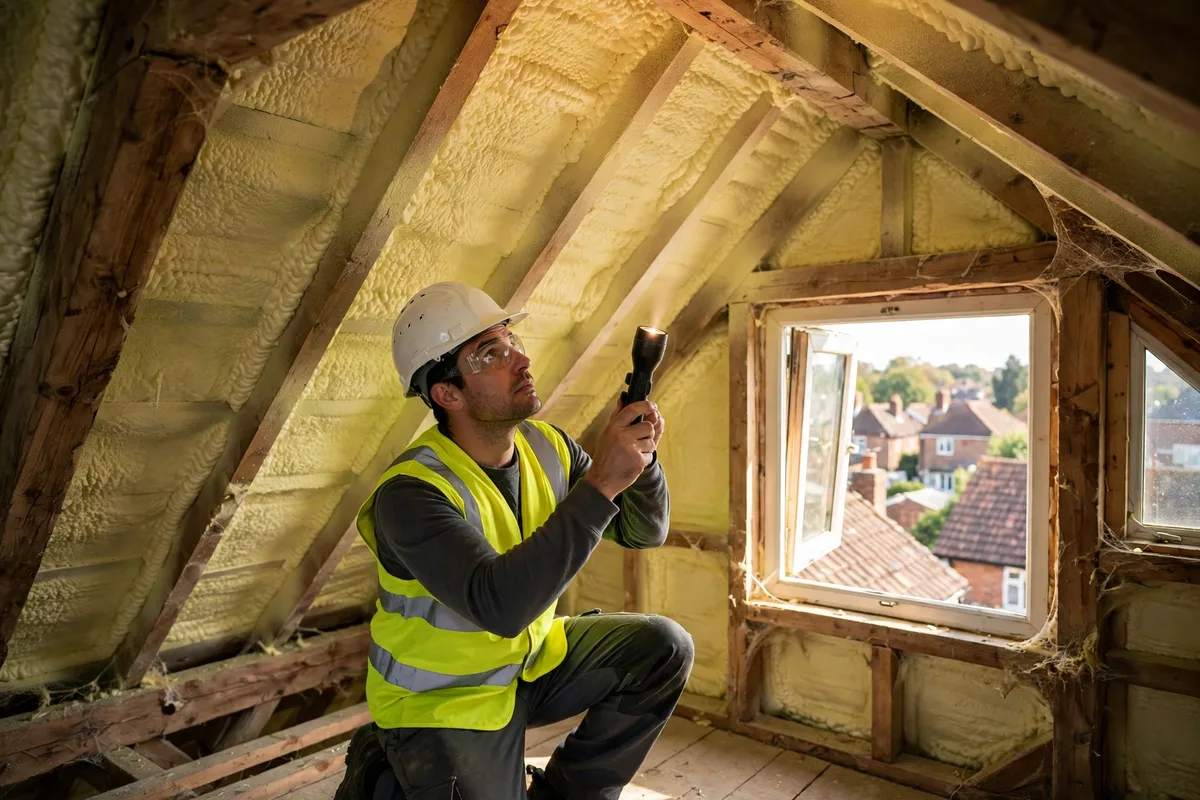
A surveyor’s job is to report on the condition of the property, and spray foam makes part of that job impossible. When foam is sprayed directly onto the underside of the roof covering, it bonds to the rafters, the felt or membrane, and sometimes the tiles or slates themselves. The timbers are covered. The surveyor cannot see whether they are dry, damp, rotting or affected by woodworm. That is the core of the objection, and it is a reasonable one: a surveyor cannot sign off on timber they cannot see.
There are two types of foam, and surveyors treat them differently. Open-cell foam is lighter and more breathable; moisture can pass through it, and it is usually easier to remove. Closed-cell foam is denser, rigid and much harder to remove; it forms a hard shell over the timbers. The type matters because it changes both the risk and the cost of putting things right, and because a lender’s valuer will ask which type is present. If you do not know which type is in your loft, that is the first thing to find out.
How the foam was installed matters as much as which type it is. Health and Safety Executive modelling from February 2024 found a low risk where open-cell foam was installed to the British Standard BS 5250:2021, with a ventilated gap left between the foam and the roof covering. The risk was high where foam was sprayed straight onto the tiles with no ventilation gap, because moisture can then be trapped against the timbers. The same foam, installed two different ways, is two different risks. This is why a valuer asks for installation paperwork: it tells them which of those two situations they are looking at.
The other thing surveyors flag is the condition of the roof covering itself. Foam can hide a slipped tile, a cracked slate or a failed felt. It can also make a future re-roof more expensive, because the foam has to come off with the old covering. A surveyor who cannot inspect the timbers will usually recommend a specialist inspection rather than guessing, and that recommendation is what then reaches the lender.
The scale of the issue is large. A House of Commons Library briefing from July 2026 put the number of UK homes with spray foam insulation at up to around 250,000. A parliamentary committee repeated a Residential Property Surveyors Association estimate that around 250,000 homes could be unmortgageable because of spray foam, with the true figure possibly higher. Those are estimates from other bodies, quoted here as such, not our own figures. They explain why the problem feels widespread: it is.
What Lenders Actually Say: The Split, Dated November 2024
Lenders do not agree with each other on spray foam, and that disagreement is the whole difficulty for sellers. There is no single rule. Each lender sets its own criteria, and those criteria change.
The clearest public snapshot is a BBC survey of the 20 largest UK lenders, carried out in November 2024. Five lenders said they would not lend against homes with roof spray foam at all: TSB, Skipton Building Society, the Co-operative Bank, Principality and Aviva, the last of those for equity release. Five others, Lloyds, Nationwide, Barclays, NatWest Group and Santander, said they decide case by case, on the valuer’s report, and may ask for installation documentation. The rest did not give a clear public position in that survey.
Treat that snapshot as history, not as today’s rulebook. Lender policy on spray foam has moved before and will move again, and a lender that refused in November 2024 may have a different position now, or a stricter one. Before you list, or before you accept an offer, the question to ask is not “what did the BBC find in 2024” but “what does this buyer’s lender say today”. Your estate agent or conveyancer can usually find out quickly, and it is worth finding out early, because it decides which buyers can actually complete.
The government’s own position shifted in October 2026. A Department for Energy Security and Net Zero paper, “Spray foam insulation: Remediation, removal and lending”, published on 22 October 2026, said that many mortgage providers will lend subject to their own criteria, that removing the foam will not always make a lender lend, and that only specialist surveyors experienced in spray foam can say whether removal is needed. It also warned that improper removal can cause further damage. RICS, the surveyors’ professional body, describes spray foam as not easily reversed, and says removal could damage the structure. The official message, in short, is that this is a surveyor’s judgement, not a job for a general builder with a scraper.
What this means in practice for a seller: the buyer’s lender will almost always want evidence, and the evidence it wants is a specialist report on the condition of the timbers. Without that report, a case-by-case lender has nothing to base a decision on, and a refusing lender has no reason to change its mind.
The Inspection Report Route: What to Do Before You List
The single most useful thing a seller can do is get a specialist inspection before the house goes on the market. It costs money, and it takes time, but it changes the conversation from “there is foam and nobody knows what is underneath it” to “here is a report from a specialist surveyor on the condition of the timbers”. That is the difference between a buyer who walks away and a buyer whose lender says yes.
The inspection should follow the Property Care Association’s Spray Foam Insulation Inspection Protocol, published in March 2023. The PCA protocol is the recognised route: a surveyor experienced in spray foam inspects the roof, takes moisture readings, and reports on the condition of the timbers, usually assessed against the moisture standard BS 5250:2021. Lenders usually want an independent specialist report of this kind rather than a general homebuyer survey, because a general surveyor will simply repeat that the timbers cannot be seen.
A pre-listing roof assessment costs around £100 to £200, according to a MyBuilder guide updated in August 2026. That is the assessment alone, not any remedial work. It is a small cost next to the price of a house, and it is the cheapest way to find out where you stand. If the report says the timbers are dry and sound, you have something concrete to show a valuer and a lender. If it finds damp or decay, you know before a buyer does, and you can decide what to do about it on your own timetable rather than in the middle of a sale.
Find out what foam you actually have before the inspection. The surveyor will want to know the type, open-cell or closed-cell, where exactly it was sprayed, when it was installed, and who installed it. If you have the installer’s paperwork, gather it. If the foam was there when you bought the house and you have no paperwork, say so; the surveyor can usually identify the type by looking at it, but paperwork makes the report stronger and the lender’s decision easier.
Do not let anyone start removing foam before a specialist has looked at it. The government’s October 2026 paper is explicit that improper removal can cause further damage, and RICS warns that removal could damage the structure. Removal is sometimes the right answer, but it is a decision that follows an inspection, not a first step.
Your Three Options, Priced
Once you know what is in your loft and what condition the timbers are in, there are three realistic ways to sell. Each has a cost, a timescale and a trade-off. The right one depends on the inspection result, the buyer’s lender, and how quickly you need to move.
Option 1: Sell as-is, with the specialist report
This is the cheapest option and, after the October 2026 government paper, the one the official guidance leans towards. You list the house, you disclose the foam honestly, and you hand the buyer’s surveyor and lender the specialist report showing the timbers are sound. A case-by-case lender can then lend on the valuer’s report, and the sale proceeds like any other.
The cost is the inspection itself, around £100 to £200 for the assessment. The risk is that the buyer’s lender is one of the outright refusers, or that the valuer wants more evidence than the report provides. That risk is real, and it is why you should find out the buyer’s lender’s position as early as possible, ideally before you accept the offer. If the buyer is with a lender that will not lend on foam at any price, no report will change that, and you will have spent weeks finding out.
This option works best when the foam is open-cell, installed to BS 5250:2021 with a ventilated gap, the timbers are dry, and you have the installation paperwork. It works worst when the foam is closed-cell, the paperwork is missing, and the buyer needs a high loan-to-value mortgage from a cautious lender.
Option 2: Sell to a cash buyer
A cash buyer does not need a mortgage, so the lender problem disappears. That is the whole attraction. The buyer, their solicitor and their surveyor will still ask questions about the foam, and a surveyor will still flag the hidden timbers, but nobody has to satisfy a lender’s criteria.
The cost is usually in the price. Cash buyers, including the cash-buyer firms that advertise for homes with spray foam, know the house is harder to sell on the open market, and their offers reflect that. How much less depends on the house, the area and the buyer, and no honest guide can put a single figure on it. Get more than one cash offer if you go this way, and compare them against what you would net from an open-market sale after the cost of the inspection report and any delay.
This option suits sellers who need speed or certainty more than they need the highest price, a probate sale, a chain that has already collapsed once, or a move with a fixed deadline. It is not the option to choose simply because the foam feels like a problem; if the inspection report is good, the open market may still pay more.
Option 3: Remove the foam and re-insulate before selling
Removal is the most expensive option and the slowest, and the government’s October 2026 paper says plainly that it will not always make a lender lend. It is the right choice when the inspection finds real damage, when the foam is closed-cell and poorly installed, or when you have already lost a sale to a lender refusal and want the house to be mortgageable for any buyer.
Removal typically costs £20 to £50 per square metre, with an average job around £1,500, plus £500 to £3,000 for repairs and new insulation, according to the same MyBuilder guide updated in August 2026. The wide range is because the cost depends on the foam type, closed-cell costs far more to remove than open-cell, the size of the roof, how accessible the loft is, and what is found underneath. Our own guide to spray foam insulation removal cost UK breaks the removal job down in detail, including the difference between open-cell and closed-cell removal, and is the place to price this option properly rather than guessing from the headline range.
Two warnings matter here. First, removal must be done by a specialist, not a general builder. Improper removal can damage the roof structure, and a lender that sees a botched removal may be less willing to lend than one that sees intact foam with a good report. Second, after removal you still need insulation. A bare, uninsulated loft will hurt the home’s energy performance, and the EPC rating a buyer sees will reflect that. Budget for the replacement insulation as part of the job, not as an afterthought, and keep the paperwork for both the removal and the new insulation.
| Option | Typical cost | Timescale | Best when |
|---|---|---|---|
| Sell as-is with a specialist report | Around £100 to £200 for the assessment | Days to a couple of weeks | Open-cell foam, dry timbers, paperwork available, buyer with a case-by-case lender |
| Sell to a cash buyer | No inspection cost, but usually a lower price | Fastest | Speed or certainty matters more than the highest price |
| Remove and re-insulate before selling | Around £1,500 for removal on average, plus £500 to £3,000 for repairs and new insulation | Weeks | Inspection finds damage, closed-cell foam, or a sale already lost to a lender refusal |
What Changed in October 2026
The government’s paper of 22 October 2026, “Spray foam insulation: Remediation, removal and lending”, is the most important recent development for sellers, and it is worth understanding what it did and did not do.
It did not ban spray foam. It did not order anyone to remove it. It did not tell lenders what to do. What it did was set out the government’s view that many mortgage providers will lend subject to their own criteria, that removal is not always the answer, and that only specialist surveyors experienced in spray foam can say whether removal is needed. That is a meaningful shift in tone from the panic that followed the first lender refusals, and it gives sellers and their advisers something official to point to.
It also matters because it came after the House of Commons Library briefing of July 2026, which put the scale of the issue at up to around 250,000 homes, and after the parliamentary committee’s repetition of the surveyors’ estimate that around 250,000 homes could be unmortgageable. The government was responding to a problem it could no longer treat as a handful of unusual cases.
For a seller, the practical effect is this: the October 2026 paper supports the inspection-first approach. Get the specialist report, show the lender the evidence, and only remove the foam if a specialist says it is needed. It does not guarantee that a particular lender will say yes. Lender criteria are still the lender’s own, and they still move.
Disclosure, Paperwork and the TA6
When you sell a house in England and Wales, you complete the Law Society’s TA6 property information form. You must answer its questions truthfully, and leaving out a fact you know is relevant can be treated as a misleading omission. Spray foam in the roof is a relevant fact. A buyer’s surveyor will almost certainly find it anyway, because foam in a loft is hard to miss, so hiding it gains nothing and risks the sale later, when the buyer has already spent money on surveys and legal work.
The honest approach is also the practical one. Disclose the foam, and hand over the paperwork at the same time. A buyer who learns about foam from your disclosure, with a specialist report attached, reacts very differently from a buyer who learns about it from a surveyor’s warning three weeks into the purchase.
Keep a paperwork file for the foam. It should contain, as far as you can gather them: the installer’s name and any certificate or guarantee, the date of installation, the type of foam used, any photographs taken during or after installation, the specialist inspection report and its moisture readings, and any correspondence with a lender or surveyor about the foam. If you bought the house with the foam already in place and have none of this, note that too, and let the inspection report carry the weight.
Listed Buildings and Conservation Areas
If your home is listed, or in a conservation area, there is an extra conversation to have before you sell or before any work is done. Spray foam of unknown origin in a listed building can raise questions with the conservation officer, particularly if removal is being considered, because removal work can affect historic fabric. The same applies to any re-insulation that changes the appearance or structure of the roof.
This does not stop a sale. It means you should talk to the conservation officer before commissioning removal work, and mention the foam to your conveyancer early so they can check whether any consent or record exists. A buyer of a listed home will have their own surveyor and solicitor looking at the same questions, so it is better that you have the answers first.
A Note on Damp and Insulation After the Sale
Whether you sell with the foam in place or remove it, the next owner will inherit the insulation question. If the foam stays, the buyer should understand what it is and what the inspection found. If it is removed, the loft needs proper replacement insulation, fitted with ventilation in mind, or the home will lose heat and may develop condensation problems.
If damp is part of what the inspection finds, it is worth understanding before you decide anything. Our guide to damp in homes explains the common causes and the difference between condensation, penetrating damp and rising damp, which matters because each has a different fix. And if you are re-insulating after removal, our loft insulation complete guide covers the standard options and the ventilation rules that the spray foam installation should have followed in the first place.
FAQs
Can you sell a house with spray foam insulation?
Yes. Spray foam is not banned in the UK and there is no law requiring its removal before a sale. The difficulty is mortgage lending: some lenders will not lend against a home with roof spray foam, and others will lend only if a specialist report shows the timbers are sound. The sale is possible, but it needs more preparation than a sale without foam.
Will a mortgage lender refuse a house with spray foam?
Some will, some will not. A BBC survey of the 20 largest UK lenders in November 2024 found five that said they would not lend, TSB, Skipton Building Society, the Co-operative Bank, Principality and Aviva for equity release, while Lloyds, Nationwide, Barclays, NatWest Group and Santander said they decide case by case on the valuer’s report. Lender policy moves, so check the specific buyer’s lender’s current position rather than relying on the 2024 survey.
Do I have to remove spray foam before selling?
No, not by law, and the government’s October 2026 paper says removal will not always make a lender lend. Only a specialist surveyor experienced in spray foam can say whether removal is needed in your case. Get the inspection first, and treat removal as a decision that follows the inspection, not a first step.
How much does a spray foam inspection cost?
A pre-listing roof assessment costs around £100 to £200, according to a MyBuilder guide updated in August 2026. The inspection should follow the Property Care Association’s Spray Foam Insulation Inspection Protocol from March 2023, with moisture readings assessed against BS 5250:2021.
How much does it cost to remove spray foam?
Removal typically costs £20 to £50 per square metre, with an average job around £1,500, plus £500 to £3,000 for repairs and new insulation, according to the same MyBuilder guide. Closed-cell foam costs far more to remove than open-cell foam, and the final figure depends on the size of the roof and what is found underneath. Our spray foam insulation removal cost guide covers the job in detail.
Should I tell the buyer about the spray foam?
Yes. You must answer the TA6 property information form truthfully, and leaving out a known relevant fact can be a misleading omission. A buyer’s surveyor will almost certainly find the foam anyway. Disclose it, and hand over the specialist report and any installation paperwork at the same time.
Can a cash buyer buy a house with spray foam?
Yes. A cash buyer does not need a mortgage, so the lender problem does not apply. Their solicitor and surveyor will still ask about the foam, and cash-buyer offers usually reflect the fact that the house is harder to sell on the open market, so compare more than one offer.
Is spray foam in the walls the same problem as spray foam on the roof?
No. The mortgage problem is specifically about foam sprayed onto the underside of a roof, because it hides the roof timbers from inspection. Foam in walls or under floors raises different questions. Do not assume that a lender’s position on roof foam applies to foam elsewhere in the house.
About the Author