Air Source Heat Pump Cost UK (2026): Prices, Grants and Running Costs
Quick Answer: What an Air Source Heat Pump Costs Before and After the Grant
An air source heat pump in the UK typically costs £11,000 to £15,600 installed before any grant, and about £3,600 to £8,100 after the £7,500 Boiler Upgrade Scheme grant in England and Wales. Those are not round guesses. The Department for Energy Security and Net Zero’s Boiler Upgrade Scheme statistics for April to June 2026 put the median installed cost at £12,908, with the middle half of installs costing £11,128 to £15,627 before the grant. Take the £7,500 grant off and the middle half lands at £3,600 to £8,100 out of your pocket.
Other 2026 guides sit in the same neighbourhood, which is reassuring. The Energy Saving Trust puts a typical installed cost at around £12,000 before the grant, and one installer guide puts typical fitted prices at £11,000 to £14,500 before the grant, or £3,500 to £7,000 after it. A broader guide that includes very small and very large homes stretches the range to £8,000 to £18,000 before the grant. The spread is real, and it is the point of this guide: a heat pump quote is a system price, not a price for a box on the wall, and the size of your home, the state of your radiators and whether you need a new cylinder move the total by thousands.
The grant changes the comparison with a boiler, but it does not erase it. A straightforward new gas boiler still costs far less up front than even a grant-assisted heat pump, and this guide says so plainly in the final section. What the grant does is bring a heat pump into the range where the running costs, the lifespan and the fact that you are no longer buying gas start to matter in the decision, rather than the purchase price alone.
One more date matters to the price. Heat pump installations are currently charged at 0% VAT, but that zero rate runs only until 31 March 2027, after which the reduced rate of 5% applies. On a typical installation that is worth roughly £560 to £780, so a quote taken in late 2026 and an installation completed after the deadline are not quite the same price. Ask your installer to confirm which VAT rate the quote assumes.
Cost by House Size
Heat pumps are sized by heat loss, not by bedroom count alone, but house size is still the quickest way to see where your quote should land. The table below combines published 2026 guides; your installer’s heat-loss calculation, not this table, decides the size you actually need.
| Home | Typical system size | Installed cost before grant | After the £7,500 grant |
|---|---|---|---|
| 1 to 2 bed flat or small terrace | 5 to 7 kW | £8,000 to £11,000 | £500 to £3,500 |
| 3 bed semi-detached | 8 to 10 kW | £10,000 to £14,000 | £2,500 to £6,500 |
| 4 bed detached | 10 to 14 kW | £12,000 to £16,000 | £4,500 to £8,500 |
| 5 bed or poorly insulated larger home | 14 to 18 kW | £15,000 to £18,000 or more | £7,500 to £10,500 or more |
Read the table with two cautions. First, a small but draughty Victorian terrace can need a larger unit than a well-insulated new-build semi, because heat loss, not floor area, is what the unit has to replace. Second, the table is the heat pump system price, not the whole project price. Radiator upgrades, a new cylinder, electrical upgrades and any insulation work you choose to do first sit outside it, and they are covered in the section on what else you may need.
The DESNZ figures give a useful cross-check on the middle of the table. By unit size, the 2025/26 medians reported from the scheme were about £11,500 for a 4 to 6 kW unit, about £12,200 for a 6 to 8 kW unit, and about £13,900 for a 10 to 12 kW unit. If your quote for a typical three-bedroom semi is far above £15,600 before the grant, ask what extra work is in it. If it is far below £10,000, ask what has been left out. Either can be legitimate, but neither should be unexplained.
What the Boiler Upgrade Scheme Pays, and Who Applies
The Boiler Upgrade Scheme, usually shortened to BUS, is the grant that does most of the work in the headline price. In England and Wales it pays £7,500 towards an air source heat pump. If your home is heated by oil or LPG and has no mains gas connection, the grant is £9,000 until 31 March 2027, an extra £1,500 on top of the standard amount. The scheme does not apply in Scotland, where Home Energy Scotland runs its own grants and loans, so a Scottish reader should not budget on the £7,500 figure.
Three practical points catch people out. First, you do not apply and wait for the money yourself. Your installer applies on your behalf, and the grant is deducted from the amount you pay, which is why quotes are usually shown both before and after the grant. Second, the installer must be MCS certified. That certification is not a badge of honour; it is a condition of the grant, and an installer who is not MCS certified cannot claim it for you. Third, the scheme is for replacing a fossil fuel heating system, and hybrid systems that pair a gas boiler with a heat pump are not eligible. If a quote mentions a hybrid set-up and a BUS grant in the same breath, query it.
The grant is per property, not per unit, and it covers the heat pump system itself, not the insulation or radiator work you might do alongside it. That distinction matters when you compare quotes. One installer may quote a lower heat pump price and leave the radiator upgrades as a separate line; another may bundle them. Both can be honest, but only a quote that separates the heat pump, the grant, the cylinder, the radiators and the electrics lets you compare like with like. Ask for that breakdown in writing before you sign anything.
What Else You May Need: Radiators, Cylinder and Electrics
A heat pump does not heat your home in the same way a gas boiler does. A boiler typically sends water around the radiators at 70 to 80 degrees. A heat pump works most efficiently at much lower flow temperatures, often around 35 to 50 degrees, which means the radiators need a larger surface area to give out the same amount of heat. That single technical fact drives most of the extra costs.
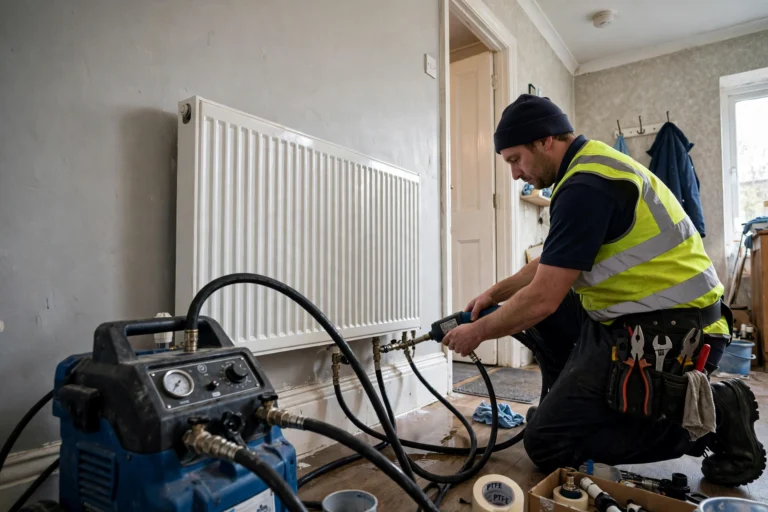
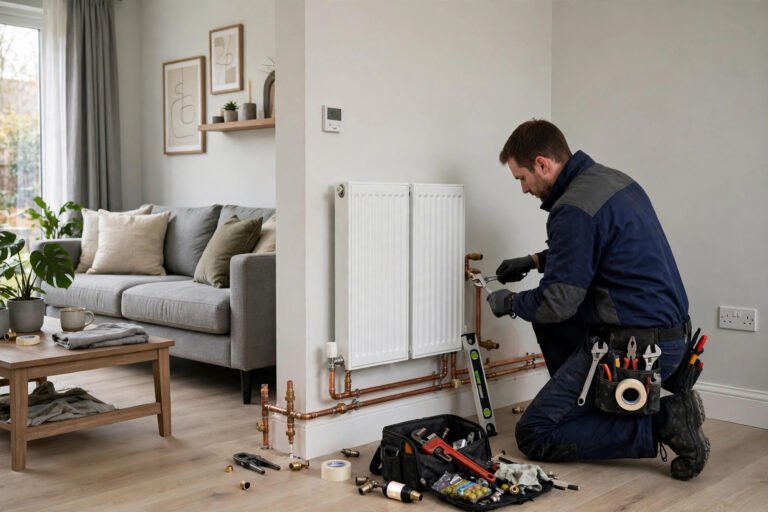
Radiators are the most common extra. Some rooms will be fine with the radiators you already have. Others will need larger radiators, or an extra radiator, to keep the room warm at a lower flow temperature. One 2026 installer guide puts radiator upgrades at £300 to £600 each, for rooms the survey flags, while our own radiator replacement cost guide prices a standard radiator supplied and fitted at £150 to £450. The difference is scope: a like-for-like swap is cheaper than upsizing a radiator, moving pipework and rebalancing a system for a heat pump. If your survey says half your radiators need upsizing, that alone can add £1,000 to £3,000 to the project, and it should be in the quote, not discovered on installation day.
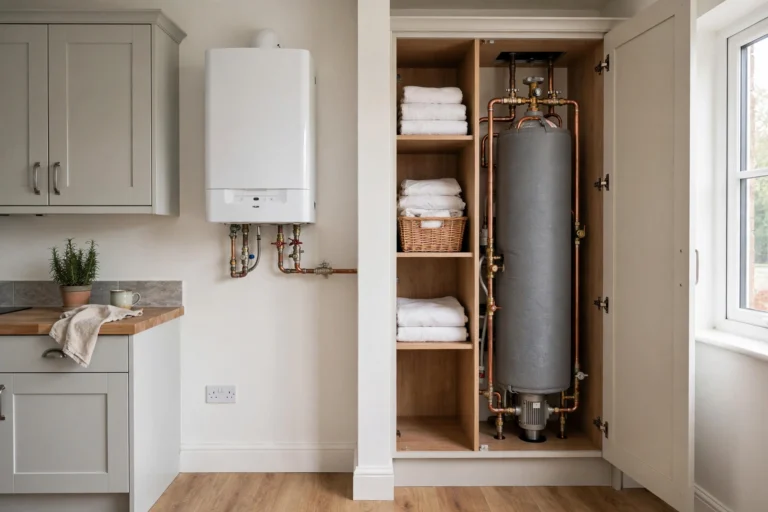
Hot water is the second extra. Most air source heat pumps need a hot water cylinder, because they do not heat water on demand the way a combi boiler does. If you already have a suitable cylinder, it may be reused, but many combi households do not have one at all, and older cylinders may not be rated for a heat pump system. A new cylinder, its controls and the space to put it are therefore a normal part of the quote, not an optional extra, and losing an airing cupboard to a cylinder is a practical cost worth thinking about before the survey.
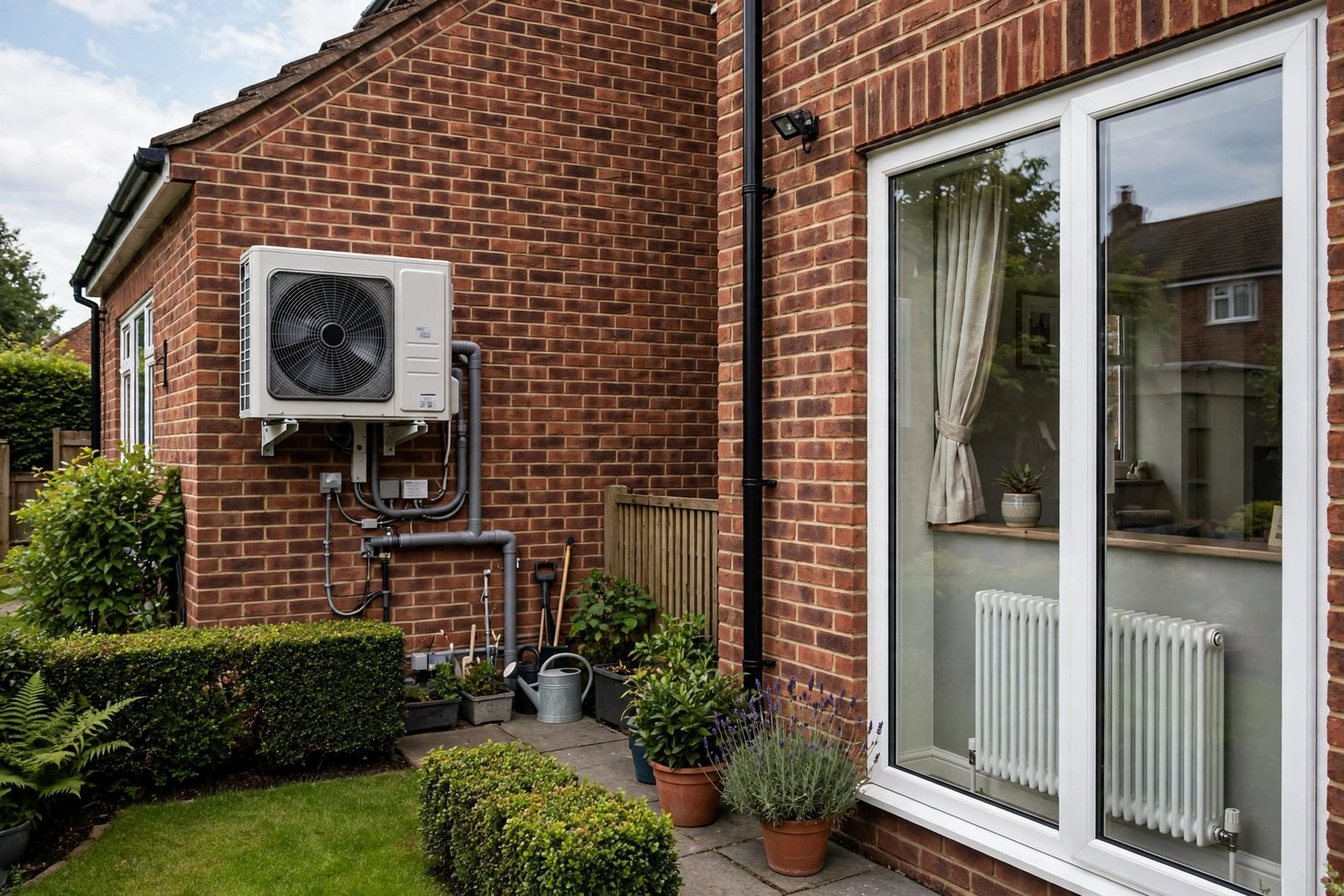
Electrics are the third extra. A heat pump needs its own electrical supply, and older consumer units, long cable runs to the outdoor unit, or a supply that needs upgrading can all add cost. The outdoor unit itself needs a suitable spot: space for airflow, a solid base, drainage for condensate, and a position that keeps noise away from neighbours and from your own bedrooms. Planning rules are generally permissive for a single air source unit, but permitted development has conditions on size, siting and noise, so a unit squeezed against a neighbour’s fence or a bedroom window can cause problems that a freestanding position would not. Your installer should check the siting against those conditions during the survey, not after the unit is delivered.
Running Costs vs Gas: Tariff-Dependent, So Read Them Carefully
The running-cost question has no single answer, because a heat pump’s efficiency depends on the weather, your tariff and the flow temperature your system is designed for. A heat pump moves heat rather than making it by burning fuel, so for each unit of electricity it uses it can deliver several units of heat. That ratio, usually quoted as a seasonal coefficient of performance, is higher in mild weather and lower in a cold snap, and it is better when the system runs at a low flow temperature, which is another reason the radiator work matters.
One 2026 guide’s estimates put the running cost of a heat pump at about £710 to £770 a year on a standard tariff, against about £840 to £910 a year for gas, and about £300 to £320 a year less than gas on a dedicated heat pump tariff. Treat those as an illustration, not a promise. Electricity costs roughly four times as much per unit as gas in the UK, so a heat pump only beats a boiler on running costs if its efficiency is high enough to overcome that price gap. On a standard electricity tariff, in a poorly insulated home, with small radiators forcing a high flow temperature, a heat pump can cost more to run than the boiler it replaced. On a heat pump tariff, with off-peak electricity, in a well-insulated home with correctly sized radiators, it can cost noticeably less.
The honest way to judge a running-cost claim in a quote is to ask for the assumptions behind it: the seasonal efficiency figure used, the electricity tariff assumed, and the annual heat demand from the heat-loss calculation. If a salesperson quotes a saving without showing those three numbers, the saving is a sales figure, not a forecast. And remember that a heat pump also removes the gas standing charge if you disconnect from gas entirely, which is a real saving that some comparisons leave out, while others count it. Check whether it is in the figure you are being shown.
Is Your Home Ready? An Insulation Checklist
A heat pump can be fitted in almost any home, but it works best, and cheapest to run, in a home that does not leak heat. Before you commit, work through this checklist with your surveyor, not after the unit is on the wall.
First, loft insulation. Most homes should have at least 270mm of loft insulation, and topping it up is one of the cheapest heat-loss reductions available. Second, walls. Cavity wall insulation, where the walls allow it, and external or internal wall insulation for solid-walled homes, cut the largest single source of heat loss in many older houses. Our external wall insulation cost guide prices that work separately, because it is a project in its own right, not a heat pump add-on. Third, draughts and windows. Draught-proofing doors and windows, and checking that single glazing or failed double glazing is not undermining the rest, costs little compared with a larger heat pump.
Fourth, the EPC. Your home’s Energy Performance Certificate gives a rough picture of where heat is being lost, and it is worth reading before the survey so you can ask informed questions. Our EPC rating explained guide walks through what each section means. Fifth, the radiators and pipework, covered above: ask the surveyor to name, room by room, which radiators stay, which grow, and which move. Sixth, the hot water question: do you have a cylinder, is it suitable, and where will a new one go if you need it?
None of this means you must insulate everything before you can have a heat pump. It means the order matters. Spending a few thousand pounds on insulation first can let you buy a smaller, cheaper heat pump and run it at a lower flow temperature for its whole life, which is a better return than buying a larger unit to heat a leaky house. If an installer tells you insulation does not matter, that is a reason to get a second survey, not to skip the insulation.
When a New Boiler Is Still the Right Choice
A heat pump is not the right answer for every home, and a guide that pretended otherwise would not be useful. A new boiler is still the right choice in several common situations.
If your boiler has failed and you need heat restored quickly, a like-for-like boiler replacement can be done in a day or two, while a heat pump survey, grant application and installation takes weeks. If your home is very poorly insulated, listed, or in a conservation area where an outdoor unit and insulation work face restrictions, a boiler may be the practical option until the fabric of the house is addressed. If you have a small flat with no outside space for a unit, no room for a cylinder, and a short remaining time in the property, the up-front cost of a heat pump may never pay back. And if you are on a tight budget with no access to the grant, for example because your home does not qualify, the price gap between a boiler and a heat pump is at its widest.
Compare the two honestly using our new boiler cost guide. A straightforward combi replacement typically costs £2,000 to £3,500 installed, against £3,600 to £8,100 after the grant for a heat pump in the middle of the range. The boiler is cheaper to buy, usually cheaper to service, and familiar to every heating engineer. The heat pump is cheaper to run in the right home, removes gas from the house, and is the option the grant system is designed to encourage. Neither is a moral choice; both are heating systems, and the right one is the one that fits your home, your budget and your timescale. The worst outcome is a heat pump fitted into a home that was never surveyed properly, or a boiler fitted into a home that was ready for a heat pump and would have saved money over its life. A proper survey, with a heat-loss calculation and a room-by-room radiator schedule, is what separates those two outcomes.
Frequently Asked Questions
How much does an air source heat pump cost in the UK?
Typically £11,000 to £15,600 installed before the grant, with the DESNZ median at £12,908 for April to June 2026. After the £7,500 Boiler Upgrade Scheme grant in England and Wales, the middle half of installs cost £3,600 to £8,100.
What does the Boiler Upgrade Scheme pay?
£7,500 towards an air source heat pump in England and Wales, or £9,000 for off-gas-grid homes heated by oil or LPG with no mains gas connection until 31 March 2027. Your MCS-certified installer applies on your behalf, and the grant is deducted from what you pay.
Do I need new radiators for a heat pump?
Often, in some rooms. Heat pumps run at lower flow temperatures than boilers, so radiators may need to be larger to give out the same heat. One installer guide prices upgrades at £300 to £600 per radiator for rooms the survey flags; a standard like-for-like radiator swap is cheaper.
Is a heat pump cheaper to run than a gas boiler?
It depends on your tariff, your insulation and your system’s efficiency. One 2026 guide estimates about £710 to £770 a year on a standard tariff against £840 to £910 for gas, and about £300 to £320 a year less than gas on a heat pump tariff. Those are estimates, not guarantees, and a poorly insulated home on a standard tariff can cost more to run.
Does a heat pump need a hot water cylinder?
Usually yes. Unlike a combi boiler, an air source heat pump does not heat water on demand, so most installations include a cylinder. If you have no cylinder now, allow space and budget for one.
How long does installation take?
A straightforward installation typically takes a few days to a week on site, after the survey and grant application. Radiator upgrades, cylinder work and electrical upgrades can extend that, so ask for a timescale that includes the extras, not just the unit.
Is VAT charged on a heat pump installation?
Currently at 0% until 31 March 2027, after which the reduced rate of 5% applies. Confirm which rate your quote assumes, especially if installation will fall after the deadline.
When is a boiler better than a heat pump?
When heat is needed urgently, when the home is very poorly insulated or has no suitable outdoor or cylinder space, when the property will be sold soon, or when the grant does not apply and the budget cannot stretch. A proper heat-loss survey is the way to decide, not a brochure.
About the Author