Quick Answer: How Much Does Bathroom Tiling Cost in the UK?
Bathroom tiling in the UK typically costs £65 to £120 per m2 supplied and fitted, with labour alone typically £35 to £70 per m2. Those are the anchors from the original research for this guide, and the 2026 guides checked for this article sit inside or close to them, which is reassuring, but they do not all agree, and the reason they disagree matters more than any single figure.
Checkatrade, updated in June 2026, puts the average tiling cost at around £110 per m2 including standard tiles, materials and labour, and puts fully tiling the walls and floors of a bathroom normally at £800 to £1,200. MyJobQuote, summarised in October 2026, puts labour for standard tiles lower, at roughly £20 to £40 per m2, with a medium bathroom fully tiled in ceramic at £900 to £2,050 with tiles supplied. TradesmenCosts, using Checkatrade data checked in October 2026, puts standard wall labour at £30 to £50 per m2 and standard floor labour at £30 to £55 per m2. A full bathroom in the original research is put at £750 to £2,500, which is wider than Checkatrade’s £800 to £1,200 because it covers more room sizes, more tile types and more preparation work.
The honest planning figure, then, is a range, not a price. For a straightforward bathroom with standard ceramic or porcelain tiles and sound walls, budget around £65 to £120 per m2 supplied and fitted, and expect the total for a full bathroom to land in the £800 to £2,000 range in most cases. Small jobs, such as tiling around a bath, are different: Checkatrade puts that at about £200 to £300 as a standalone task, because a tiler still has to travel, set up, cut and clean up, and a half-day job cannot be priced as a fraction of a full bathroom. The rest of this guide explains where in the range your bathroom is likely to fall, and why two quotes for the same room can differ by hundreds of pounds without either tiler being wrong.
One measurement point first, because it causes most of the confusion in quotes. Bathroom tiling is priced by the area being tiled, not by the size of the bathroom floor. A bathroom with a 4 m2 floor can easily have 15 to 20 m2 of wall tiling once the shower, the bath surround and the splash areas are counted. Always ask a tiler to state the tiled area in m2, separately for walls and floors, so you can compare quotes like with like.
Labour Versus Materials: What the per m2 Price Actually Includes
A per m2 tiling price is made of three parts, and quotes differ mainly in which parts they include.
Labour is the largest part in most jobs. The 2026 guides give a wide labour range because tilers charge in two different ways. Per m2 pricing suits larger, straightforward areas: standard wall tiles at £30 to £50 per m2 and standard floor tiles at £30 to £55 per m2 in the TradesmenCosts summary, or £20 to £40 per m2 for standard tiles in the MyJobQuote summary. Day-rate pricing suits small or fiddly jobs: Checkatrade puts a tiler at £200 to £350 per day, and TradesmenCosts, on Checkatrade data, at £250 to £350 per day, while MyJobQuote puts the day rate lower, at £150 to £250. A tiler who quotes by the day for a small bathroom is not overcharging; a per m2 rate only works when there is enough area for the rate to cover a full day. Ask which method your quote uses, and for a small job, expect the day rate to set the price.
Tiles themselves are the second part, and the range is enormous. Checkatrade gives a typical tile price of around £50 per m2 on average, with ceramic at around £35 per m2, while PropertyJobQuotes puts ceramic at £15 to £40 per m2, porcelain at £30 to £70 per m2, and natural stone at £50 to £120 or more per m2. The tile you choose can therefore move the total more than the labour rate does. A budget ceramic at the lower end and a large-format porcelain or a natural stone at the upper end are not the same job, even in the same room.
The third part is fixing materials and sundries: adhesive, grout, primer, trims, sealant and, where needed, tanking membrane in the wet zone. These are sometimes included in a supplied-and-fitted per m2 price and sometimes listed separately, which is one reason an all-in £110 per m2 figure and a labour-only £40 per m2 figure can both be correct. Before you compare two quotes, check whether adhesive, grout, trims and waste disposal are included in each, and whether the price includes VAT. A quote that looks cheaper because it excludes grout, trims and disposal is not cheaper.
As a rule of thumb for budgeting, labour is roughly half to two-thirds of a standard supplied-and-fitted job, with tiles and fixing materials making up the rest. On a premium tile job, that balance flips, and the tile cost dominates. That is normal, and it is why the tile-type table in the next section matters.
Bathroom Tiling Cost by Tile Type
Tile type affects price in three ways: the tile cost per m2, the labour rate, because some tiles are slower to lay, and the wastage rate, covered later in this guide.
Ceramic tiles are the budget and mid-range standard for bathroom walls. Checkatrade puts ceramic at around £35 per m2 for the tile, and MyJobQuote puts ceramic installed, tiles and labour together, at £60 to £90 per m2. They are lighter and easier to cut than porcelain, which keeps labour at the standard rate, and they suit walls well. Their limitation is that not every ceramic tile is suitable for floors, so check the tile specification for floor use before using a wall ceramic on a bathroom floor.
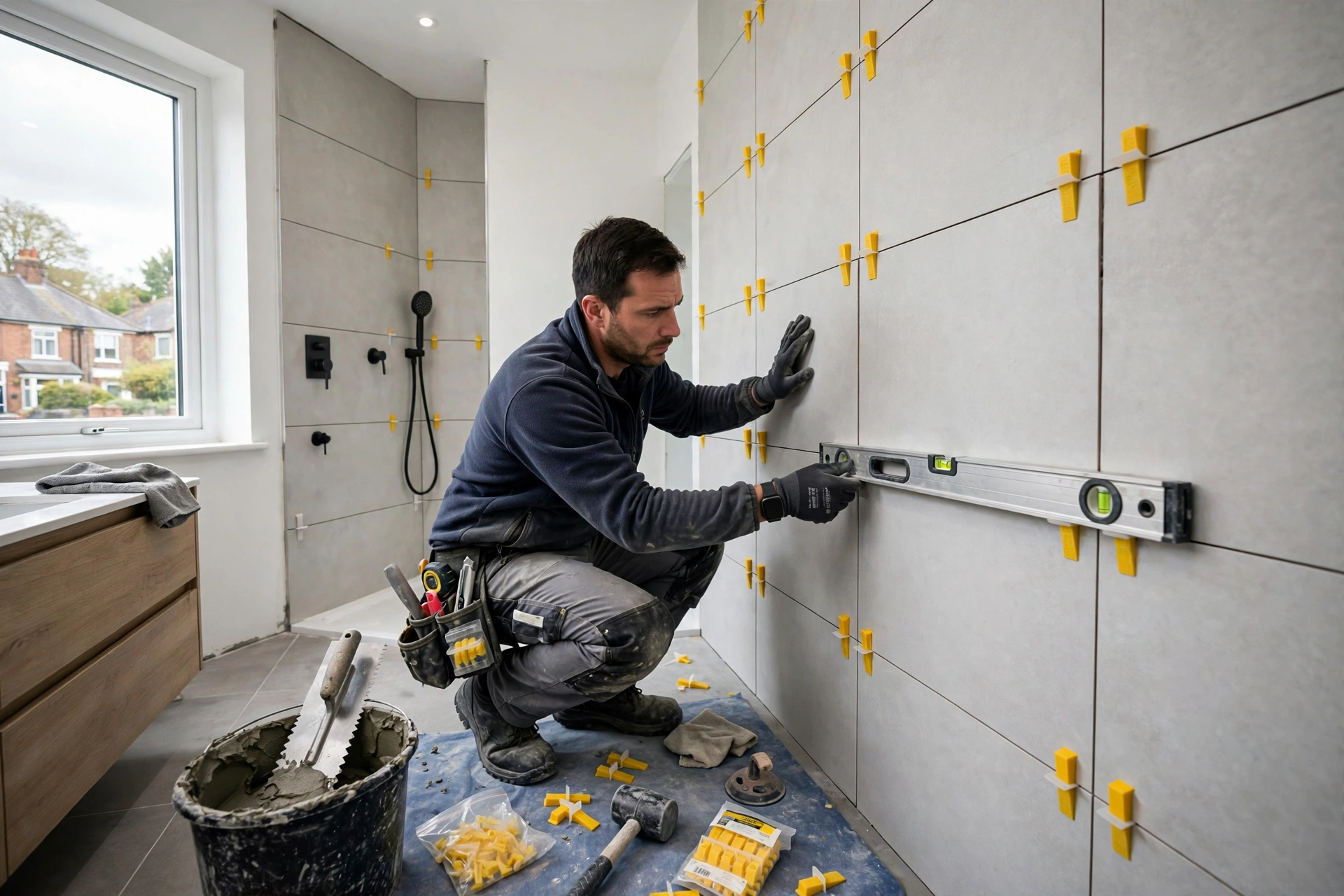
Porcelain tiles cost more per m2, at £30 to £70 per m2 in the PropertyJobQuotes guide, but they are harder wearing and suitable for both walls and floors, which makes them the usual choice for a bathroom floor and for a fully tiled room in one tile. Labour for standard porcelain is at the standard rate, but large-format porcelain, tiles of 800 mm or more on a side, is slower: TradesmenCosts puts large-format labour at £45 to £70 per m2, because levelling, handling and cutting all take longer, and a wall that is not flat will show in a large tile in a way it would not in a small one.
Mosaic and metro tiles are the labour-intensive end of the range. TradesmenCosts puts mosaic or metro labour at £50 to £80 per m2, and MyJobQuote puts mosaic installed at £120 to £200 or more per m2 including tiles and labour. Small tiles mean more grout lines, more cutting around fittings, and more time per m2. They suit feature strips, shower niches and splashbacks, where a small area gives a big visual effect, but tiling a whole bathroom in mosaic is one of the most expensive choices you can make, and it should be a deliberate design decision, not a default.
Natural stone, including marble, travertine and slate, is the premium end. PropertyJobQuotes puts natural stone tiles at £50 to £120 or more per m2 for the tile alone, and TradesmenCosts puts natural stone labour at £50 to £90 per m2, with sealing on top. Stone varies in thickness and absorbency, it needs sealing, and it needs a tiler who works with stone regularly. If a quote for stone is at a standard ceramic labour rate, ask whether sealing and stone-specific adhesive are included, because those are the lines that get missed.
| Tile type | Tile cost per m2 | Labour per m2 | Installed guide per m2 |
|---|---|---|---|
| Ceramic, standard wall or floor | £15 to £40, typically around £35 | £20 to £50 | £60 to £90 |
| Porcelain, standard format | £30 to £70 | £30 to £55 | £65 to £120 |
| Porcelain, large format (800 mm or more) | £30 to £70, often at the upper end | £45 to £70 | Higher than standard porcelain, by the extra labour |
| Mosaic or metro | Varies widely by sheet and finish | £50 to £80 | £120 to £200 or more for mosaic |
| Natural stone, sealed | £50 to £120 or more | £50 to £90 | Premium: tile plus labour plus sealing |
The installed column is a guide built from the sources above, not a single source figure, because no single guide prices every tile type on the same basis. Use it to compare tile choices, not as a quote.
Worked Examples: Small Bathroom, Family Bathroom and Ensuite
Worked examples are useful only if the maths is shown, so each example below states the tiled area, the labour rate used, and the tile price used, all taken from the ranges above. These are illustrations, not quotes: preparation, removal and tanking are dealt with separately in the next sections, and your tiler’s measured area is what counts.
Small bathroom, ceramic tiles. Suppose the floor is 3.5 m2 and the walls to be tiled come to 12 m2, a total tiled area of 15.5 m2. At a standard labour rate of £40 per m2, labour is 15.5 times £40, which is £620. Tiles at £35 per m2, allowing 10 percent extra for cuts and wastage, means buying 17.1 m2, which costs about £599. Labour plus tiles therefore comes to about £1,219, before fixing materials, trims, preparation or removal. That sits above Checkatrade’s £800 to £1,200 for a fully tiled bathroom, because this example tiles a larger wall area and counts tiles at full price, but it is in the same territory, and it shows why wall area, not floor area, drives the total.
Family bathroom, porcelain tiles. Suppose the floor is 5 m2 and the walls come to 20 m2, a total of 25 m2. At £40 per m2, labour is £1,000. Porcelain at £50 per m2, allowing 10 percent extra, means buying 27.5 m2, which costs £1,375. Labour plus tiles comes to £2,375 before preparation. That is at the upper end of the original research range for a full bathroom, and it reflects a larger room with a mid-range porcelain rather than a budget ceramic. If the same room were tiled in budget ceramic, the tile bill would fall by several hundred pounds, which is the single biggest saving available without cutting labour quality.
Ensuite, ceramic tiles, smaller area. Suppose the floor is 3 m2 and the walls come to 10 m2, a total of 13 m2. At £40 per m2, labour is £520. Ceramic at £35 per m2, allowing 10 percent extra, means buying 14.3 m2, which costs about £501. Labour plus tiles comes to about £1,021 before preparation. An ensuite can still be a two-day job once setting out, cutting around a shower valve and a window, grouting and sealing are counted, so do not expect an ensuite to cost half a family bathroom just because it is smaller.
Three lessons run through all three examples. First, wall area dominates: in each example, walls are three to four times the floor area. Second, tile choice moves the total by hundreds of pounds in the same room. Third, a quote that only states a total, without the tiled area and the tile price, cannot be compared with another quote. Ask for the breakdown, and the examples above give you the format to ask for it in.
If you are budgeting for the whole room rather than just the tiling, our bathroom renovation cost guide sets tiling in the context of the suite, plumbing, electrics and finishing, so the tiling figure does not get mistaken for the whole renovation cost.
Patterns and Wastage: Why You Buy More Tiles Than You Lay
Wastage is the difference between the area you tile and the area of tiles you buy, and it is not waste in the sense of tiles thrown away for no reason. It is the offcuts from edges, corners, window reveals, pipe holes and pattern matching, plus a few spares for future repairs.
For a straight lay, where tiles are laid in a simple grid, allow 10 percent extra over the measured tiled area. That is the allowance used in the worked examples above. For a diagonal lay, a herringbone pattern, or a brick-bond pattern with a large tile, allow 15 percent, because more tiles are cut at angles and more offcuts cannot be reused. Mosaic sheets and small-format tiles waste less in cutting, but they still need spares, because a damaged tile in a shower niche is much harder to match later if the range has been discontinued.
Pattern choice also affects labour, not just tile quantity. A straight lay is the fastest to set out and lay. Brick bond, where each row is offset by half a tile, takes longer to set out around fittings. Herringbone, where tiles are laid at angles to each other, is the slowest of the three, because every edge tile is cut and the setting out has to be exact or the pattern drifts across the room. TradesmenCosts puts complex floor work, including diagonal and herringbone, at £35 to £45 per m2 in one summary and large-format and pattern work higher in another, which reflects the same point: pattern is a labour cost, not just a tile cost. If a herringbone bathroom floor appeals to you, budget for both the extra tiles and the extra day.
Two practical points save money here. First, buy all the tiles, including the wastage allowance, from the same batch, because tiles from different batches can vary slightly in shade, and that variation shows on a wall in daylight. Second, keep the spare tiles, not just a box or two in the loft but labelled with the tile name and supplier, because a future repair with a matching tile is a small job, while a repair with a discontinued tile can mean retiling a whole wall.
Preparation Costs: Removal, Backer Board and Tanking
Preparation is where tiling quotes most often diverge, because one tiler includes it and another prices it as an extra. The work itself is straightforward to understand, even if the price varies by room condition.
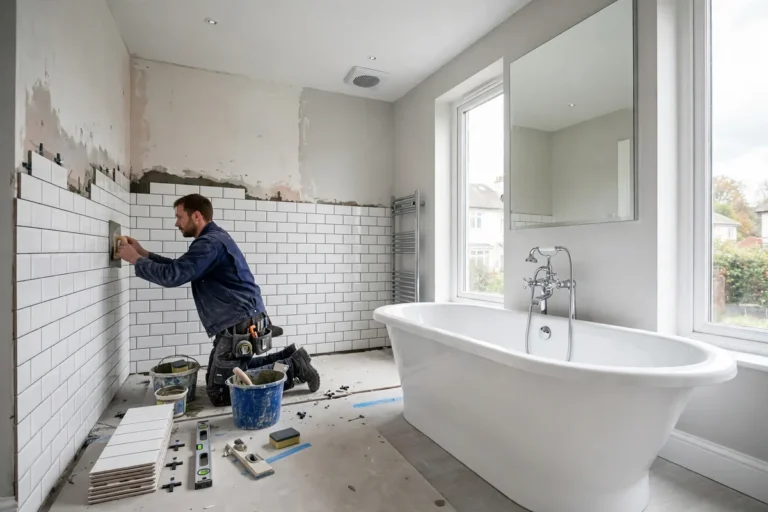
Tile removal comes first in a retile. Old tiles have to come off, adhesive has to be cleaned back, and the wall underneath has to be inspected. A wall that looks sound under old tiles can be damaged, damp, or out of plumb once the tiles are off, and that damage has to be repaired before new tiles go on. Removal is usually charged by time or by area, and it adds at least part of a day to a full bathroom retile. A quote for tiling over existing tiles should be treated with caution: it can work on a sound, flat surface, but it adds weight, it raises floor and fitting levels, and it hides any damp or damage underneath.
Backer board is the second preparation item, and it matters most in wet areas. Standard plasterboard is not a good tiling surface in a shower, because it softens if water gets behind the tiles. Cement-based backer board, or a waterproof tile backer panel, gives a stable, water-resistant surface for the shower walls and the bath surround. It is an extra material and labour cost, but it is the difference between tiles that stay put and tiles that fail because the board behind them failed. Ask whether backer board is included for the shower zone, and what board is specified.
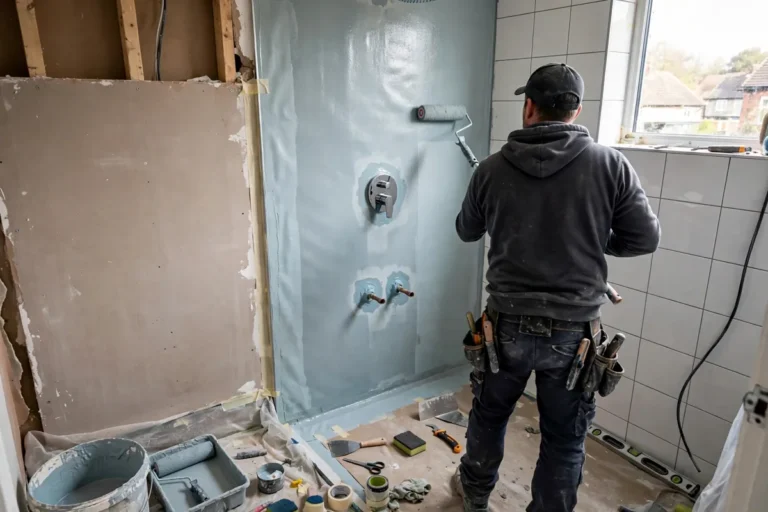
Tanking is the third item, and it is the one that separates a bathroom that stays dry from one that leaks into the room below. Tanking is a waterproof membrane applied to the shower walls and floor before tiling, and it is essential in a wet room and strongly recommended in any shower area. Our wet room cost guide explains tanking systems in detail, because in a wet room the whole floor is tanked, and our walk-in shower cost guide covers the shower-zone version of the same job. For budgeting, treat tanking as a separate line, not as part of the per m2 tiling rate, and ask whether the membrane, the jointing tape and the drain connection are all included.
Other preparation lines include levelling a floor that is not flat, which matters most for large-format tiles, repairing plaster, and moving or boxing in pipework so tiles can run cleanly behind fittings. None of these is expensive on its own, but together they can add a day to the job, and a quote that does not mention them is likely to grow once work starts. The cheapest tiling quote is often the one that assumes perfect walls, and perfect walls are rare in a bathroom that is being retiled.
Tiler Day Rates: When a Day Rate Beats a per m2 Rate
Day rates and per m2 rates are two ways of pricing the same work, and each suits a different job.
Per m2 pricing works best for larger, straightforward areas: a full bathroom, a large floor, or a long run of wall tiling where the tiler can work continuously. The guides above put standard labour at £20 to £50 per m2 depending on the source and the tile, with higher rates for large format, mosaic and stone. On a 25 m2 family bathroom, per m2 pricing gives a clear total that scales with the area, and it rewards a tiler who works efficiently.
Day-rate pricing works best for small or fiddly jobs: a splashback, a shower enclosure, tiling around a bath, or a bathroom with many cuts around windows, niches and pipework. Checkatrade puts a tiler at £200 to £350 per day, TradesmenCosts at £250 to £350 per day on Checkatrade data, and MyJobQuote at £150 to £250 per day. The spread reflects region, experience and whether the rate is for a sole tiler or a tiler plus a labourer. A small job priced per m2 can look cheap until the minimum charge, travel and setting-up time are added, which is why Checkatrade puts a standalone bath surround at £200 to £300 and a shower at £250 to £900, and TradesmenCosts puts a small bathroom floor at £250 to £400 in labour for a day and a shower enclosure at £300 to £700 in labour for one to two days.
Region matters, and London and the South East sit at the upper end of every range in this guide. A day rate or per m2 rate that is normal in London can be well above the rate in the Midlands, the North, Wales or Scotland, and the guides that break this out put London labour higher by roughly a quarter to a third. Get local quotes rather than applying a national average to your postcode.
For a full bathroom, Checkatrade puts the job at 3 to 4 days, and TradesmenCosts at 3 to 5 days for walls and floors together, which is consistent: setting out, cutting, grouting, sealing and cleaning cannot be compressed into a single day without cutting corners. A quote that promises a full bathroom in one day should be asked how grout curing and sealing are handled. A realistic programme, and a tiler who explains it, is worth more than a fast promise.
If the tiling is part of a new room rather than a retile, our cost of adding an ensuite guide covers the plumbing and building work that has to happen before the tiler starts, because tiling is one of the last trades in, and delays earlier in the job land on the tiling programme.
Frequently Asked Questions
How much does it cost to tile a bathroom in the UK?
Typically £65 to £120 per m2 supplied and fitted. Checkatrade puts a fully tiled bathroom normally at £800 to £1,200, MyJobQuote puts a medium bathroom fully tiled in ceramic at £900 to £2,050 with tiles supplied, and the original research range for a full bathroom is £750 to £2,500, depending on room size, tile type and preparation.
How much does a tiler charge per m2?
Labour alone is typically £35 to £70 per m2 in the original research, with 2026 guides putting standard wall labour at £30 to £50 per m2, standard floor labour at £30 to £55 per m2, large-format labour at £45 to £70 per m2, and mosaic or metro labour at £50 to £80 per m2. Always check whether the per m2 figure is labour only or supplied and fitted.
How much does a tiler charge per day?
Checkatrade puts a tiler at £200 to £350 per day, TradesmenCosts at £250 to £350 per day on Checkatrade data, and MyJobQuote at £150 to £250 per day. Day rates suit small or fiddly jobs, while per m2 rates suit larger straightforward areas.
How many tiles do I need for a bathroom?
Measure the wall and floor areas to be tiled separately, add them together, then add 10 percent for a straight lay or 15 percent for a diagonal or herringbone pattern. Buy from one batch, and keep spares for future repairs.
Is it cheaper to tile a bathroom yourself?
Labour is the saving, but bathroom tiling, especially in a shower zone, depends on preparation, tanking and setting out. A DIY job that skips backer board or tanking can cost more to fix than the labour saved. For a splashback or a simple wall, DIY is realistic; for a shower or a wet area, a professional job is usually the safer spend.
Does bathroom tiling need tanking?
Yes in a shower zone, and across the whole floor in a wet room. Tanking is the waterproof membrane under the tiles, not the tiles themselves. Ask whether it is included in the quote, and what membrane and jointing system is specified.
How long does bathroom tiling take?
Checkatrade puts fully tiling a bathroom at normally 3 to 4 days, and TradesmenCosts at 3 to 5 days for walls and floors. Small jobs, such as a bath surround, take part of a day, while a shower enclosure takes one to two days in labour terms.
What is the cheapest way to tile a bathroom?
Choose a standard-format ceramic or porcelain tile, a straight lay, and keep the tiled area to the wet zones and splash areas rather than tiling every wall to the ceiling. Do not save money by skipping preparation, backer board or tanking, because those are the lines that prevent a retile.
About the Author