Quick Answer: Power Flush Cost by Radiator Count
A power flush in the UK typically costs £300 to £800 for a normal home, and the number of radiators is the main thing that moves the price. Small systems are quicker to clean, large systems take longer and need more cleaning cycles, so most installers price by radiator count rather than by bedroom count alone, although the two usually track each other.
The table below combines the published 2026 guides cross-checked for this article. Treat the figures as guide prices for a straightforward system, not as a quote for your home, because the condition of the water inside your system matters as much as its size.
| Home and system size | Typical radiators | Typical power flush cost |
|---|---|---|
| Flat or small home | Up to 6 | £300 to £400 |
| Two to three bedroom home | 7 to 10 | £400 to £550 |
| Four bedroom home | 11 to 15 | £550 to £700 |
| Large or multi-zone property | 16 or more | £700 to £800 or more |
Checkatrade’s guide, updated in June 2026, puts the overall average at £350 to £800 and gives a similar shape: £350 for a two-bedroom flat with four radiators, £450 for a two-bedroom house with six, £550 for a three-bedroom house with ten, and £800 for a four-bedroom house with fifteen. iHeat’s 2026 guide sits slightly lower, at £300 to £700 overall, with £300 to £400 for up to six radiators, £400 to £550 for seven to ten, and £550 to £700 for eleven to fifteen. The difference between the guides is not a contradiction. It is the London and South East effect, plus the difference between a basic flush and a flush that includes a new filter, new valves or a second visit. If your quote is well above £800 for a standard ten-radiator system, ask what extra work is in it. If it is well below £300, ask what has been left out, in particular the inhibitor dose at the end, which is covered below.
A power flush is a deep clean of the whole central heating system. A machine pumps water, at a higher flow rate than the boiler’s own pump, through the radiators and pipework in turn, with cleaning chemicals added to loosen the black iron-oxide sludge, known as magnetite, that builds up inside steel radiators and pipework over years. The dirty water is flushed out until it runs clear, the system is refilled with clean water, and a corrosion inhibitor is added to slow the sludge forming again. It is not a boiler service, and it is not a repair in itself. It is maintenance for a system whose water has gone dirty, and it only pays when dirty water is actually the problem.
Signs You Actually Need a Power Flush
Most power flushes are sold to people who do not need one, which is why this section comes before the price detail. Work through these signs honestly before you book, because the cheaper fixes below are often the right ones.
The classic sign is radiators that are cold at the bottom but warm at the top. Hot water rises, so a radiator with sludge sitting in its lower half heats at the top and stays cold below. If several radiators show the same pattern, and bleeding them does not fix it, sludge is a likely cause. A single radiator cold at the bottom, while the rest heat evenly, is more often a balancing problem or a stuck valve on that one radiator, not a whole-system sludge problem.
Dark water is the second sign. When you bleed a radiator, the water should be fairly clear. Black or very dark brown water, especially from several radiators, points to magnetite in the system. A boiler that makes kettling noises, like a kettle coming to the boil, can also point to sludge or scale restricting flow through the heat exchanger, although limescale in hard-water areas can cause a similar noise and is a different problem.
Slow radiators are a third sign. If radiators take a long time to heat up, or some rooms never quite reach temperature even with the thermostat turned up, restricted flow from sludge is one possible cause, but so is an undersized radiator, poor balancing or a pump that is failing. A heating engineer who diagnoses sludge from one cold radiator, without checking the water colour, the valves and the balancing, is guessing.
Age and history matter too. A system that has never had inhibitor topped up, that has had radiators replaced without the system being cleaned, or that is fifteen or twenty years old with its original water still in it, is far more likely to benefit than a five-year-old system that was cleaned and dosed when the boiler was fitted. Ask yourself, or better, ask the engineer to show you: what colour is the water, and when was inhibitor last added? Those two answers tell you more than any sales pitch.
Power Flush vs Chemical Flush: What Is the Difference, and What Does Each Cost?
A chemical flush and a power flush are often confused, and some quotes use the words interchangeably, which makes comparing prices difficult. They are different jobs, at different prices, for different levels of dirt.
A chemical flush, sometimes called a chemical cleanse, adds cleaning chemicals to the system water and leaves them to circulate, usually for days, before the system is drained and refilled with clean water and inhibitor. It is gentler, it takes less engineer time on the day, and it suits a system that is mildly dirty. Tradesmen Costs puts a stand-alone chemical cleanse at £380 for six to ten radiators and £500 for eleven to fifteen, which is in the same range as a power flush for smaller systems but without the machine work.
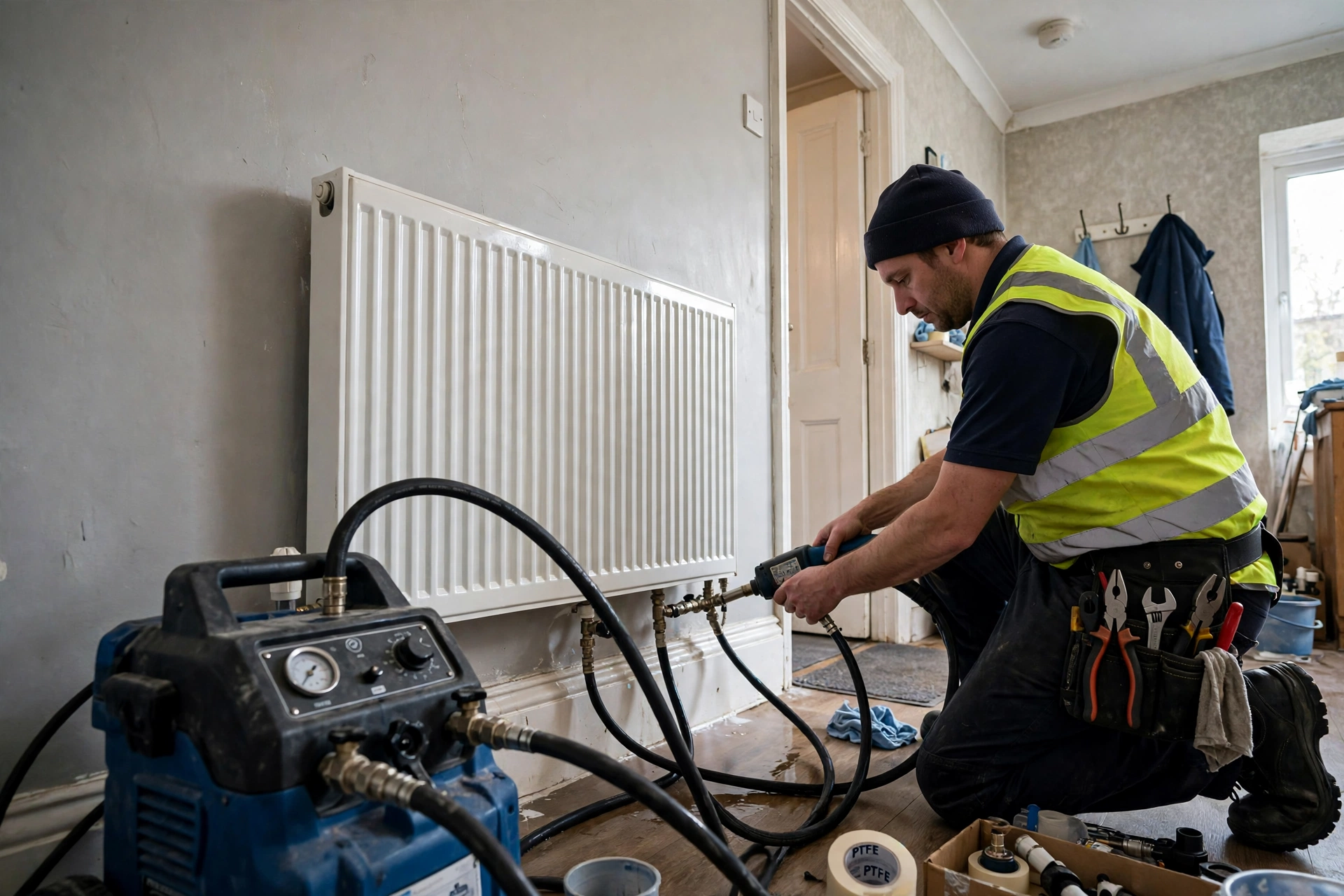
A power flush uses a dedicated machine to pump the cleaning solution through each radiator individually, at high flow but low pressure, so debris is physically carried out rather than just loosened and left to circulate. It is the stronger clean, it takes most of a day for a normal home and up to two days for a large one, and it suits a system with heavy sludge, cold bottoms on several radiators, and dark water throughout. That is why it is the standard recommendation when a new boiler is being fitted to an old system: the new boiler’s heat exchanger is far less tolerant of dirty water than the old one it replaces.
There is also a third, cheaper option that is often all that is needed: a system clean during a boiler replacement, or a hot flush, where the engineer cleans the system as part of the installation work rather than as a separate priced job. If you are having a new boiler fitted, ask whether a flush is included in the boiler quote and what kind it is, before you pay for a separate power flush on top. Paying twice for the same clean is one of the most common wastes in this area.
In short, choose a chemical flush for mild dirt and a tight budget, a power flush for heavy sludge across several radiators, and neither until you have checked the cheaper causes in the next-but-one section. A quote that does not say which kind of flush it is, or that prices a chemical flush as if it were a power flush, is not a quote you can compare fairly.
What Happens on the Day
Knowing the process helps you judge whether the engineer has done a proper job, rather than a quick drain and refill dressed up as a flush.
First, the engineer connects the power flushing machine to the system, usually at the boiler or at a radiator point, and adds a cleaning chemical. Each radiator is then flushed in turn, with its valves opened and closed so the machine drives water through that radiator alone, while the engineer taps the radiator and checks the water coming out. Heavily sludged radiators may need several passes, and the engineer should show you the water clearing over the course of the job. If the water runs clear from the start on every radiator, that is useful information in itself: the system may not have needed a power flush at all.
Next, the system is drained, refilled with clean water, and a neutraliser is run through if the cleaning chemical requires it. The radiators are then bled, the system is balanced so each radiator gets its fair share of flow, and the boiler pressure is set correctly. Balancing matters more than it sounds: a system that is not balanced after a flush will still heat unevenly, and the homeowner can easily mistake that for the flush having failed.
Finally, and this is the step that separates a proper job from a rushed one, inhibitor is added and the water is tested. Inhibitor is a chemical that slows corrosion inside radiators and pipework, and without it the sludge will simply build up again. A magnetic filter, covered in the next section, is fitted or cleaned at the same visit on many jobs. The whole visit typically takes one day for a system of up to about ten radiators, and one to two days for larger systems. If an engineer promises a full power flush in an hour, that is not a power flush; that is a drain-down.
Ask for a short written note at the end: what the water looked like at the start, whether a filter was fitted or cleaned, what inhibitor was used, and whether any radiator still showed a problem after flushing. That note is also useful evidence if a boiler manufacturer later asks whether the system was cleaned, which is covered under BS 7593 below.
When a Power Flush Is the Wrong Fix
This is the section most installer guides leave out, because they are selling the service. A power flush is the wrong fix more often than homeowners realise, and paying for one in these situations wastes money and delays the real repair.
If only one radiator is cold, and it is cold all over rather than cold at the bottom, the cause is almost always a stuck thermostatic valve, a closed lockshield valve, or air trapped in that radiator, not sludge. Bleeding the radiator costs nothing, freeing a stuck valve pin costs a fraction of a flush, and replacing a single valve is a small job. Our radiator replacement cost guide prices a standard radiator supplied and fitted at £150 to £450, which is a useful comparison: replacing one genuinely blocked radiator is often cheaper than flushing the whole system for it.
If radiators are cold at the top and warm at the bottom, that is air, not sludge. Air rises, so it collects at the top. Bleed the radiator with a radiator key and a cloth, check the boiler pressure afterwards, and the problem usually goes. If air keeps returning, there may be a leak or a pressure problem to find, but a flush will not fix returning air.
If the boiler itself is failing, noisy for a mechanical reason, or well past its economical life, a flush will not save it. A heat exchanger blocked solid with scale, a pump that has failed, or a boiler that needs a major part can all masquerade as a sludge problem. In that case the honest comparison is between a flush at £300 to £800 and a new boiler at typically £2,000 to £3,500 installed, and the engineer should say which side of that line your boiler sits on before you spend the smaller sum.
If the system has a leak, a flush will not seal it, and the fresh water added after a flush will simply dilute the inhibitor and start the corrosion cycle again until the leak is fixed. And if radiators are cold because they are undersized for the room, or because the system was never balanced properly, no amount of cleaning will make an undersized radiator give out more heat. That is a sizing problem, which is a different job entirely.
The rule of thumb is simple: a power flush fixes dirty water. If the water is not dirty, or the fault is in one valve, one pump or one boiler part, fix that fault instead. A reputable engineer will tell you this even when it costs them a flush booking. An engineer who recommends a flush without checking the water, the valves and the balancing is one to question.
Magnetic Filters and Inhibitor: The BS 7593 Part
A power flush without a filter and inhibitor is a short-term fix. Sludge forms because steel radiators corrode slowly in water that contains oxygen. A magnetic filter, fitted on the return pipe near the boiler, traps magnetite particles as they circulate, so they can be cleaned out at the annual service instead of settling in radiators again. Inhibitor, dosed into the system water, slows the corrosion that creates the particles in the first place. The two work together, and most good installations now include both.
Fitting a magnetic filter during a flush typically costs £120 to £220 in the London guide cross-checked for this article, while Tradesmen Costs puts filter labour at £70 per hour for one to two hours, before the cost of the filter unit itself. If a filter is already fitted, cleaning it during the flush should be part of the job, not an extra. Ask whether the quote includes a filter, a clean of an existing filter, or neither, because quotes that differ by £150 often differ only on this line.
This is also where BS 7593 comes in. BS 7593 is the British Standard code of practice for the preparation, commissioning and maintenance of domestic central heating and cooling water systems. In plain terms, it sets out that a system should be cleaned before a new boiler is fitted, that a permanent filter should be fitted, and that inhibitor should be dosed to the manufacturer’s recommended level and checked. Boiler manufacturers refer to it when they assess warranty claims, so keeping the flush note and the inhibitor record from the previous section is not paperwork for its own sake. It is the evidence that the system was commissioned properly if a warranty question ever arises.
Inhibitor does not last forever. It is diluted every time the system is drained, and it degrades over time, which is why it should be checked and topped up at the annual boiler service. A system that was flushed and dosed five years ago and never checked since may well need attention again, but a system flushed last year with inhibitor still at the right level almost certainly does not. That service check, by a Gas Safe registered engineer for any gas boiler work, is the cheapest protection for the money spent on a flush. Our gas safety certificate guide explains the Gas Safe side of heating work in more detail.
Keeping the System Clean After a Flush
A power flush should be a once-in-many-years job, not an annual expense. If an engineer suggests a flush every year, something else is wrong with the system, and that something should be found first.
Keep the inhibitor topped up at each annual service and ask the engineer to test it, not just to assume it is still there. Have the magnetic filter cleaned at the same service; a filter full of sludge is no longer filtering anything. Bleed radiators when they need it, and check the boiler pressure after bleeding, topping up only to the pressure shown in the boiler manual, usually around 1 to 1.5 bar when cold. Repeated pressure loss is a symptom, usually a small leak or a failed expansion vessel, and it should be investigated rather than topped up indefinitely, because each top-up adds fresh oxygenated water that speeds corrosion.
Watch for the early signs returning: cold bottoms on several radiators, dark water on bleeding, or a boiler that starts kettling again. Caught early, a chemical clean or a filter clean may be enough. Left for years, the same heavy sludge returns and another full power flush becomes necessary. The cheapest power flush is the one you do not need because the system was kept clean in between.
Finally, keep perspective on the whole heating system. A flush improves flow and efficiency in a dirty system, and it protects a new boiler, but it does not make an old, inefficient boiler efficient, and it does not fix undersized radiators or poor insulation. If your heating bills are high, compare the flush against the bigger decisions in our combi boiler vs system boiler guide and our new boiler cost guide before spending on maintenance alone. A clean system attached to the wrong boiler, or to radiators that are too small for the rooms, will still disappoint.
Frequently Asked Questions
How much does a power flush cost in the UK? Typically £300 to £800, depending on radiator count. As a guide, up to six radiators £300 to £400, seven to ten radiators £400 to £550, eleven to fifteen radiators £550 to £700, and sixteen or more radiators £700 to £800 or more. London and the South East sit at the higher end.
How long does a power flush take? Usually one day for a system of up to about ten radiators, and one to two days for larger systems. A chemical flush takes less engineer time on the day, because the chemicals are left to circulate before the system is drained.
What is the difference between a power flush and a chemical flush? A chemical flush adds chemicals to the system water and leaves them to circulate, then drains and refills the system. A power flush uses a machine to pump the cleaning solution through each radiator in turn, which is the stronger clean for heavy sludge. A chemical cleanse costs around £380 for six to ten radiators and £500 for eleven to fifteen in one published guide.
How do I know if I need a power flush? The strongest signs are several radiators cold at the bottom but warm at the top, black or very dark water when bleeding radiators, and a boiler kettling, in a system that has not had inhibitor topped up for years. One cold radiator, or radiators cold at the top, usually point to a valve, balancing or air problem instead.
Will a power flush fix a cold radiator? Only if sludge is the cause. If the radiator is cold all over, check the valve first. If it is cold at the top, bleed it first. If several radiators are cold at the bottom and the water is dark, a flush is a sensible next step.
Do I need a magnetic filter as well? It is strongly recommended, and BS 7593 sets out cleaning, a permanent filter and correct inhibitor dosing as good practice when commissioning a system. Fitting a filter during a flush typically costs £120 to £220, and an existing filter should be cleaned during the flush and at each annual service.
Is a power flush needed when fitting a new boiler? Usually yes, if the system is old or dirty. A new boiler’s heat exchanger is less tolerant of dirty water than an old one, and manufacturers may ask for evidence that the system was cleaned. Ask whether a flush is included in the boiler quote before paying for a separate one.
When should I not pay for a power flush? When only one radiator is affected, when the problem is air at the top of a radiator, when the boiler itself has failed, when there is an unresolved leak, or when radiators are undersized for the room. In those cases fix the actual fault first, and get a second opinion if a flush is recommended without the water being checked.
About the Author