Quick Answer: What Electric Shower Installation Costs in the UK
An electric shower installation in the UK costs £250 to £450 for a like-for-like swap on an existing circuit, according to Trade2Join, and £320 to £610 supplied and fitted for the same job, according to JobPrices. A full new installation, where a new circuit has to be run from the consumer unit, costs £770 to £1,500 for a 9.5kW shower, according to JobPrices, and can pass £1,400 once an enclosure and tray are added, according to RIGS Electrical.
The reason quotes for the same shower vary so much is that “electric shower installation” is not one job. It is three different jobs, and the price depends on which one yours is. Swapping a broken electric shower for a new one on the circuit that is already there is a half-day job. Fitting a more powerful shower that needs a thicker cable and a bigger breaker is a bigger job. Putting an electric shower where there has never been one, with a new circuit run from the consumer unit, is the biggest job of the three. Most cost guides mix all three together into one range, which is why you will see the same shower quoted anywhere from £250 to £1,500.
| Installation tier | Typical UK price | What it covers |
|---|---|---|
| Like-for-like swap, existing circuit | £250 to £450 (Trade2Join); £320 to £610 supplied and fitted (JobPrices) | New unit fitted onto the existing cable, breaker and water feed |
| Higher-wattage upgrade, new cable and breaker | £450 to £900 extra for the electrical work (JobPrices) on top of the unit and fitting | Thicker cable, larger breaker, sometimes a consumer unit change |
| First-time install, new circuit from the consumer unit | £770 to £1,500 for a 9.5kW shower (JobPrices); from around £750, over £1,400 with enclosure and tray (RIGS Electrical) | New circuit, new cable run, unit, fitting and certification |
| Electric shower unit only | £50 to £300 (Fantastic Services); £100 to £300 by model (Mira); £140 to £250 for a 9.5kW unit (JobPrices) | The shower unit itself, bought separately |
| Fitting labour alone (electrics already in place) | £100 to £200 (Mira); fitting £180 to £360 (JobPrices) | Labour only, no unit and no new wiring |
The figures in this guide come from 2026 cost guides published by JobPrices, Trade2Join, RIGS Electrical, Checkatrade, Fantastic Services and Mira, cross-checked against each other. They are not our own survey, and they disagree in places, because some quote a fitter working alone, some quote a full team, some are London prices and some are national averages. The article separates the jobs so you can see which figure applies to yours.
One thing to settle before you get a quote: whether there is already an electric shower circuit in your bathroom. If there is, and the new shower is the same power or lower, you are in the cheapest tier. If there is no circuit at all, or the new shower is much more powerful than the old one, the electrical work is where the money goes, not the shower unit. A £150 shower on a £900 new circuit is a £1,050 job, and no amount of shopping around for a cheaper shower changes that.
Unit vs Installation: The Two Costs That Decide Your Total
Every electric shower quote is two costs added together: the unit and the installation. Confusing the two is how people end up surprised. A shower advertised at £99 is the unit only. The installation is everything else: the electrician’s time, the cable, the breaker, the water connection, and the certificate at the end.
The unit itself is the smaller cost in most jobs. Fantastic Services puts electric shower units at £50 to £300, Mira at £100 to £300 depending on the model, and JobPrices at £140 to £250 for a 9.5kW unit. The price rises with power and features. A basic 8.5kW shower with a simple dial is at the bottom of the range. A 10.5kW shower with a digital display, multiple spray patterns and a thermostatic control is at the top. The power rating, measured in kilowatts, is the number that matters most, because it decides both how strong the shower feels and how much electrical work the installation needs.
Installation is the cost that varies. Mira puts labour alone at £100 to £200 when the electrical setup already exists, and JobPrices puts fitting at £180 to £360. That is the labour for a straightforward swap: isolate the old shower, remove it, fit the new one onto the same cable and water feed, test it and leave. The moment new wiring is needed, the price jumps. JobPrices puts the extra cost of a new circuit at £450 to £900, and RIGS Electrical puts electrical work alone at £280 to £380 per day for a Part P registered electrician.
There is one more cost that catches people out: the enclosure. An electric shower is often fitted as part of a wider bathroom change, and the tray, screen or enclosure is priced separately. RIGS Electrical notes that a full new install can exceed £1,400 once an enclosure and tray are included. If your quote does not mention the tray or screen, ask whether they are included or whether you are expected to supply them.
A useful way to read any quote is to ask for the three lines separately: unit, electrical work, and fitting. If a quote gives you one number with no breakdown, you cannot tell whether you are paying for a premium shower or a premium circuit. Ask for the split before you accept, and compare like with like across quotes.
The Three Installation Tiers
Before you price your job, work out which tier you are in. Everything in this guide hangs off this decision, and it is the question a good electrician asks first.
Tier 1: Like-for-like swap. There is already an electric shower in the bathroom, on its own circuit, and the new shower is the same power or lower. The cable and breaker stay. This is the cheapest tier.
Tier 2: Higher-wattage upgrade. There is already a circuit, but the new shower is more powerful than the old one, so the cable and breaker have to be upgraded to carry the extra load. The water feed stays, the wiring does not.
Tier 3: First-time install. There has never been an electric shower in this bathroom, or never one in this position, so a brand-new circuit has to be run from the consumer unit to the bathroom. This is the most expensive tier, and it is also the one that triggers the notification rules explained later in this guide.
| Tier | Your situation | Typical UK price | Time on site |
|---|---|---|---|
| 1. Like-for-like swap | Existing circuit, same or lower power | £250 to £450; £320 to £610 supplied and fitted | 2 to 4 hours, nearer 2 |
| 2. Higher-wattage upgrade | Existing circuit, higher power | Unit and fitting plus £450 to £900 for the new cable and breaker work | Half a day to a full day |
| 3. First-time install | No circuit at all | £770 to £1,500 for a 9.5kW shower; over £1,400 with enclosure and tray | A full day, sometimes two |
The three tiers are priced separately in the sections below, with worked totals for each one.
Tier 1: Like-for-Like Swap on an Existing Circuit
This is the most common electric shower job, and the cheapest. Your old shower has failed, or it looks tired, and you want a new one in the same place, on the same wiring.
Trade2Join prices a like-for-like swap at £250 to £450. JobPrices prices the same job supplied and fitted at £320 to £610, and RIGS Electrical prices a complete like-for-like job including the unit at £350 to £650. The differences between those ranges come down to the unit chosen and the region: a £140 unit fitted in the Midlands is not the same price as a £250 unit fitted in London. Mira puts the labour alone at £100 to £200 when the electrical setup already exists, which tells you how much of the total is the unit and how much is the work.
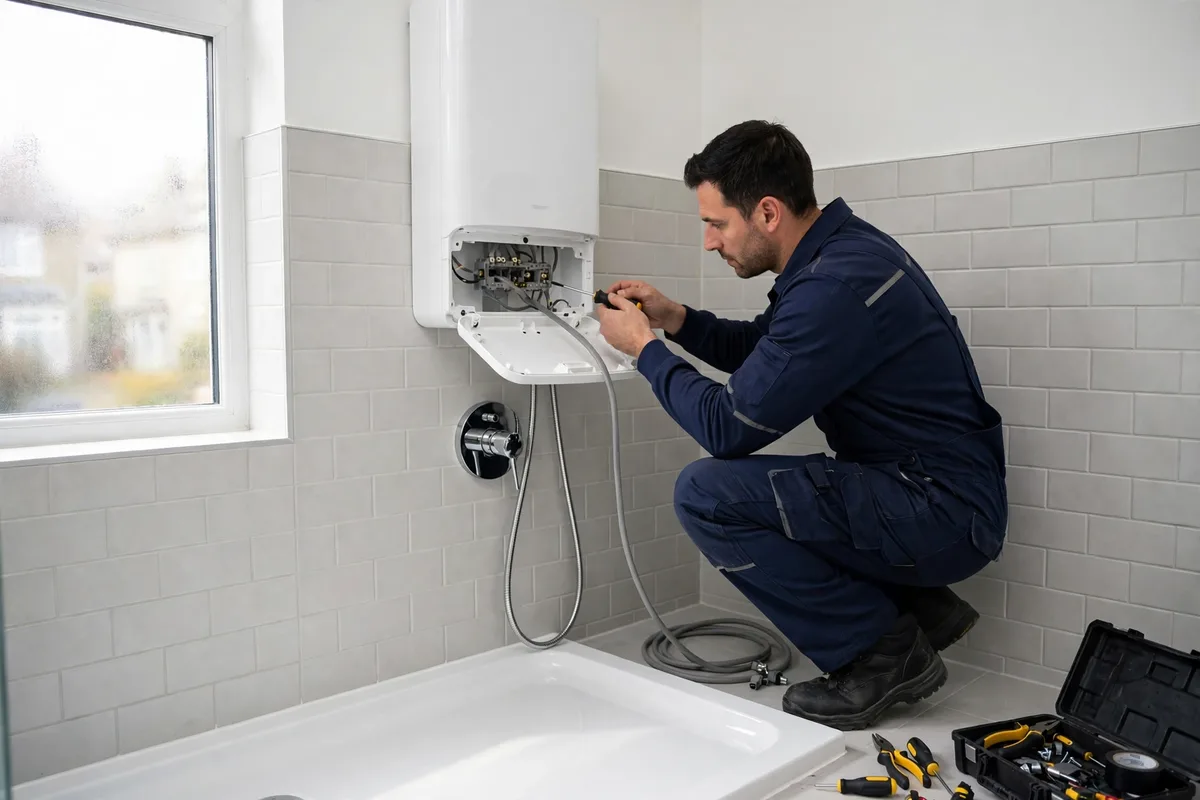
The job itself is straightforward. The electrician isolates the circuit at the consumer unit, removes the old shower, checks the existing cable and breaker, fits the new shower onto the same fixings and connections, reconnects the cold water feed, tests the shower and the RCD protection, and leaves. Checkatrade, Mira and JobPrices all agree it takes 2 to 4 hours, nearer 2 hours for a straightforward swap.
There are two things that can push a Tier 1 job out of the cheapest range. The first is a shower that is not a true like-for-like swap: if the new unit’s water inlet or cable entry is in a different place from the old one, the electrician has to move pipework or reroute the cable, and that adds time. The second is the condition of the existing circuit. If the cable is damaged, the breaker is the wrong size, or the consumer unit has no RCD protection, the electrician cannot legally or safely connect the new shower to it, and the job becomes a Tier 2 job. A good electrician checks this before starting, not after the old shower is already off the wall.
A worked total for Tier 1 looks like this. A mid-range 9.5kW unit at £200, plus fitting labour at £150, gives a total of £350, which sits inside both the Trade2Join and JobPrices ranges. Choose a £100 basic unit and the total drops towards £250. Choose a £280 premium unit with a London electrician and the total rises towards £610. The unit you choose moves the price more than the labour does at this tier.
One caution about promotional prices: manufacturers sometimes offer discounted installation, such as Mira’s £80 install offer running until 30 November 2026. That is a promotion, not a market price, and it does not tell you what an independent electrician will charge. Use it to compare, not to set your budget.
Tier 2: Upgrading to a Higher-Wattage Shower
The most common reason to change an electric shower is that the old one is weak. The water runs lukewarm in winter, or the flow is a dribble. The natural answer is a more powerful shower, usually moving from an 8.5kW unit to a 9.5kW or 10.5kW one. That is where the cable question appears.
A more powerful shower draws more current, and the cable and breaker have to be able to carry it safely. The existing cable was sized for the old shower. If it is too thin for the new one, it has to be replaced, and the breaker has to be changed to match. This is the electrical work that turns a £350 swap into a £800 or £900 job.
JobPrices puts the extra cost of the new circuit work at £450 to £900. RIGS Electrical puts electrical work alone at £280 to £380 per day for a Part P registered electrician. The range is wide because the work varies so much: replacing a cable that runs in a straight line through an accessible loft is a morning’s work, while replacing one buried in a solid wall or running under a tiled floor is a full day with making good afterwards.
Typical UK practice is that an 8.5kW shower usually runs on a 6mm² cable with a 40A breaker, while a 9.5kW or 10.5kW shower usually needs a 10mm² cable with a 45A or 50A breaker. Those are typical sizes, not a rule you can apply from your armchair. The electrician has to check the existing cable, the length of the run, how the cable is installed, and the capacity of the consumer unit before deciding what is needed. If your consumer unit is old and has no spare way for a larger breaker, the upgrade can also mean a consumer unit change, which adds cost on top.
There is a second reason a Tier 2 job costs more than people expect: the water supply. A more powerful shower heats more water, but it still needs enough cold water pressure coming in. If your mains pressure is low, a 10.5kW shower will not feel much better than the 8.5kW one it replaced. The electrician or plumber should check the incoming pressure before you buy the bigger unit. If pressure is the real problem, the answer may be a different kind of shower altogether, and that is covered in the comparison section later in this guide.
A worked total for Tier 2 looks like this. A 10.5kW unit at £250, plus fitting at £200, plus new cable and breaker work at £450 to £900, gives a total of £900 to £1,350. That is roughly double a Tier 1 swap, and the extra money is all in the wall, not in the shower. Before you commit, it is worth asking the electrician a direct question: will the extra power actually feel better in my bathroom, given my water pressure? If the answer is no, a like-for-like swap at Tier 1 prices is the better spend.
Tier 3: First-Time Install With a New Circuit
This is the most expensive tier, and the one where the widest quotes appear. There has never been an electric shower in this bathroom, or you want one in a different position from the old one, so a new circuit has to be run from the consumer unit all the way to the shower.
JobPrices budgets £770 to £1,500 in total for a 9.5kW shower on a new circuit. RIGS Electrical puts a full new install at from around £750, and notes it can exceed £1,400 once an enclosure and tray are included. The range reflects how far the cable has to travel and how much disruption the route causes: a consumer unit next to the bathroom with a clear loft route is at the bottom, while a consumer unit at the far end of the house with solid floors in between is at the top.
The work itself has several parts. The electrician runs a new cable from the consumer unit to the bathroom, fits a new breaker and an RCD or RCBO for protection, installs a ceiling pull cord or wall-mounted isolator switch outside the wet zone, connects the cold water feed, fits and tests the shower, and certifies the work. On top of that, there is the making good: chasing cable into walls, lifting floorboards, and repairing plaster and decoration afterwards. Some quotes include making good, some do not, and that is one of the first things to check when comparing prices.
A first-time install is also often part of a bigger bathroom job. If you are converting a bath to a shower, the enclosure, tray and tiling are separate costs, and the electric shower is only one line in the budget. Our guide to bath to shower conversion cost prices the whole conversion project, and our walk-in shower cost guide prices the three scopes of a walk-in shower, from a tray conversion to a full wet room. The electric shower itself is the smallest part of either of those jobs.
A worked total for Tier 3 looks like this. A 9.5kW unit at £200, plus a new circuit and electrical work at £450 to £900, plus fitting at £180 to £360, gives a total of £830 to £1,460, which lines up with the JobPrices range of £770 to £1,500. Add a shower tray and screen at £300 to £600 and the total passes £1,400, exactly as RIGS Electrical describes. If a quote for a first-time install comes in well below £770, ask what has been left out: the circuit, the certification, or the making good are the usual omissions.
Cable Size: Why It Decides the Job (and the Price)
If there is one technical fact worth understanding before you get quotes, it is this: the cable decides the job. The shower unit is the visible part, but the cable behind the wall is what sets the price, the timescale and the rules.
An electric shower heats water instantly as it passes through the unit, which is why it needs so much power. A 10.5kW shower draws around 45 amps, which is more than a whole ring main for your sockets. That current has to travel through a cable thick enough to carry it without overheating, protected by a breaker that trips if something goes wrong. If the cable is too thin, it heats up. If the breaker is too small, it trips every time you shower. If the breaker is too big for the cable, the cable is unprotected. All three are unsafe, and a competent electrician will not connect a shower to a circuit that is wrong in any of those ways.
That is why the first thing a good electrician does on a Tier 1 swap is check the existing cable and breaker, not just fit the new unit. The check takes minutes: the cable size is printed on its sheath, the breaker rating is printed on the consumer unit, and the electrician compares both against the new shower’s power rating. If they match, the swap goes ahead. If they do not, the job becomes a Tier 2 upgrade, and the price changes with it.
The cable also decides the route. A new cable has to run from the consumer unit to the bathroom, and the route it takes is what makes one Tier 3 quote £770 and another £1,500. A straight run through an accessible loft is quick. A run that has to cross solid floors, chase through tiled walls or go around a steel beam is slow and disruptive. When you compare Tier 3 quotes, ask each electrician to describe the cable route they are pricing. Two quotes that describe different routes are not comparable, even if the shower is the same.
There is one more cable-related cost that is easy to miss: the isolator. An electric shower needs a means of isolation, usually a ceiling pull cord or a wall switch outside the bathroom zones, and if there is not already one in the right place, fitting one is part of the job. It is a small cost on its own, but it is a sign of a thorough quote. A quote that does not mention isolation or protection has probably missed something.
Part P and Notification: The Rules for New Circuits
Electric shower work sits under the Building Regulations in England and Wales, and the rules are different for a swap and for a new circuit. Getting this wrong does not just risk a fine. It can cause problems when you sell the house, because a buyer’s solicitor will ask for the certificate.
A like-for-like swap on an existing circuit is generally not notifiable work. The electrician replaces one unit with another on a circuit that already exists, and no new circuit is created. That is why a Tier 1 job is quick and straightforward, and why it does not normally need building control involvement.
A new circuit is different. Installing a new circuit for an electric shower is notifiable work in England and Wales, which means it has to be either carried out by an electrician registered with a competent person scheme, who can self-certify the work, or notified to building control before the work starts. JobPrices states this plainly, and RIGS Electrical notes that BS 7671, the wiring regulations, and Part P of the Building Regulations apply. Checkatrade and Mira both note that a Part P-certified installer is needed.
In practice, this means you should use a registered electrician for any Tier 2 or Tier 3 job, and you should receive a certificate when the work is finished. The certificate is the Electrical Installation Certificate for the new circuit, and it is the document that proves the work was done to the regulations. Keep it with your house paperwork. If you sell, your solicitor will want it. If you do not have it, you may need an inspection and a retrospective certificate, which costs more than getting it right the first time.
The rules differ across the UK. Part P applies in England and Wales. In Scotland, electrical work is covered by the Building (Scotland) Regulations, and a building warrant may be needed for some work. In Northern Ireland, the Building Regulations (Northern Ireland) apply. The principle is the same everywhere: a new circuit is regulated work, and the person doing it must be competent and the work must be certified. If an electrician tells you no certificate is needed for a brand-new circuit, that is a reason to get a second opinion.
If you want to understand the wider electrical safety picture in your home, our EICR cost guide explains what an Electrical Installation Condition Report covers and what it costs. An EICR is a different job from a shower installation, but it is the report that often reveals whether a consumer unit or a circuit is ready for a new shower in the first place.
What a Good Quote Includes (and What to Ask Before You Accept)
Electric shower quotes vary so much that comparing them takes care. Two quotes for the same shower can differ by hundreds of pounds, and the difference is usually in what each one includes, not in the hourly rate.
A good quote should list the unit by make and model, the electrical work by what is being installed or replaced, the fitting labour, and the certification. It should say whether the price includes the tray, screen or enclosure, and whether making good is included. It should state the timescale and whether the bathroom will be out of use. And it should name the electrician’s registration: a competent person scheme such as NICEIC, NAPIT or ELECSA.
Before you accept, ask these questions. What tier is my job, and why? What cable size and breaker does the new shower need, and what is already there? Is this a notifiable job, and will I get a certificate? Does the price include making good after the cable run? Is the tray and screen included, or do I supply them? And what happens if the existing circuit turns out to be unsuitable once the old shower is off the wall?
Three quotes is the usual advice, and it works well here, because the spread tells you something. If two quotes are close and one is far below, the low one has usually left something out. If all three are far apart, the electricians are probably pricing different tiers, and the question to ask is which tier your job actually is.
Watch out for quotes that price only the unit and a vague “fitting” line. Fitting a shower onto a circuit that does not exist yet is not the same job as swapping one onto a circuit that does, and a quote that does not mention the circuit at all has not understood the job. Also watch out for anyone who offers to fit a shower without checking the consumer unit. The consumer unit is where the circuit starts, and an electrician who does not look at it has not priced the work.
Payment is worth agreeing in advance. A deposit for the unit is normal. Full payment before the work is finished is not. And if the electrician supplies the unit, check the warranty: most manufacturers require an annual service or a registered installer for the warranty to hold, and the installer should tell you that before you buy.
Running Costs: What an Electric Shower Costs to Run
An electric shower heats water only while it is running, which is why it is cheap to run per shower and expensive to run badly. There is no cylinder of hot water sitting there losing heat all day. The cost is the electricity used during the minutes the shower is on.
RIGS Electrical puts the running cost at around 8p to 14p per shower at 2026 electricity rates. That is RIGS’s figure, based on a typical shower length and the electricity prices at the time it was published, and it will move with your tariff. A longer shower, a higher power setting, or a more expensive tariff all push the cost up. A short shower on a low setting pushes it down.
The power rating affects the running cost, but not in the way people assume. A 10.5kW shower uses more electricity per minute than an 8.5kW one, but it also heats the water faster, so you may run it for less time or at a lower setting. The real difference between the two is the feel of the shower, not the bill. The bill is decided by how long you stand under it and what your electricity costs per unit.
There is one running-cost trap worth knowing about. In winter, the cold water coming into the house is colder, so the shower has to work harder to heat it, and the flow rate drops. A shower that feels strong in July can feel weak in January. That is normal for electric showers, and it is not a fault. It is also a reason to choose a higher-wattage shower if your mains water is cold in winter, provided your cable and circuit can support it, which brings you back to the Tier 2 question.
Compared with a mixer shower fed from a combi boiler or a cylinder, an electric shower is usually cheaper per shower, because it does not heat water you do not use, and it does not need the boiler to be on. Compared with a power shower, which uses a pump to boost pressure, an electric shower is cheaper to run and simpler to maintain, but it cannot match the flow of a pumped system. The choice between them depends on your water pressure, which is the subject of the next section.
Electric Shower vs Mixer and Power Showers: Which Fits Your Home
An electric shower is not the only way to get a shower, and it is not always the best one. The right choice depends on your water system, your pressure, and whether there is already a hot water supply to the bathroom.
An electric shower takes a cold water feed only and heats it as it passes through. It needs no boiler, no cylinder and no hot water pipe to the bathroom. That makes it the right choice when there is no hot water supply in the bathroom, when the boiler is at the far end of the house, or when you want a shower that works even when the boiler is off. It is also the simplest option for an ensuite or a loft conversion where running hot water pipes would be expensive.
A mixer shower takes hot and cold water from your existing system and mixes them. If you have a combi boiler with good pressure, a mixer shower usually gives a stronger flow than an electric shower, because the boiler is heating the water and the mains is pushing it. Our guide to bath shower mixer taps covers the mixer side in detail. The trade-off is that a mixer shower depends on the boiler. If the boiler is off or broken, there is no shower.
A power shower takes water from a hot water cylinder and a cold water tank and uses a pump to boost the pressure. It gives the strongest flow of the three, but it needs a cylinder and a tank, which many modern homes no longer have. Our shower pump installation cost guide prices the pump side of that decision. If your home has a combi boiler and no cylinder, a power shower is not an option at all.
The decision is really a plumbing question, not a shopping question. If you have good mains pressure and a combi boiler, a mixer shower is usually the better shower. If your pressure is low and you have no cylinder, an electric shower is usually the practical answer. If your pressure is low and you do have a cylinder, a power shower is worth pricing. And if you are adding a shower to a bathroom that has never had one, an electric shower is often the cheapest to install, because it needs only a cold feed and a new circuit, not a full hot water run.
One last point on this choice: an electric shower and a mixer shower can live in the same bathroom. Some households fit an electric shower as a second shower in an ensuite, while the family bathroom keeps its mixer. That is a common arrangement, and it is worth considering if your main shower is good but you need a second one quickly and cheaply.
How Long Installation Takes
A like-for-like swap takes 2 to 4 hours, nearer 2 hours when everything goes to plan, according to Checkatrade, Mira and JobPrices. You will be without a shower for that morning, and the bathroom is usable again the same day.
A higher-wattage upgrade takes half a day to a full day, depending on the cable route. The shower itself is fitted in the same time as a swap, but the cable work adds hours, and if the route involves chasing into walls or lifting floorboards, the making good adds more.
A first-time install takes a full day, and sometimes two. The cable run is the long part, and the making good after it is what stretches the job into a second day. If the install is part of a wider bathroom renovation, the shower is fitted near the end of the job, after tiling and before the final snagging, and the timeline is set by the renovation, not the shower. Our guide to bathroom renovation cost prices the whole project and covers the typical trade sequence, so you can see where the shower fits in.
Delays are usually caused by the cable route, not the shower. A route that looked simple on the quote can turn out to run through a steel beam, a solid floor or a wall full of pipes, and the electrician has to find another way. That is another reason to ask the electrician to describe the route before you accept the quote, and to agree in advance what happens if the route changes.
FAQs
How much does it cost to install an electric shower in the UK?
A like-for-like swap on an existing circuit costs £250 to £450 according to Trade2Join, or £320 to £610 supplied and fitted according to JobPrices. A first-time install with a new circuit costs £770 to £1,500 for a 9.5kW shower according to JobPrices. The circuit is what decides the price, not the shower.
Do I need an electrician to fit an electric shower?
Yes. An electric shower is wired directly into its own circuit, and the work involves the consumer unit, the cable sizing and the protective devices. A new circuit is notifiable work in England and Wales and must be done by a registered electrician or notified to building control. Even a like-for-like swap should be done by a competent electrician, because the existing circuit has to be checked before the new shower is connected.
Can I replace an 8.5kW shower with a 10.5kW shower?
Only if the cable and breaker can carry the extra load. A 10.5kW shower usually needs a thicker cable, typically 10mm², and a larger breaker, typically 45A or 50A, while an 8.5kW shower usually runs on 6mm² cable with a 40A breaker. The electrician must check what is already installed. If the cable has to be replaced, the job moves from a swap to an upgrade, and the price rises by £450 to £900 according to JobPrices.
Does an electric shower need planning permission?
No, an electric shower does not need planning permission. But a new circuit is notifiable under Part P of the Building Regulations in England and Wales, which means it must be done by a registered electrician who can self-certify, or notified to building control before work starts. You should receive a certificate when the work is finished.
How long does it take to install an electric shower?
A like-for-like swap takes 2 to 4 hours, nearer 2 hours, according to Checkatrade, Mira and JobPrices. A higher-wattage upgrade takes half a day to a full day. A first-time install with a new circuit takes a full day, sometimes two, depending on the cable route and the making good.
What size cable does an electric shower need?
It depends on the shower’s power. As typical UK practice, an 8.5kW shower usually runs on 6mm² cable with a 40A breaker, and a 9.5kW or 10.5kW shower usually needs 10mm² cable with a 45A or 50A breaker. Those are typical sizes, and the electrician must confirm the cable size, the length of the run and the way the cable is installed on site before deciding. Never size a cable from a guide alone.
Is an electric shower cheaper to run than a mixer shower?
Usually, yes, per shower. An electric shower heats water only while it is running, so there is no cylinder losing heat all day. RIGS Electrical puts the cost at around 8p to 14p per shower at 2026 electricity rates. A mixer shower fed from a combi boiler can give a stronger flow, but it depends on the boiler being on, and the real running cost in either case is decided by how long you shower and what your tariff charges per unit.
About the Author